table of contents
Quick answer: Mold During Renovation in NYC is often found with work that involves opening walls, removing flooring, or disturbing ceilings frequently uncovers mold that has been growing undetected inside building assemblies for months or years. When mold is discovered during active renovation, work must stop in the affected area, the discovery must be documented, and the assessment and remediation requirements should be confirmed before disturbing the affected area; regulated New York projects require independent licensed providers. General contractors and building owners who proceed with renovation over active mold contamination create significant liability exposure. GreenRoom Remediation coordinates licensed mold assessment and remediation for renovation projects across all five NYC boroughs. Call (917) 965-3754 to schedule an assessment before or during your renovation.
Renovation projects in NYC’s aging housing stock carry a mold risk that most homeowners and contractors underestimate until it materializes mid-project. A gut renovation in a Brooklyn brownstone, a bathroom remodel in a Queens co-op, or a kitchen update in a Manhattan apartment all involve opening building assemblies that may have harbored slow moisture intrusion for decades. The mold growing inside those assemblies is not visible from the surface, does not produce obvious odors in some cases, and gives no indication of its presence until the wall is open and the contamination is directly in the work environment.
Why NYC Renovation Work Uncovers Mold So Frequently
NYC’s pre-war building stock was constructed with materials and moisture management assumptions that do not match the thermal and humidity conditions those buildings now experience. Original plumbing systems that have developed slow leaks over decades, HVAC systems added to buildings not designed to accommodate them, bathroom ventilation that is inadequate for modern usage patterns, and window replacements that sealed buildings more tightly than their original construction intended have all contributed to moisture conditions inside walls that were not present when the buildings were new.
When a general contractor opens a wall in a pre-war brownstone or a mid-century apartment building, they are frequently exposing building cavities that have had moisture intrusion at some point in the building’s history. The insulation, if any, may have absorbed and retained that moisture. The wood framing may have developed surface mold that is visible only when the drywall or plaster is removed. The sheathing behind exterior walls may have condensation-related mold that is completely invisible from the interior.
The renovation itself amplifies the risk in a specific way: demolition work creates airborne dust and particles from materials that may contain mold spores, and those spores distribute through the renovation space and into adjacent areas before anyone has identified the contamination. A contractor who opens a wall containing mold without containment in place has already created a contamination event in the work environment before the mold is even discovered. For more on how hidden moisture drives mold growth in NYC buildings, see our article on hidden moisture and recurring mold problems in NYC.
What NY State Law Requires When Mold Is Found During Renovation
New York State Labor Law Article 32 applies to mold remediation regardless of whether the mold is discovered during renovation, routine maintenance, or following a water damage event. When mold involving 10 or more square feet is discovered during renovation, the renovation work in the affected area must stop, the condition must be assessed by a licensed mold assessor, and remediation must be performed by a licensed mold remediator before construction work in that area resumes.
The licensed assessor and the licensed remediator must be separate entities. A general contractor cannot self-certify mold remediation in their own renovation project. The assessor produces a written remediation protocol, the remediator executes the work to that protocol, and a post-remediation clearance test by an independent assessor confirms the contamination has been resolved before the renovation continues. This process adds time and cost to any renovation project where mold is discovered, and property owners who have not budgeted for it can face significant project delays.
General contractors and property owners who proceed with renovation work over active mold contamination, cover it up with new drywall or finishes, or fail to follow the Article 32 process face regulatory penalties, potential HPD violation exposure, and significant liability if future occupants develop health issues traceable to the concealed contamination. NYC’s enforcement posture on mold in renovation contexts has tightened substantially since Local Law 55 of 2018. For more on HPD mold violation exposure, see our guide on how to clear an HPD mold violation in NYC.
The Smart Approach: Pre-Renovation Mold Assessment
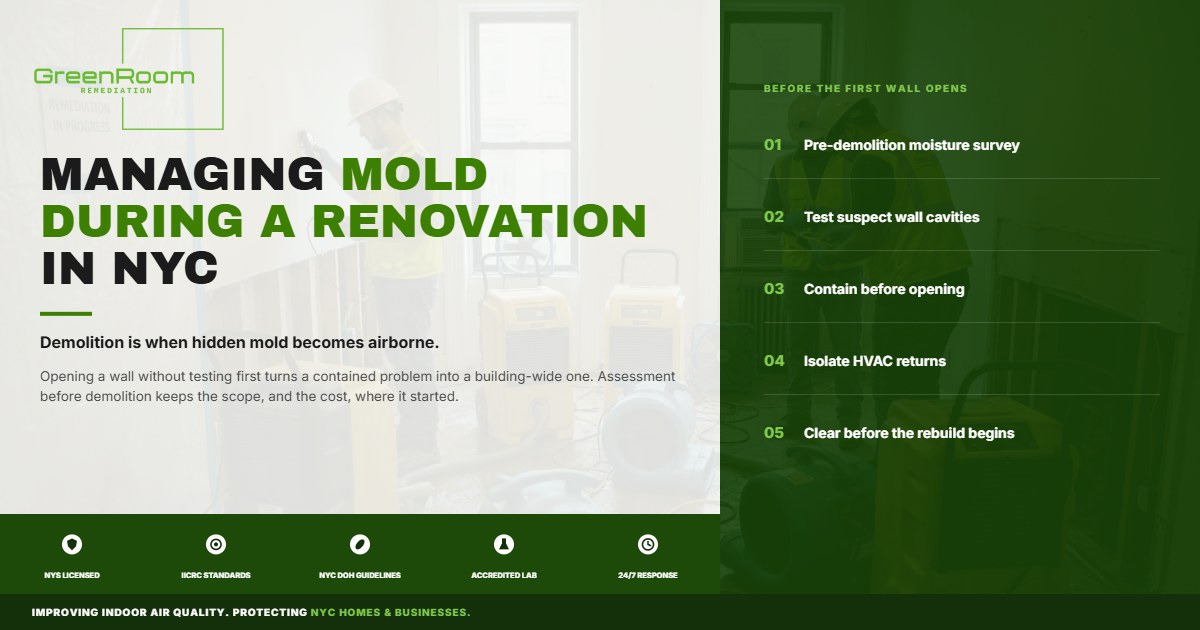
The most cost-effective approach to renovation mold risk in NYC is a pre-renovation mold assessment before demolition begins. A licensed mold assessor inspects the renovation scope areas using moisture meters, infrared thermal imaging, and in some cases limited invasive probing to identify elevated moisture conditions in walls and assemblies before they are opened. Areas with elevated moisture that are likely to contain mold growth can be flagged for controlled opening with containment in place, rather than discovered mid-project during open demolition.
Confirm the scope and price of a pre-renovation assessment before booking. GreenRoom’s $749.99 testing package includes up to three air and/or swab samples and a report; it should not automatically be treated as a regulated assessment or a renovation-wide investigation. Ask which documents, access and inspection limits apply to your project.
When the pre-renovation assessment identifies contamination, remediation can be scheduled as a planned phase of the renovation rather than an emergency disruption. Contractors can sequence their work around the remediation timeline, material orders can be adjusted, and the project proceeds with a complete picture of what the renovation actually involves. For more on what the mold inspection process includes, see our article on mold testing in NYC: current scope and pricing.
What to Do If Mold Is Discovered Mid-Renovation
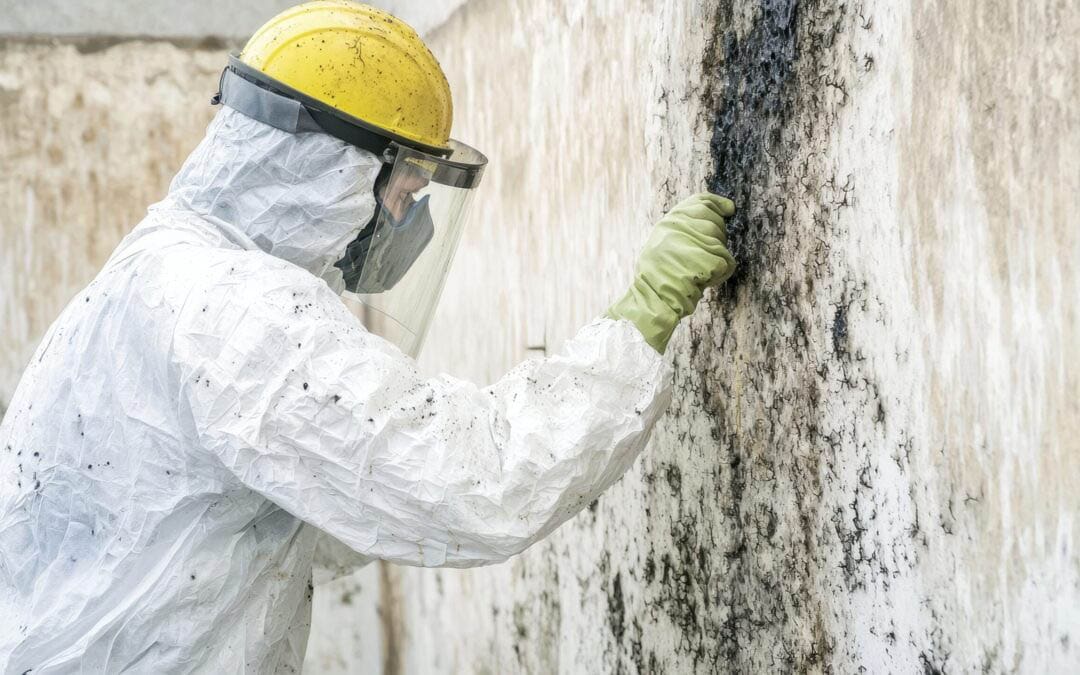
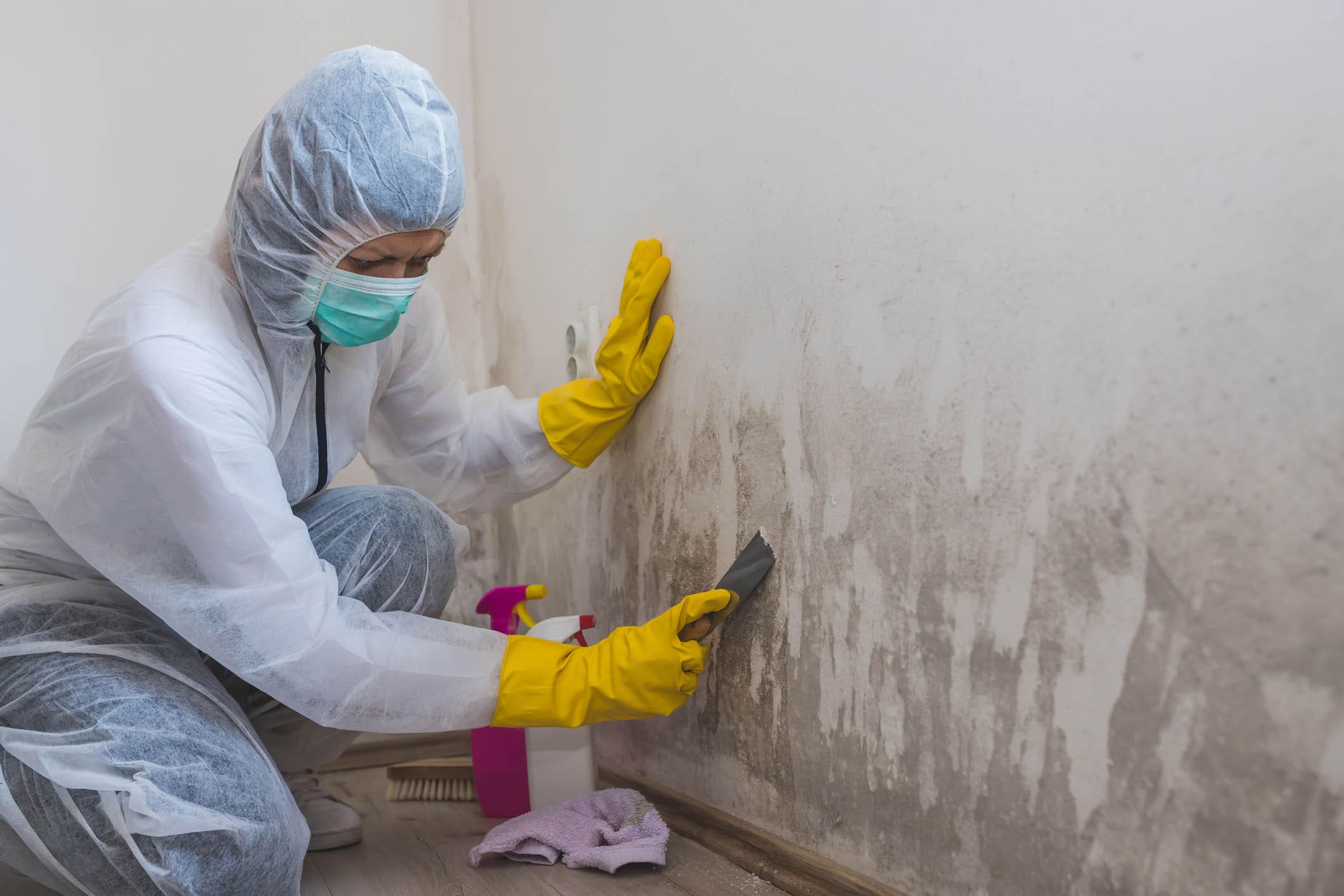
When mold is discovered after demolition has already begun, the immediate steps are to stop work in the affected area, photograph the contamination before anything is disturbed further, contain the area with plastic sheeting to prevent additional spore spread, and contact a licensed mold assessor for an emergency inspection. Workers who have been in the area should be informed of the discovery, and OSHA requirements for worker notification and protective equipment apply.
The general contractor and property owner should document the discovery date and conditions in writing, including photographs and a written record of what work was underway and what materials were disturbed before the discovery. This documentation protects all parties in the event of subsequent disputes about project delays, cost increases, or health claims from workers or future occupants.
If the renovation is in a rental building, the landlord’s obligation to remediate mold under NYC Administrative Code Section 24-154 applies regardless of whether the discovery occurred during renovation. Tenants displaced by renovation-related mold remediation may have rights to temporary relocation assistance depending on the circumstances. For more on landlord obligations and tenant rights in mold situations, see our guide on mold in NYC rental apartments and tenant rights.
Does Insurance Cover Mold Discovered During Renovation?
Whether mold discovered during renovation is covered by insurance depends on whether the mold can be traced to a covered sudden and accidental water event that occurred during the policy period. Mold that developed from a slow leak or chronic moisture condition over an extended period is typically excluded as gradual damage under standard homeowners and property policies, regardless of when it is discovered. Mold from a covered event such as a burst pipe that is discovered during subsequent renovation may be eligible as part of the original claim if it can be documented as causally connected to the covered event.
Renovation contractors typically carry general liability insurance that covers property damage they cause during their work, but this coverage does not extend to pre-existing mold conditions uncovered during renovation. The allocation of responsibility for pre-existing mold discovered during renovation is a fact-specific legal question. Renovation contracts in NYC increasingly include mold discovery clauses that define the parties’ obligations and cost-sharing when mold is found, and property owners should review their renovation contracts for these provisions before work begins. For more on how insurance covers mold, see our guide on whether homeowners insurance covers mold remediation in NYC.
Frequently Asked Questions
Can my contractor just remove the mold and continue renovation?
No. For mold areas of 10 square feet or more, NY State Labor Law Article 32 requires a licensed mold assessor to inspect and write a remediation protocol, and a separately licensed mold remediator to perform the work. A general contractor cannot self-perform mold remediation in a renovation context without these licensed parties involved.
How long does renovation mold remediation take?
Small mold conditions discovered in a renovation context typically require 2 to 5 days for remediation plus 5 to 7 business days for clearance testing results. Larger conditions requiring structural material removal and extended drying may take 1 to 3 weeks. For more on timeline expectations, see our article on how long mold remediation takes in NYC.
Should I get a pre-renovation mold inspection even if I don’t see any signs of moisture?
For renovations in pre-war NYC buildings involving bathroom, kitchen, or exterior wall demolition, a pre-renovation inspection is strongly advisable even without visible moisture signs. Infrared imaging and moisture meters identify elevated moisture conditions in building assemblies that are not visible on the surface. The inspection cost is consistently less than the project disruption cost of a mid-renovation discovery.
For pre-renovation mold assessment or emergency mold assessment during an active renovation project in Brooklyn, Manhattan, Queens, the Bronx and Staten Island, call GreenRoom Remediation at (917) 965-3754. Call to confirm appointment availability. Emergency water-damage phone service is available 24/7.
GreenRoom Remediation | NY State Licensed Mold Remediation Contractor (License #24-6S44B-SHMO) | IICRC-Certified | OSHA-Trained | BBB Accredited | Serving NYC, Brooklyn, Queens, Manhattan, the Bronx, Staten Island, Long Island, Westchester, and Surrounding Areas.
view related content