table of contents
Quick answer: New York City tenants have legally enforceable rights when mold appears in a rental unit. Under NYC Administrative Code Section 24-154 and the warranty of habitability established by New York Real Property Law Section 235-b, landlords are required to investigate and remediate mold in rental units. In buildings with 10 or more residential units, Local Law 55 of 2018 requires that Class B violations (mold covering 10 to 29 square feet in a room) and Class C violations (30 square feet or more) be remediated by a NYS-licensed mold remediator and assessed by a separate NYS-licensed mold assessor under New York State Labor Law Article 32. Smaller mold conditions and buildings with fewer than 10 units may be addressed using prescribed safe work practices, though the landlord’s habitability obligation applies regardless of building size. Tenants who notify landlords in writing and receive no response have several escalation pathways including HPD complaints, DHCR rent reduction proceedings, and housing court action. GreenRoom Remediation works with tenants and landlords across all five NYC boroughs to document mold conditions, coordinate licensed remediation, and produce the paperwork that protects both parties. Call (917) 965-3754 for a same-day assessment.
Mold in a rental apartment is one of the most common and most contested habitability disputes in New York City. The legal framework that governs it is specific, the documentation requirements matter enormously, and tenants who handle the process correctly have real leverage to force remediation. Tenants who handle it poorly, most commonly by failing to notify in writing or by waiting too long, frequently find themselves with limited options even when the mold problem is serious. Understanding what the law actually requires and how to enforce it is what determines whether a mold dispute gets resolved in weeks or drags on for months.
What Does NYC Law Require Landlords to Do About Mold?
The foundational legal obligation for NYC landlords on mold is the warranty of habitability under New York Real Property Law Section 235-b. This warranty, implied in every residential lease in New York State, requires landlords to maintain rental units in a condition fit for human habitation throughout the tenancy. Courts in New York have consistently held that significant mold growth constitutes a breach of the warranty of habitability, entitling tenants to rent reductions and other remedies.
NYC Administrative Code Section 24-154, enacted as part of Local Law 55 of 2018, adds specific mold remediation requirements for buildings with three or more units. Under this law, landlords who discover or receive written notice of mold growth in a dwelling unit must investigate the condition and, when mold is confirmed, remediate it using a licensed mold remediator for any affected area of 10 square feet or more. The remediation must be performed by a contractor licensed under New York State Labor Law Article 32, and the assessor who inspects the condition must be a separately licensed entity from the contractor who performs the removal.
For buildings with fewer than three units, the warranty of habitability still applies but the specific Licensed contractor requirements of Local Law 55 apply differently. Landlords in all buildings remain obligated under the warranty of habitability to address mold conditions that affect habitability, regardless of building size.
What Should Tenants Do When They Discover Mold?
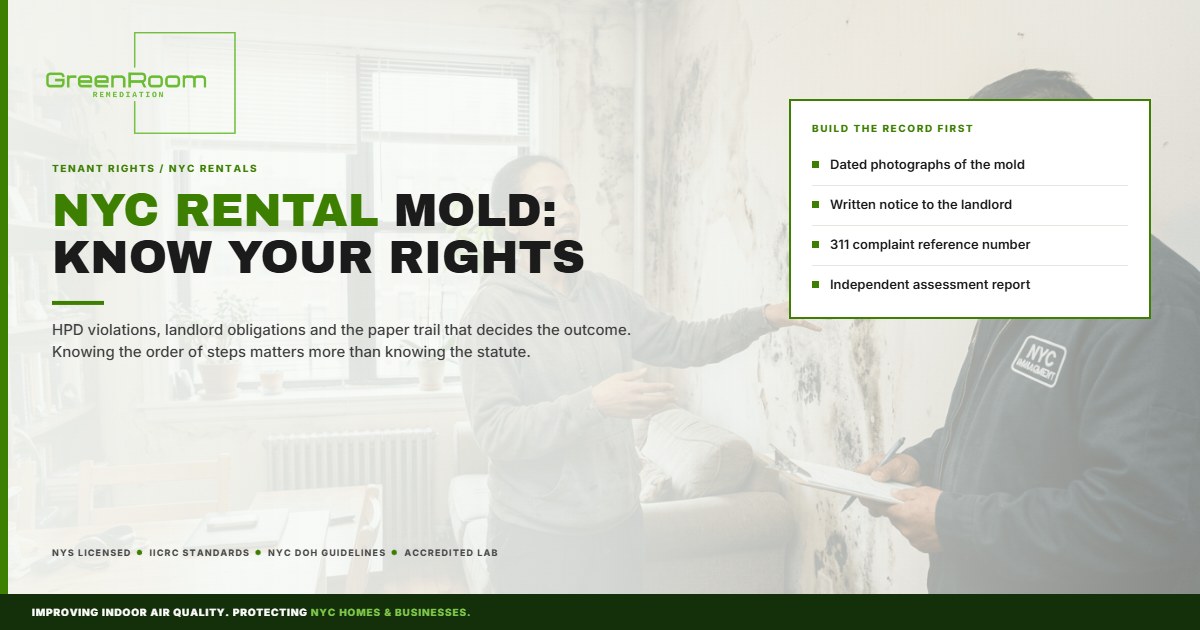
The single most important action a tenant can take when mold appears in their apartment is to notify the landlord in writing immediately. This is not a formality. Written notification creates a legal record of the landlord’s knowledge of the condition, which is required to establish the landlord’s obligation to act and the timeline from which their response is measured.
Step 1: Document the Mold
Before contacting the landlord, photograph and video the visible mold growth. Capture wide-angle shots that show the location in context and close-up shots that show the extent of the growth. Photograph any water staining, moisture damage, or evidence of the source such as pipe leaks or window condensation. Metadata embedded in smartphone photos includes date and time stamps that can be important if the dispute later involves questions about when the condition appeared.
Step 2: Notify the Landlord in Writing
Send written notification to the landlord or property manager by email, text, or certified mail. The notification should describe the location of the mold, the approximate size of the affected area, any associated moisture or water intrusion you have observed, and a request for the landlord to inspect and remediate the condition. Keep a copy of every communication. If you use certified mail, retain the receipt and delivery confirmation. If you use email or text, do not delete the thread.
Written notification is what triggers the landlord’s obligation to act under NYC Administrative Code Section 24-154. A verbal complaint to a superintendent that the landlord denies receiving is not an enforceable notification. Many tenants lose leverage in mold disputes because they can demonstrate that the condition exists but cannot prove that the landlord knew about it, which is the legal predicate for the landlord’s obligation to act.
Step 3: Allow Reasonable Access for Inspection
New York law requires tenants to provide landlords reasonable access to inspect and repair conditions in the unit. Refusing access after providing written notice can complicate a tenant’s position in subsequent enforcement actions. Document any scheduled inspection visits, including whether the landlord actually appeared, and keep notes on what the landlord’s representative observed and what they stated about next steps.
What If the Landlord Does Not Respond?
When a landlord fails to respond to written notification or responds but takes no action within a reasonable timeframe, tenants have several escalation pathways available under NYC law. The appropriate pathway depends on the severity of the condition and the tenant’s goals.
HPD Complaint
Filing a complaint with the NYC Department of Housing Preservation and Development is the most direct escalation step for most tenants. HPD complaints can be filed online at nyc.gov/hpd or by calling 311. HPD will schedule an inspection of the unit and, if a mold violation is confirmed, issue a formal violation notice to the landlord. For buildings with 10 or more units, Class B violations require correction within 30 days and Class C violations, classified as immediately hazardous, require correction within 24 hours. HPD violations that remain uncorrected expose landlords to civil penalties and potential emergency repair orders where HPD completes the work and charges the cost to the property owner. The HPD violation record also becomes part of the building’s publicly visible compliance history, which affects the landlord’s standing with lenders and buyers if the property is ever refinanced or sold. For more on how HPD mold violations work and what the correction process involves, see our guide on how to clear an HPD mold violation in NYC.
DHCR Rent Reduction
Tenants in rent-stabilized or rent-controlled apartments can file a complaint with the New York State Division of Housing and Community Renewal for a reduction of rent services. If DHCR determines that the landlord has failed to maintain required services including habitability conditions, it can order a rent reduction that remains in effect until the condition is corrected and the landlord certifies restoration of services. Rent reduction orders are a significant financial consequence for landlords, particularly in stabilized buildings where the reduction affects the base rent used to calculate future legal regulated rents.
Housing Court Action
Tenants can initiate a housing court proceeding for an order to correct in Housing Court. This is an HP proceeding, named for the statutory provision, which asks the court to compel the landlord to make repairs. If successful, the court issues an order requiring the landlord to remediate within a specified timeframe and may impose civil penalties for non-compliance. Tenants who have suffered demonstrable harm from mold exposure may also have a basis for seeking damages in a plenary action, though those claims involve more complex litigation and typically require an attorney.
What Are Tenants’ Rights Regarding Temporary Relocation During Remediation?
When mold remediation requires a tenant to vacate the unit temporarily, the question of who bears the cost of temporary relocation is not always straightforward under New York law. For remediation required by an HPD violation or ordered by a court, landlords may be responsible for providing temporary alternative housing or compensating the tenant for reasonable relocation costs during the remediation period. The specific obligation depends on whether the need to vacate arises from the landlord’s remediation work or from the condition itself rendering the unit uninhabitable.
Tenants who are asked to vacate for remediation should request written confirmation from the landlord of the expected duration, a commitment to the unit being returned to habitable condition, and clarity on whether rent abatement or relocation assistance applies during the temporary displacement. These terms should be documented before the tenant vacates rather than negotiated after remediation is complete.
How Does Mold Insurance Work in Rental Apartments?
In a rental apartment, the landlord’s property insurance covers the structure, building systems, and common elements. The tenant’s renters insurance covers personal property and liability. When mold develops from a building system failure such as a burst pipe, roof leak, or HVAC failure, the landlord’s insurer is the first line of coverage for the structural remediation. A tenant whose personal property is damaged or destroyed by mold resulting from the landlord’s failure to address a known condition may have a claim against the landlord’s liability coverage based on the documented written notice and the landlord’s failure to act.
Tenants who have renters insurance should also review their policy for mold coverage on contents, as some policies sub-limit or exclude mold damage to personal property. For a full breakdown of how mold insurance claims work across different NYC property types including rentals, co-ops, and condos, see our guide on insurance claims for mold in NYC co-ops, condos, and rentals.
What Landlords Need to Know About Mold Compliance
Landlords who receive written mold complaints from tenants should treat them as time-sensitive compliance obligations rather than maintenance requests. The combination of HPD violation exposure, DHCR rent reduction risk, housing court proceedings, and warranty of habitability liability creates a set of consequences that grow substantially more costly the longer a mold condition remains unaddressed after written notice is received.
The correct response to a written tenant mold complaint is to schedule a licensed mold assessment promptly, coordinate licensed remediation if contamination is confirmed, and produce documentation demonstrating that the remediation was completed by licensed contractors following the assessor’s written protocol. This documentation protects the landlord’s compliance standing with HPD, satisfies the insurance claim requirements if the mold is connected to a covered water damage event, and demonstrates good faith in any subsequent tenant dispute.
GreenRoom Remediation works directly with property managers and landlords across Brooklyn, Queens, Manhattan, the Bronx, and Staten Island to coordinate licensed assessment, remediation, and HPD compliance documentation efficiently. For properties where mold is connected to a water damage event, we coordinate with insurance adjusters simultaneously so the remediation and the insurance claim proceed on parallel tracks rather than sequentially. For more on how water damage documentation affects insurance outcomes, see our article on what Brooklyn property owners need to know about water damage, insurance, and documentation.
Frequently Asked Questions
How long does a landlord have to fix mold in NYC?
Under NYC Administrative Code Section 24-154, once an HPD violation is issued, Class B mold violations must be corrected within 30 days and Class C violations within 24 hours. Without an HPD violation, the warranty of habitability requires correction within a reasonable timeframe after the landlord receives written notice. What constitutes reasonable depends on the severity of the condition and circumstances, but courts generally expect landlords to take meaningful action within days to weeks of receiving written notice of a significant mold condition.
Can I withhold rent because of mold in my NYC apartment?
Rent withholding is a legally risky strategy in New York. Tenants who withhold rent without a court order are exposed to eviction proceedings for non-payment. The more legally protected approaches are filing an HPD complaint, pursuing a DHCR rent reduction for stabilized tenants, or filing an HP proceeding in housing court to compel repairs. Consulting a tenant’s rights attorney before withholding rent is strongly advisable.
My landlord painted over the mold. Is that legal?
Painting over mold is not legal remediation under NYC Administrative Code Section 24-154 or New York State Labor Law Article 32. It does not remove the contamination, does not address the moisture source, and does not constitute the licensed remediation required by law for areas exceeding 10 square feet. If your landlord has painted over mold, document the condition with photographs, file an HPD complaint, and request a licensed assessment. A landlord who paints over a documented mold condition after receiving written notice may face additional exposure in any subsequent habitability dispute.
Can my landlord evict me for complaining about mold?
Retaliatory eviction in New York is prohibited under New York Real Property Law Section 223-b. A landlord cannot commence eviction proceedings against a tenant in retaliation for reporting housing code violations, contacting a government agency about conditions, or taking other legally protected actions related to the habitability of the unit. If a landlord commences eviction proceedings within a year of a tenant’s protected action, there is a presumption of retaliation that the landlord must rebut. Tenants who believe they are facing retaliatory eviction should consult a tenant’s rights attorney immediately.
What is an HP proceeding?
An HP proceeding is a housing court case initiated by a tenant under New York Real Property Law to compel a landlord to make repairs or address conditions that violate housing maintenance standards. HP proceedings are filed in Housing Court and do not require an attorney, though legal representation strengthens the tenant’s position. If the court grants an order to correct, the landlord is required to complete the specified repairs within the court-ordered timeframe and may face civil penalties for non-compliance.
Does mold in my apartment affect my lease renewal?
In rent-stabilized tenancies, landlords are required to offer lease renewals and cannot refuse based on a tenant’s exercise of their legal rights including mold complaints. In market-rate tenancies, landlords have more discretion over lease renewal decisions, though retaliatory non-renewal within the period protected by New York Real Property Law Section 223-b creates the same presumption of retaliation as eviction proceedings. Tenants concerned about lease renewal in connection with a mold dispute should document all communications carefully and consult a tenant’s rights attorney.
Tenants and landlords dealing with mold in NYC rental properties can call GreenRoom Remediation at (917) 965-3754 for a licensed assessment. We serve all five boroughs, Long Island, Westchester, and Northern New Jersey, 24 hours a day, 7 days a week.
GreenRoom Remediation | NY State Licensed Mold Remediation Contractor (License #24-6S44B-SHMO) | IICRC-Certified | OSHA-Trained | BBB Accredited | Serving NYC, Brooklyn, Queens, Manhattan, the Bronx, Staten Island, Long Island, Westchester, and Surrounding Areas.
view related content