table of contents
Quick Answer: Why Documentation Matters After Water Damage in Brooklyn
Water damage in Brooklyn properties becomes significantly more expensive when the first 24 to 72 hours are not documented properly. Insurance carriers increasingly rely on moisture readings, infrared imaging, drying logs, antimicrobial treatment records, and daily psychrometric documentation to evaluate whether water damage restoration was performed correctly. Without this documentation, property owners often face claim disputes, delayed approvals, uncovered secondary damage, and increased mold remediation costs.
In Brooklyn brownstones, multifamily buildings, and older NYC properties, water damage rarely remains isolated to one visible area. Moisture can travel through wall cavities, flooring systems, shared plumbing pathways, and HVAC infrastructure long before visible damage appears. Professional water damage restoration in Brooklyn focuses not only on structural drying, but also on documenting the drying process in a way that protects the insurance claim and reduces long-term mold risk.
What Brooklyn Property Owners Need to Know – Water Damage, Insurance & Documentation | NYC Mold Remediation & Water Damage Restoration
Water Damage Is an Insurance and Risk Management Problem
Water damage in Brooklyn properties almost always becomes more expensive than the initial event suggests, and the reason is usually the same: inadequate documentation during the first 24 to 72 hours. Property owners who treat water damage as a cleanup problem rather than an insurance and risk management problem tend to pay more out of pocket, face longer drying timelines, and run a higher risk of secondary mold remediation costs.
The owners who handle water damage well understand that the response itself is only half the work. The documentation is the other half.
GreenRoom Remediation approaches water damage restoration in Brooklyn as both a structural drying project and a documentation process. In many NYC claims, the quality of the documentation ultimately determines whether the insurance carrier approves the full scope of work or disputes portions of the claim later.
How Insurance Carriers Evaluate Water Damage Claims
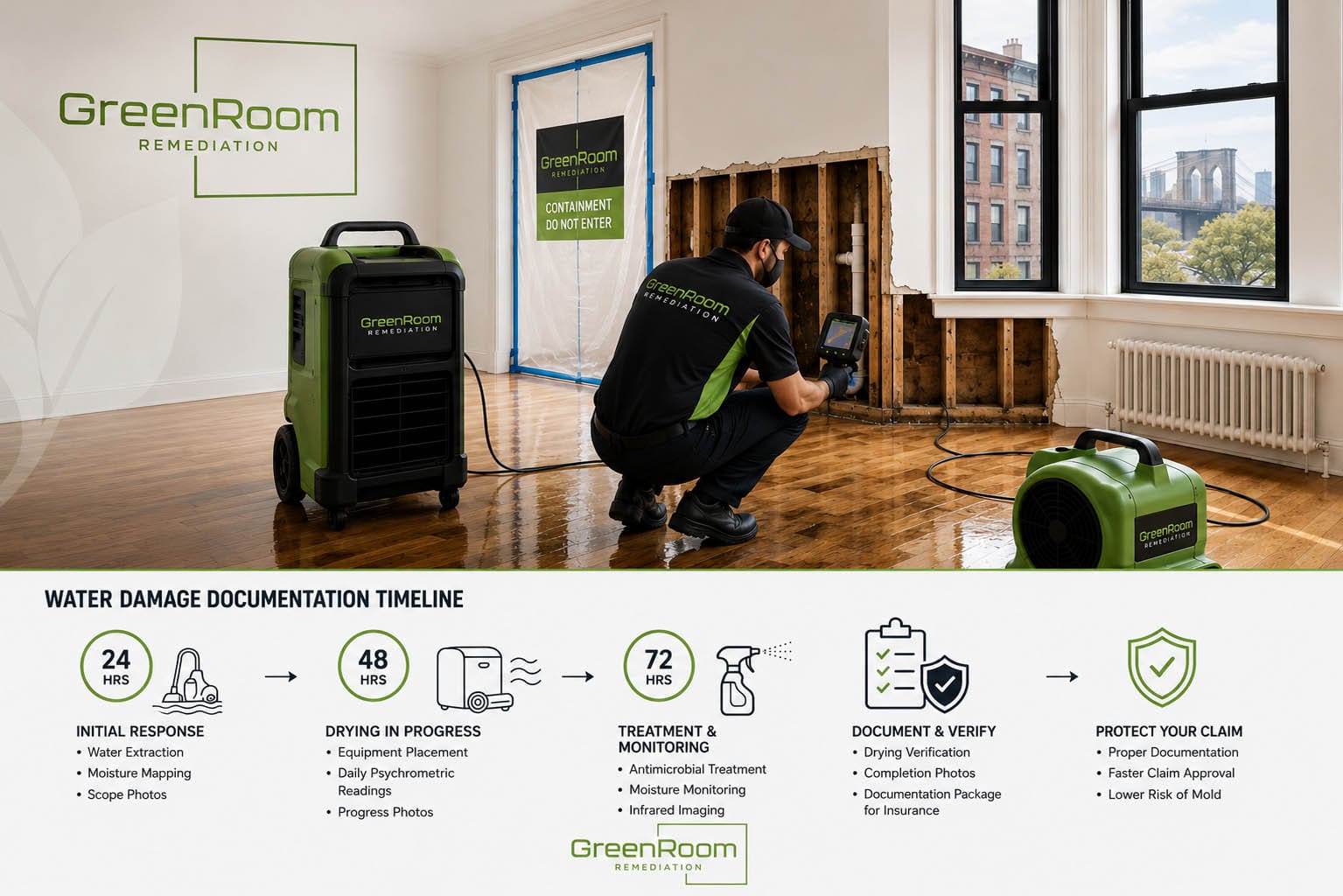
Modern insurance claim processes for water damage rely heavily on objective documentation. Carriers want to see initial scope photos, moisture readings, equipment placement records, daily psychrometric data, antimicrobial pretreatment documentation, and verified drying completion.
Adjusters are increasingly trained to scrutinize claims where this documentation is incomplete because missing records create disputes about the extent of the damage, the duration of exposure, and whether secondary mold growth could have been prevented.
Property owners who lose claim disputes often lose because they cannot prove what was done, when it was done, or whether drying conditions were monitored properly throughout the restoration process.
Brooklyn properties create additional documentation challenges because of building age, shared plumbing systems, older roofing assemblies, and the frequency of hidden moisture conditions in multifamily buildings. A professional restoration team documents these conditions during the initial walk-through, which protects the property owner whether the claim remains straightforward or becomes contested later.
The First 24 Hours Determine Most of the Outcome
Water damage timelines move quickly.
Standing water begins absorbing into drywall, flooring systems, insulation, and structural framing almost immediately. Wood framing can begin losing structural integrity within hours, while microbial growth may begin developing within 24 to 48 hours depending on humidity and temperature conditions.
By 72 hours, secondary mold remediation often becomes part of the project. Within a week, the cost difference between immediate response and delayed response can multiply dramatically.
An effective emergency water damage response includes professional water extraction, moisture mapping with infrared imaging, antimicrobial pretreatment of saturated materials, and calculated placement of structural drying equipment. Brooklyn brownstones are particularly vulnerable because their floor systems, plaster walls, and older framing assemblies retain moisture long after surfaces appear dry.
This is one of the primary reasons water damage restoration in Brooklyn should always include hidden moisture investigation rather than relying on visible damage alone.
Why Equipment Selection Matters More Than Equipment Quantity
Many restoration companies overdeploy drying equipment as a hedge against complaints, which inflates equipment hours and project costs without necessarily improving drying performance.
Effective drying depends on selecting the correct combination of low-grain refrigerant dehumidifiers, desiccant systems for colder or high-humidity environments, axial and centrifugal air movers positioned at calculated angles, and structural cavity drying systems where necessary. The equipment strategy is engineered, not estimated.
Brooklyn walk-ups and brownstones often have limited electrical capacity, so equipment planning must account for amperage availability without overloading circuits. Manhattan high-rises create different challenges involving noise restrictions, floor protection requirements, and tenant coordination. Queens multifamily properties frequently require drying plans that minimize disruption for multiple occupants simultaneously.
The right equipment configuration shortens drying timelines, reduces unnecessary costs, and strengthens the documentation supporting the insurance claim.
Daily Documentation Protects the Insurance Claim
Daily moisture documentation tracks the progress of structural drying and provides the evidence required for claim approval.
This documentation includes temperature readings, relative humidity, psychrometric calculations, grains-per-pound measurements, and moisture readings from all monitored materials and structural assemblies. These readings confirm whether drying conditions are improving and verify when the structure has returned to acceptable moisture levels.
Property owners who allow restoration companies to skip daily documentation often discover later that the insurance adjuster cannot justify approving the full invoice because measurable drying progress was never documented.
Photographic documentation is equally important. Initial scope photos establish the condition of the property before mitigation work begins. Daily progress photos document equipment placement, demolition scope, and changes to the drying plan. Final completion photos confirm the condition of the restored structure after drying is complete.
This combination of psychrometric and visual documentation is often what separates a clean insurance claim from a contested one.
The Connection Between Water Damage and Mold Risk
Every water damage event creates mold risk.
The longer moisture remains trapped inside structural materials, the greater the likelihood that microbial growth will develop. This is why professional water restoration includes antimicrobial pretreatment as a standard component of the mitigation process rather than an optional add-on.
Antimicrobial treatment slows microbial growth during the structural drying window, allowing the building materials time to stabilize before mold colonies develop. Without this step, even a relatively fast drying response can still result in secondary mold remediation work weeks or months later.
Brooklyn properties face higher baseline mold risk than newer suburban construction because older building materials, limited ventilation, shared wall systems, and fluctuating humidity conditions all favor microbial growth.
A properly executed water damage restoration project in Brooklyn includes mold risk management as part of the restoration strategy. This often includes antimicrobial pretreatment, HEPA-filtered air scrubbing, moisture verification, and post-drying evaluation for early signs of contamination.
What Property Owners Should Verify Before Hiring a Restoration Company
Brooklyn property owners hiring a water damage restoration company should verify that the company maintains IICRC certification for water restoration and includes daily psychrometric documentation as part of the standard workflow.
They should also confirm that antimicrobial pretreatment is part of the restoration process rather than an additional upsell, and that the company carries appropriate insurance for the scope of work being performed.
Professional restoration companies should be able to provide:
- Moisture readings
- Infrared imaging documentation
- Daily drying logs
- Equipment placement records
- Written scopes of work
- Structural drying verification
When all of these elements align, the restoration process tends to move through the insurance claim smoothly while reducing the likelihood of secondary mold complications.
When documentation, moisture tracking, or drying verification are missing, property owners often end up paying more out of pocket, dealing with claim disputes, or facing additional mold remediation costs later.
The documentation matters because everything downstream of the initial response depends on it.
GreenRoom Remediation | NY State Licensed Mold Remediation Contractor (License #24-6S44B-SHMO) | IICRC-Certified | OSHA-Trained | BBB Accredited | Serving NYC, Brooklyn, Queens, Manhattan, the Bronx, Staten Island, Long Island, Westchester, and Surrounding Areas.
view related content