table of contents
How to Clear an HPD Mold Violation in NYC: The Complete Process for Property Owners and Landlords
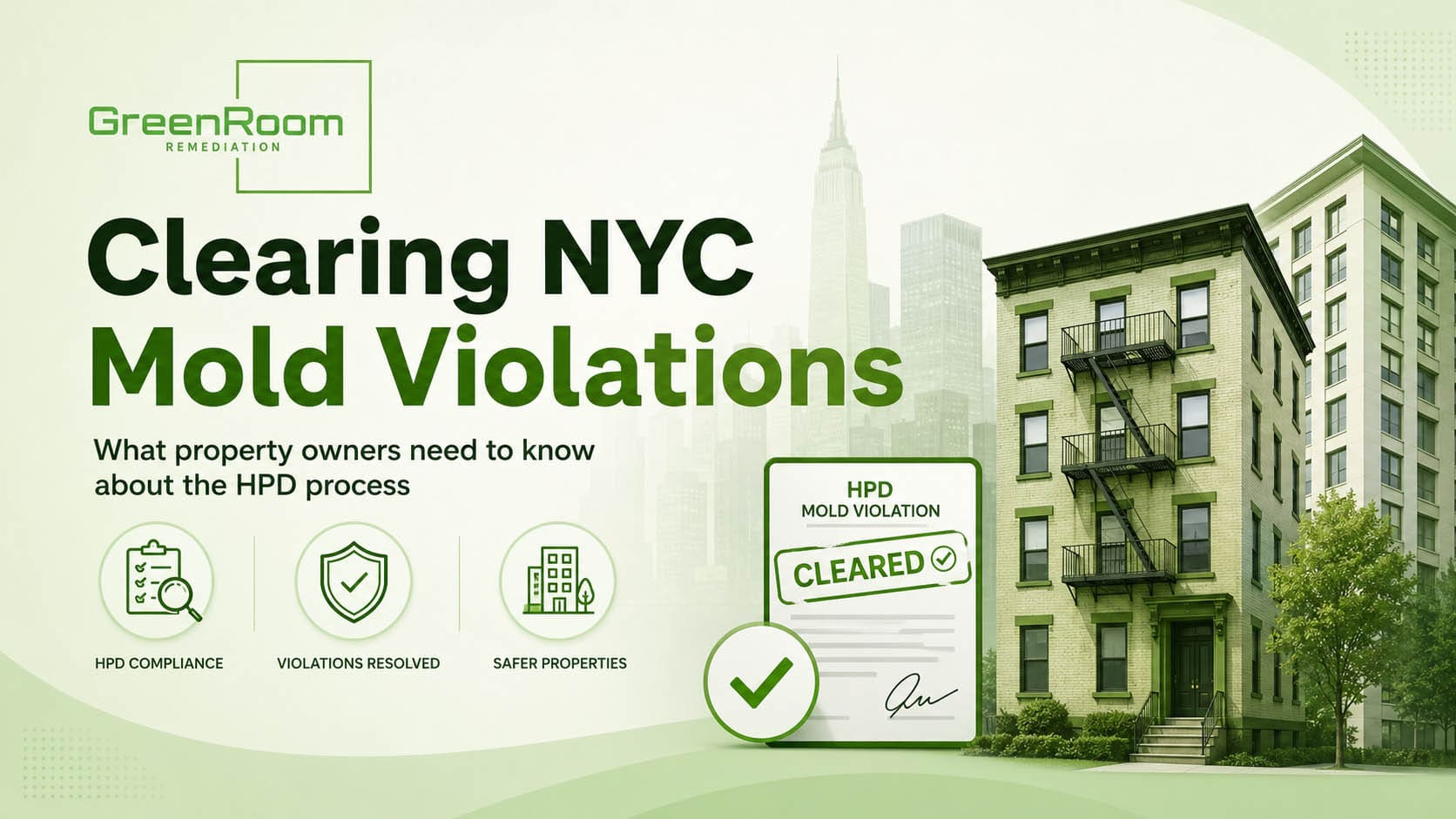
Quick answer: When the NYC Department of Housing Preservation and Development (HPD) issues a mold violation, property owners must correct the violation using NYS-licensed mold assessment and mold remediation contractors, complete the HPD Affidavit of Compliance (AF-8 for Class B and C violations in buildings with 10 or more units; AF-7 for Class A violations or buildings with fewer than 10 units) with required documentation, and submit that package to HPD to begin the certification and dismissal process. Buildings with 10 or more units face Class A, B, or C violation classifications based on mold area thresholds, while buildings with fewer than 10 units have two correction pathways including a self-addressed option for smaller areas. If HPD does not conduct a reinspection within 70 days of receiving your certification, the violation is deemed complied. GreenRoom Remediation handles the full HPD mold violation correction process, from licensed assessment through remediation, documentation, and submission of all required compliance paperwork.
An HPD mold violation is one of the more consequential notices a New York City property owner or landlord can receive, and it carries legal obligations that are more specific, more time-sensitive, and more documentation-heavy than most building owners expect. The violation does not just require fixing the mold. It requires fixing it in a way that satisfies HPD’s correction and certification standards, using separately licensed professionals, and submitting a compliance package that includes affidavits from both the mold assessor and the mold remediator before the violation can be dismissed.
Understanding exactly what HPD requires, what the violation classes mean, and what happens if the process is not completed correctly is the difference between a dismissed violation and an escalating enforcement action.
What Triggers an HPD Mold Violation?
An HPD mold violation is issued when a Housing inspector identifies mold growth in a residential building that meets the threshold requiring formal correction under NYC Local Law 55 of 2018 and the associated NYC Administrative Code provisions. Violations are typically triggered by tenant complaints filed through 311, HPD inspection sweeps of buildings with prior violations or complaints, and emergency inspections following water damage events such as burst pipes, roof leaks, or flooding.
The violation process begins the moment HPD issues the notice to the property owner or managing agent. From that point forward, the property owner is on the clock to correct the condition, certify the correction, and submit the required documentation package. The specific obligations differ based on building size and the severity of the mold condition, which is why understanding the classification structure matters before deciding how to respond.
How HPD Classifies Mold Violations by Building Size
HPD’s violation classification system applies differently depending on whether your building has fewer than 10 units or 10 or more units. That threshold determines both the severity categories available and the correction pathway options.
For buildings with fewer than 10 units, HPD issues a single violation class regardless of mold area. Property owners with smaller buildings have two correction pathways available. The first is having the mold condition inspected and corrected by licensed mold assessment and mold remediation contractors, which is the same licensed professional requirement that applies to all larger buildings. The second pathway allows self-addressing the mold condition using safe work practices, which applies only when the affected area falls below the 10-square-foot threshold that triggers mandatory licensed remediation under NY State Labor Law Article 32. Property owners who choose the self-correction pathway must still document that safe work practices were followed and complete the HPD certification process.
For buildings with 10 or more units, HPD issues one of three violation classes based on the area of mold present:
Class A violations apply when visible mold covers less than 10 square feet in a room within a dwelling unit (or less than 30 square feet on any given level, hallway, or common area). Owners have 90 days to correct and certify Class A violations. Class B violations apply when mold covers 10 to 29 square feet in a room within a dwelling unit and the condition is considered hazardous. Owners have 30 days to correct and certify Class B violations. Class C violations apply when mold covers 30 square feet or more in a room within a dwelling unit and the condition is immediately hazardous. Owners must begin work within 24 hours and complete correction within 21 days. Class C violations carry the most urgent correction timeline and the greatest legal exposure for non-compliance.
For Class B and Class C violations in buildings with 10 or more units, property owners must hire a NYS-licensed mold assessment company to identify the mold, determine the underlying causes, and compile a full Inspection Report. Critically, this assessment company must be a different legal entity from the mold remediation company that performs the removal work. This is not a procedural recommendation. It is a legal requirement under NY State Labor Law Article 32, and HPD’s compliance review confirms that the two contractors are separately licensed before accepting the documentation package.
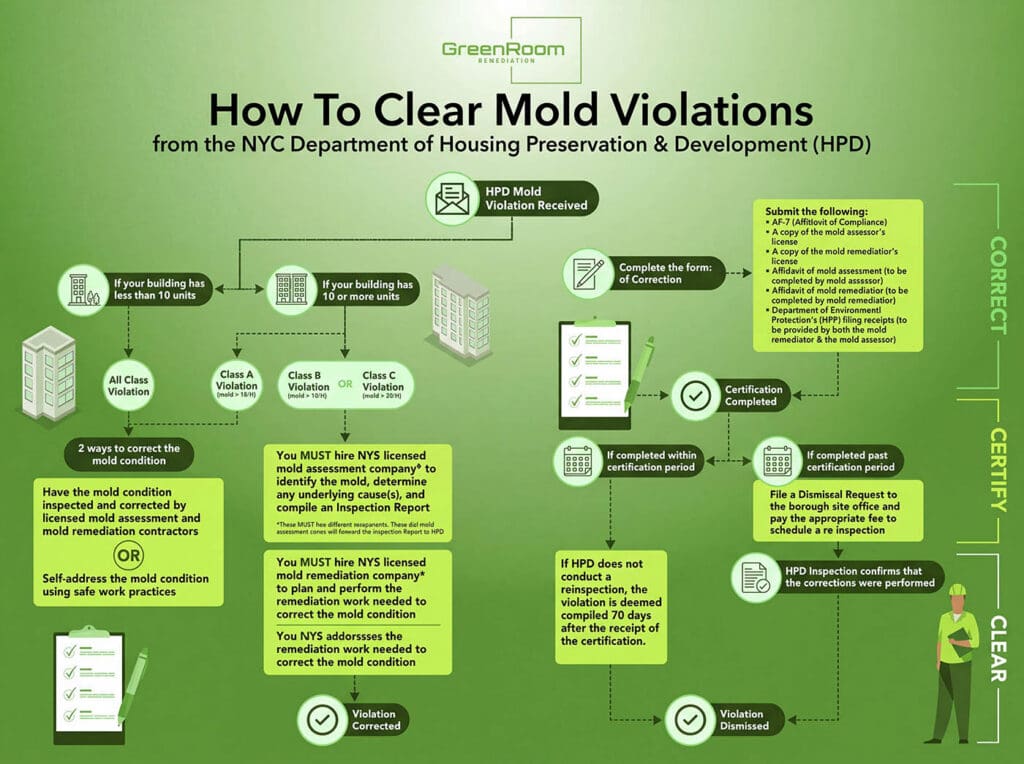
The Four Phases of HPD Mold Violation Correction
HPD’s correction process follows four sequential phases: Correct, Certify, Complete, and Clear. Each phase has specific requirements and documentation obligations, and the process does not advance until the requirements of the prior phase are satisfied.
Correct is the remediation phase. The licensed mold assessment company conducts the inspection, identifies the mold species and affected area, determines the moisture source or underlying cause, and produces the Inspection Report that the mold remediation company uses to plan and execute the removal work. The mold remediation company then performs the actual remediation according to that plan. Both contractors file their respective documentation with HPD’s Department of Environmental Protection as part of the correction record.
Certify is the documentation submission phase. The property owner completes HPD’s Form of Correction and assembles the full compliance package. This is where many property owners encounter delays because the package must be complete before HPD will accept it. A missing affidavit or an unlicensed contractor’s documentation will cause the package to be rejected and reset the timeline.
Complete tracks whether the certification was submitted within or past the certification period specified in the violation notice. If submitted within the certification period, the process moves directly toward dismissal review. If submitted past the certification period, the property owner must file a Dismissal Request with the borough site office and pay the applicable fee to schedule a reinspection. HPD then conducts that reinspection to confirm the corrections were performed before the violation can be dismissed.
Clear is the dismissal phase. If HPD does not conduct a reinspection within 70 days of receiving the certification, the violation is deemed complied and dismissed automatically. If HPD does conduct a reinspection and confirms the corrections were performed correctly, the violation is dismissed.
What the HPD Compliance Documentation Package Must Include
The documentation package that HPD requires to process a mold violation certification is specific, and submitting an incomplete package is one of the most common reasons violations remain open longer than necessary. Every item in the package must be present before HPD accepts the submission.
The required documents depend on building size and violation class. For Class B or Class C violations in buildings with 10 or more units (the most common scenario requiring licensed professionals), the submission must include: the AF-8 Affidavit of Compliance, a copy of the mold assessor’s NYS license, a copy of the mold remediator’s NYS license, the Affidavit of Mold Assessment completed by the mold assessor, the Affidavit of Mold Remediation completed by the mold remediator, and the Department of Environmental Protection filing receipts provided by both the mold remediator and the mold assessor.
The AF-8 Affidavit of Compliance (for Class B and C violations in 10+ unit buildings) and AF-7 (for Class A violations in 10+ unit buildings, or any class in buildings with fewer than 10 units) are the property owner’s sworn statements that the mold condition has been corrected in accordance with HPD requirements. The assessor and remediator affidavits are sworn professional statements confirming the scope of the work performed by each licensed party. The DEP filing receipts confirm that both contractors have filed their documentation with the appropriate city agency. All six document categories must be present in the submission.
We prepare and organize this full documentation package on every HPD violation project we handle. Our process is specifically built around HPD’s submission requirements, which means our clients submit complete packages the first time rather than going through rejection and resubmission cycles that can add weeks to the open violation timeline.
If you have received an HPD mold violation and need the correction, certification, and dismissal process handled by licensed professionals, call GreenRoom Remediation at (917) 965-3754. We handle the full process from assessment through HPD submission, 24 hours a day, 7 days a week.
How to Clear an HPD Mold Violation in NYC | NYC Mold Remediation & Water Damage Restoration
How HPD Mold Violations Connect to Insurance Claims
An HPD mold violation issued following a water damage event such as a burst pipe, failed water heater, or roof leak sits at the intersection of two parallel processes: the HPD correction and certification process and the property insurance claim. Handling both correctly at the same time requires coordination that most property owners do not anticipate.
From the insurance side, the mold violation itself is documentation that the condition was identified by an official city agency, which strengthens the claim record. The HPD-required licensed assessment and remediation work generates exactly the kind of professional documentation package that insurers need to process a mold remediation claim: licensed contractor credentials, scope of work, affidavits from both the assessor and remediator, and DEP filing receipts. When we prepare the HPD compliance package for a client, that same documentation serves double duty as the insurer’s claim file.
Where property owners run into trouble is when they treat the HPD process and the insurance claim as separate workflows managed by different parties on different timelines. The assessor files with HPD on one schedule while the insurer’s adjuster is waiting on documentation on another, and the remediation scope gets defined by HPD’s requirements rather than by the actual moisture migration the water event caused. We manage both workflows simultaneously, ensuring the licensed assessment report satisfies HPD’s Inspection Report requirement while also documenting the full scope of moisture damage the insurer needs to process the claim.
For landlords in particular, an HPD mold violation following a covered water damage event is a strong foundation for an insurance claim. The violation establishes the condition officially, the licensed assessment establishes the scope and cause, and the remediation creates the documentation trail. Coordinating those elements so that the insurer’s adjuster and HPD’s certification process both receive complete information simultaneously is what keeps properties from being caught in an open violation with an unresolved claim at the same time.
What Happens If You Ignore an HPD Mold Violation
An unaddressed HPD mold violation does not simply remain open. It escalates. Class B and Class C violations that are not corrected within the required timeframe can result in HPD referring the building for emergency repair, with costs charged to the property owner. Buildings with multiple open violations or patterns of non-compliance face increased inspection frequency, civil penalties, and potential inclusion in HPD’s Alternative Enforcement Program, which carries significant additional fees and oversight obligations.
For landlords managing rental buildings across Brooklyn, Queens, the Bronx, or Staten Island, an open HPD mold violation also creates direct legal exposure under the NYC warranty of habitability. Tenants living with an active mold violation have grounds for rent reduction proceedings before the Division of Housing and Community Renewal (DHCR), and they can use the open violation as evidence in housing court proceedings. A violation that could have been cleared within 30 to 45 days with a properly managed correction process becomes a compounding liability the longer it stays open.
The 70-day automatic dismissal provision, which deems a violation complied if HPD does not reinspect within 70 days of receiving the certification, provides a meaningful pathway to resolution. But it only applies once a complete certification package has been accepted by HPD. An incomplete submission does not start that 70-day clock.
How Violation Class Affects Your Correction Timeline
Understanding the urgency attached to each violation class is important for prioritizing your response. HPD does not publish a single correction timeline that applies to all violations uniformly. Class A violations have longer correction periods than Class B violations, and Class C violations carry the shortest correction timeline given their immediately hazardous designation.
Property owners who receive a Class C violation in a building with 10 or more units are dealing with a condition HPD has classified as an immediate hazard. That classification reflects mold covering more than 20 square feet and signals that occupant health exposure is a current, active concern. Prompt licensed assessment and remediation in Class C situations is both a legal obligation and a practical necessity, because mold at that scale in an occupied building continues to release spores into shared air systems with every day the condition goes unaddressed.
For insurance purposes, a Class C violation also communicates the severity of the condition to the insurer’s adjuster in terms that accelerate claim review. An adjuster reviewing a licensed mold remediation claim supported by HPD violation documentation, a licensed assessor’s Inspection Report, and a licensed remediator’s Affidavit of Mold Remediation has a significantly more complete and credible claim file than one reviewing a claim without any official violation record.
| Violation Class | Building Type | Mold Area Threshold | Urgency Level | Licensed Contractors Required |
|---|---|---|---|---|
| All Class | Fewer than 10 units | Any area | Standard | Required for areas over 10 sq ft; self-correction permitted below threshold |
| Class A | 10 or more units | More than 10/H sq ft | Standard | Yes, separate assessor and remediator |
| Class B | 10 or more units | More than 10/H sq ft | Hazardous | Yes, separate assessor and remediator |
| Class C | 10 or more units | More than 20/H sq ft | Immediately hazardous | Yes, separate assessor and remediator |
Frequently Asked Questions
What is an HPD mold violation and what does it mean for my property? An HPD mold violation is an official notice from the NYC Department of Housing Preservation and Development that a mold condition in your building requires formal correction under NYC Local Law 55 of 2018. It means you are legally obligated to correct the condition using licensed professionals (for buildings with 10 or more units or mold areas over 10 square feet), submit a documentation package to HPD, and obtain certification that the violation has been corrected. Unaddressed violations escalate and can result in civil penalties and emergency repair orders.
What is the difference between a Class A, Class B, and Class C HPD mold violation? All three apply to buildings with 10 or more units. Class A violations involve mold exceeding 10 square feet per hour and are the least urgent tier. Class B violations involve the same area threshold but are classified as hazardous conditions. Class C violations involve mold exceeding 20 square feet per hour and are classified as immediately hazardous. Class C violations carry the shortest correction timeline and the greatest legal exposure for non-compliance.
Do I have to hire licensed contractors to clear an HPD mold violation? For buildings with 10 or more units, yes. You must hire a separately licensed NYS mold assessment company and a separately licensed NYS mold remediation company. These must be two different legal entities under NY State Labor Law Article 32. For buildings with fewer than 10 units, self-correction using safe work practices is permitted for smaller affected areas, but the property owner must still complete HPD’s certification process.
What documents do I need to submit to HPD to clear a mold violation? For Class B or C violations in buildings with 10 or more units, you must submit the AF-8 Affidavit of Compliance, a copy of the mold assessor’s NYS license, a copy of the mold remediator’s NYS license, the Affidavit of Mold Assessment completed by the assessor, the Affidavit of Mold Remediation completed by the remediator, and the Department of Environmental Protection filing receipts from both contractors. All six document categories must be present for HPD to accept the submission.
What happens if I submit the HPD certification package past the certification period? You must file a Dismissal Request with the borough site office and pay the applicable fee to schedule a reinspection. HPD then inspects the property to confirm corrections were performed. If HPD does not conduct the reinspection within 70 days of receiving your certification, the violation is deemed complied and dismissed automatically.
What is the 70-day automatic dismissal rule? If HPD does not conduct a reinspection within 70 days of receiving a complete certification package, the violation is deemed complied and dismissed automatically. This provision only applies once HPD has accepted a complete submission. An incomplete package does not start the 70-day clock.
Can an HPD mold violation help my insurance claim? Yes. An HPD violation provides official city documentation that the mold condition exists and was identified by a government inspector. The licensed assessment and remediation work required to clear the violation generates the same documentation package insurers need to process mold remediation claims, including licensed contractor credentials, scope of work, and professional affidavits. When managed correctly, the HPD correction process and the insurance claim can run simultaneously using the same documentation.
How long does it take to clear an HPD mold violation? Timeline depends on violation class, how quickly licensed contractors can be engaged, and whether the certification package is submitted within or past the certification period. A well-managed correction process with licensed contractors and a complete documentation package can be resolved within 30 to 45 days from violation receipt. Violations that involve documentation gaps, unlicensed contractors, or incomplete submissions take significantly longer and may trigger reinspection fees.
What happens if I use an unlicensed contractor to clear an HPD mold violation? HPD will reject the certification package because the contractor license copies are required documentation. The violation remains open, the correction timeline resets, and you may face civil penalties for non-compliance. Using an unlicensed contractor also gives your insurer grounds to deny the mold portion of any related insurance claim.
Can GreenRoom Remediation handle the full HPD violation correction process? Yes. We handle licensed mold assessment coordination, remediation, and preparation of the complete HPD documentation package including all required affidavits and DEP filing receipts. We also manage the insurance claim documentation simultaneously when a water damage event is the underlying cause of the violation.
For HPD mold violation correction, certification, and insurance claim coordination in Brooklyn, Manhattan, Queens, the Bronx, Staten Island, Long Island, Westchester, and Northern New Jersey, call GreenRoom Remediation at (917) 965-3754. Available 24 hours a day, 7 days a week.
GreenRoom Remediation | NY State Licensed Mold Remediation Contractor (License #24-6S44B-SHMO) | IICRC-Certified | OSHA-Trained | BBB Accredited | Serving NYC, Brooklyn, Queens, Manhattan, the Bronx, Staten Island, Long Island, Westchester, and Surrounding Areas.
view related content