table of contents
- What Is Professional Mold Testing?
- What Does the $499 Mold Inspection Include?
- When Do You Actually Need Mold Testing Before Remediation?
- Why NY State Law Requires Separate Companies for Testing and Remediation
- How to Read Your Mold Test Results
- What Happens After the Inspection?
- How Much Does Additional Sampling Cost?
- Where Does GreenRoom Remediation Provide Mold Testing?
- Frequently Asked Questions
- How long does a mold inspection take?
- Can I stay in my home during mold testing?
- What is the difference between mold testing and mold inspection?
- Do I need mold testing before buying or selling a home in NYC?
- Are DIY mold test kits accurate?
- How does mold testing support an insurance claim?
- What happens if my mold test comes back negative?
Quick answer: Professional mold testing in NYC starts at $499 for a standard inspection and includes a visual assessment, moisture mapping, air sampling, and lab-certified results with a written report. The $99 per additional sample fee applies when multiple rooms or areas require separate sampling. By law under New York State Labor Law Article 32, the company that performs your mold testing must be a different licensed entity from the company that performs any remediation work. GreenRoom Remediation coordinates certified independent mold assessors and uses the inspection results to plan and execute the remediation scope when contamination is confirmed.
Mold testing is one of those services that most property owners do not think about until they smell something they cannot locate, see a stain they cannot explain, or discover water damage that sat longer than it should have. At that point, the question shifts from whether to test to what testing actually involves and whether the results will tell them anything useful. In NYC, where older building stock, shared plumbing systems, and dense occupancy create conditions that hide mold well, those questions matter more than they do in most other markets.
What Is Professional Mold Testing?
Professional mold testing is a structured assessment process performed by a licensed mold assessor that determines whether mold is present in a property, identifies the species and concentration of any contamination found, locates the moisture conditions that are supporting growth, and produces a written report that can be used to plan remediation or satisfy insurance, legal, or real estate requirements.
Mold testing in New York differs from informal inspection or DIY test kits in one critical way: it requires a licensed professional under New York State Labor Law Article 32 for any assessment connected to a remediation project involving more than 10 square feet of contamination. Licensed assessors carry credentials issued by the New York State Department of Labor and follow documented protocols for sampling methodology, chain of custody, and lab submission. The results they produce carry professional and legal weight that a $30 hardware store kit cannot replicate.
In NYC buildings specifically, professional mold testing is also more technically demanding than in standalone homes. Mold spores travel through shared HVAC systems, wall cavities, and ventilation risers. A single contamination source in one unit of a Brooklyn co-op or Queens multifamily building can produce elevated spore counts in adjacent units that show no visible growth. Air sampling captures that airborne contamination in a way that visual inspection alone cannot.
What Does the $499 Mold Inspection Include?
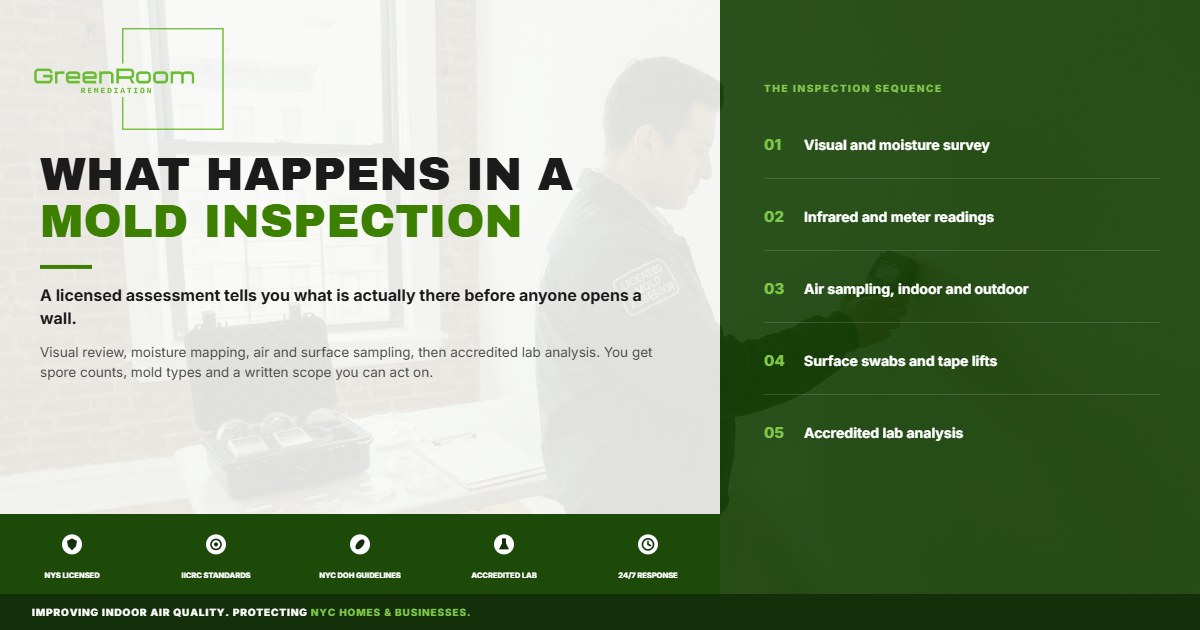
The standard $499 mold inspection at GreenRoom Remediation includes four components that together produce a complete picture of the contamination conditions in your property.
Visual Inspection and Moisture Assessment
The inspection begins with a full walkthrough of the property using calibrated moisture meters and thermal imaging to identify elevated moisture readings in walls, floors, ceilings, and structural cavities. In Brooklyn brownstones, Manhattan apartments, and Queens multifamily buildings, moisture routinely hides behind plaster, under flooring, and inside wall assemblies that appear completely dry on the surface. The visual inspection documents visible staining, discoloration, odor sources, and water intrusion pathways that help explain how the moisture conditions developed and where hidden growth is most likely to exist.
Air Sampling
Air sampling uses a calibrated spore trap pump to draw a measured volume of indoor air through a collection cassette over a timed period. One outdoor baseline sample is always collected alongside indoor samples to establish what spore species and concentrations are present in the ambient outdoor air. The comparison between indoor and outdoor counts is what tells the assessor whether indoor air quality has been compromised by active mold growth. Elevated indoor counts of species that are low or absent outdoors indicate active indoor contamination rather than normal seasonal variation. The standard $499 inspection includes one indoor air sample. Properties with multiple rooms, floors, or suspected contamination zones require additional samples at $99 each.
Surface and Tape Sampling
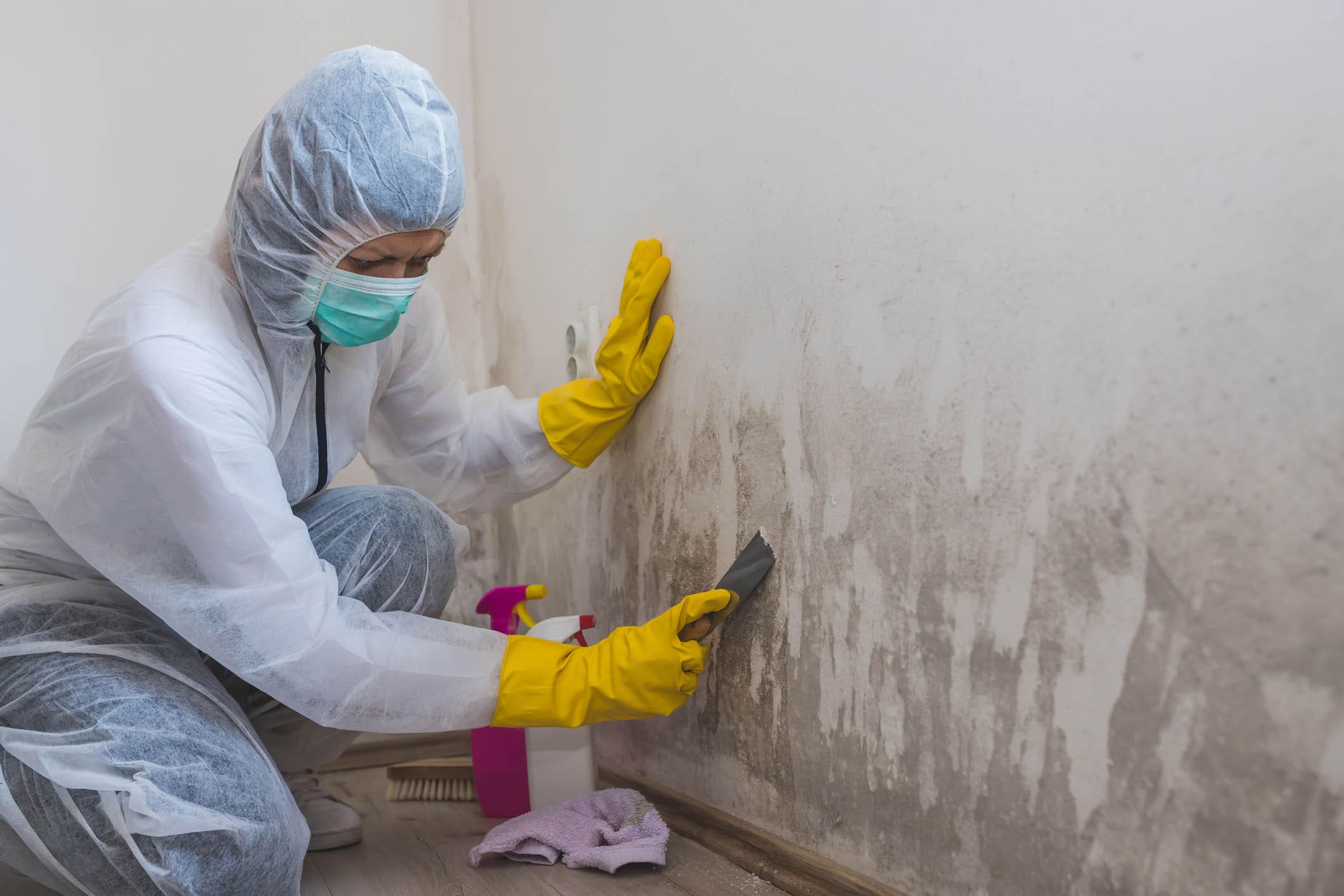
When visible staining or suspected mold growth is present, tape lift or swab samples are collected directly from affected surfaces. Surface sampling identifies the specific mold species present at the visible growth location and confirms whether discoloration is biological growth or another cause such as efflorescence or soot. In older NYC buildings where dark staining on walls or ceilings is common, surface sampling resolves the question definitively rather than leaving the property owner to guess. Additional surface samples beyond what is included in the standard inspection are billed at $99 per sample.
Lab Analysis and Written Report
All samples are submitted to an accredited laboratory under a documented chain of custody. Lab results identify mold species, quantify spore concentrations, and characterize the contamination relative to outdoor baseline conditions. The licensed mold assessor then produces a written report that summarizes findings, identifies the likely moisture source and contamination pathways, and recommends a remediation scope when contamination is confirmed. This written report is the document that a licensed remediation contractor, including GreenRoom Remediation, uses as the basis for the remediation plan under New York State Labor Law Article 32. It is also the document that insurance adjusters, building managers, co-op boards, and attorneys rely on when contamination becomes a claim or dispute.
When Do You Actually Need Mold Testing Before Remediation?
Mold testing is the right first step in most situations, but there are specific scenarios where it is clearly necessary and a few where it is less critical. Understanding the difference helps property owners make an informed decision rather than skipping testing when they should not or paying for testing that will not change the outcome.
Testing is clearly necessary when you have symptoms such as persistent musty odors, unexplained respiratory irritation, or allergy flare-ups without visible mold, because testing confirms whether invisible airborne contamination is the cause. It is also necessary before any remediation project in an NYC building with 10 or more square feet of suspected contamination, because New York State Labor Law Article 32 requires a licensed assessor’s report and written remediation protocol before a licensed remediator can begin work. For real estate transactions, insurance claims, HPD violation responses, and tenant disputes, independent testing documentation carries legal weight that a contractor’s visual assessment alone cannot provide.
The one situation where moving directly to remediation without testing can be appropriate is when large-scale visible contamination exists following a documented water damage event and the source is already confirmed. In those cases, a licensed assessor still typically documents the pre-remediation conditions for insurance and compliance purposes, but the assessment may be more focused than a full diagnostic investigation. If you are uncertain which path applies to your situation, a professional inspection is the lower-risk starting point. For more on how water damage connects to mold growth, see our guide on mold remediation, water damage restoration, and indoor air quality.
Why NY State Law Requires Separate Companies for Testing and Remediation
New York State Labor Law Article 32 prohibits the same licensed entity from performing both the mold assessment and the mold remediation on the same project. This separation of duties is a legal protection for property owners, not a bureaucratic inconvenience.
When the company conducting the inspection is the same company that would profit from the remediation, there is a structural incentive to overstate the scope of contamination. Requiring an independent assessor eliminates that conflict of interest. The assessor’s report defines what remediation is needed. The remediator is then legally bound to follow that scope rather than expanding it unilaterally.
In practice, this means that GreenRoom Remediation does not perform mold assessments on projects where we will also perform the remediation. We coordinate with licensed independent assessors, review the assessor’s report with you, and then execute remediation according to the documented protocol. This is the legally required process in New York, and it is also the right process for ensuring the assessment is objective. Any contractor in NYC that offers to inspect and remediate under a single license on the same project is operating outside of Article 32, which creates both legal and insurance exposure for the property owner. For more on how this affects insurance claims, see our article on whether homeowners insurance covers mold remediation in NYC.
How to Read Your Mold Test Results
Lab reports from mold air sampling identify mold species and report concentrations in spores per cubic meter of air. The comparison between your indoor results and the outdoor baseline sample is more informative than the raw numbers alone.
A result where indoor spore counts for common species such as Cladosporium or Penicillium are similar to or lower than outdoor counts generally indicates that indoor air quality has not been significantly compromised by active indoor growth. A result where indoor counts substantially exceed outdoor counts, or where species that are rare outdoors such as Stachybotrys chartarum or Chaetomium are detected indoors at any concentration, indicates active indoor contamination that warrants investigation and likely remediation.
The written report from your licensed assessor translates the raw lab data into a practical finding and recommendation. If the report identifies confirmed contamination and recommends remediation, it will also include a written protocol specifying the scope of work, containment requirements, and clearance verification standards the remediator must follow. That protocol is the document GreenRoom Remediation works from when planning and executing a remediation project. To understand what happens after that assessment, see our article on hidden moisture and recurring mold problems in NYC, which explains why addressing the moisture source is as important as removing the visible contamination.
What Happens After the Inspection?
If the inspection finds no significant contamination and moisture readings are within acceptable ranges, the assessor’s report provides documentation that air quality is within normal parameters. This result is valuable for peace of mind, real estate disclosures, and insurance purposes even when no remediation is needed.
If the inspection confirms contamination, the assessor’s written protocol defines the remediation scope. GreenRoom Remediation reviews that protocol with you, provides a remediation estimate based on the documented scope, and schedules the work according to the timeline your situation requires. For contamination resulting from a water damage event that may be covered by homeowners insurance, the inspection report also becomes part of the insurance claim documentation. See our guide on whether your NYC insurance policy will cover the damage for specifics on how testing results support claim filings.
After remediation is complete, a post-remediation clearance test is performed by the independent assessor to confirm that air quality has returned to acceptable levels and that the remediation was successful. This clearance test costs $499 and produces the documentation insurers and compliance requirements need to close the project file. Clearance testing is not optional on NYC projects governed by Article 32 and IICRC S520 standards. It is the final verification step that confirms the work was done correctly. For co-op or condo buildings where HPD violations may be involved, the clearance test results are also part of the HPD compliance documentation. See our guide on how to clear an HPD mold violation in NYC for the full compliance process.
How Much Does Additional Sampling Cost?
The standard $499 inspection includes one indoor air sample and the outdoor baseline. Properties with multiple rooms, separate floors, adjacent units, or HVAC systems that may be circulating contamination between spaces typically require additional samples to build a complete picture of the contamination scope.
Each additional air or surface sample is $99. A typical two-bedroom Brooklyn apartment with suspected contamination in two rooms might require 3 to 4 total samples including the outdoor baseline, bringing the total to $597 to $696. A larger contamination investigation in a multifamily building or commercial space with multiple areas of concern may require 6 to 10 samples or more. The assessor discusses sampling strategy with you during the inspection so you understand what additional samples are needed and why before the cost is incurred.
Skipping additional samples to reduce cost carries a real risk: an incomplete sampling plan may miss contamination in adjacent spaces, leading to a remediation scope that does not address the full extent of the problem. Incomplete remediation is one of the most common reasons mold returns within months of a project that appeared successful. For more on why mold recurs, see our article on hidden moisture as the real cause of recurring mold problems in NYC.
Where Does GreenRoom Remediation Provide Mold Testing?
GreenRoom Remediation coordinates certified mold testing across all five NYC boroughs including Brooklyn, Manhattan, Queens, the Bronx, and Staten Island, as well as Long Island, Westchester, and Northern New Jersey. Response times for standard inspections are typically within 24 to 48 hours. Emergency inspections for active water damage situations or urgent real estate timelines are available with same-day or next-day scheduling depending on assessor availability.
Frequently Asked Questions
How long does a mold inspection take?
A standard residential mold inspection typically takes 1 to 2 hours depending on the size of the property and the number of areas being assessed. Larger properties, multi-unit buildings, or inspections involving HVAC systems and multiple floors may take 2 to 3 hours. Lab results are typically returned within 3 to 5 business days of sample submission.
Can I stay in my home during mold testing?
Yes. Mold testing does not involve any demolition, containment, or chemical application. The assessor conducts a walkthrough, takes air samples using a pump and cassette, and may collect tape lift samples from visible growth areas. Occupants can remain in the property during the inspection without any health risk from the testing process itself.
What is the difference between mold testing and mold inspection?
A mold inspection is the visual and moisture assessment component of the process. Mold testing refers specifically to the collection and lab analysis of air or surface samples. In practice, professional assessments in NYC include both: the visual inspection identifies where to sample, and the lab results quantify what was found. The two terms are often used interchangeably but technically describe different components of the same assessment process.
Do I need mold testing before buying or selling a home in NYC?
There is no legal requirement in New York to conduct mold testing before a real estate transaction, but it is strongly advisable when there is any history of water damage, visible staining, musty odors, or prior remediation work. Buyers who discover mold after closing without prior disclosure may have legal recourse, and sellers who can document a clean inspection report are in a stronger position if contamination questions arise later.
Are DIY mold test kits accurate?
DIY mold test kits sold at hardware stores have significant limitations. Because they use passive spore collection rather than calibrated air sampling, they cannot produce the quantified results needed to compare indoor air quality against outdoor baseline conditions. They also cannot identify moisture sources, assess contamination scope, or produce the licensed assessor’s report required for remediation projects under New York State Labor Law Article 32. They may confirm that mold spores exist in a space, but mold spores exist in virtually every indoor environment at some level. What matters is the concentration relative to outdoor conditions and whether specific high-risk species are present at elevated levels.
How does mold testing support an insurance claim?
A licensed assessor’s report establishes the presence, scope, species, and moisture source of mold contamination in documented form that insurance adjusters can review and rely on. Without this documentation, claims are more likely to be disputed or denied. For mold resulting from a covered water damage event such as a burst pipe or water heater failure, the assessor’s report is one of the key documents in the claim file. See our guide on whether homeowners insurance covers mold remediation in NYC for a full breakdown of what insurers require.
What happens if my mold test comes back negative?
A negative result means the air sampling and surface sampling did not detect contamination at levels that indicate active indoor mold growth. This is a useful result because it documents that air quality is within acceptable parameters at the time of testing. If you continue to experience symptoms or suspect a moisture source that was not fully investigated, a follow-up inspection with expanded sampling may be warranted. A negative result on limited sampling does not definitively rule out contamination in areas that were not sampled.
To schedule a certified mold inspection in Brooklyn, Manhattan, Queens, the Bronx, Staten Island, Long Island, Westchester, or Northern New Jersey, call GreenRoom Remediation at (917) 965-3754. We are available 24 hours a day, 7 days a week for emergency assessments and standard inspections.

GreenRoom Remediation | NY State Licensed Mold Remediation Contractor (License #24-6S44B-SHMO) | IICRC-Certified | OSHA-Trained | BBB Accredited | Serving NYC, Brooklyn, Queens, Manhattan, the Bronx, Staten Island, Long Island, Westchester, and Surrounding Areas.
view related content