table of contents
Does Homeowners Insurance Cover Mold Remediation in NYC? What’s Covered, What’s Not, and How to File
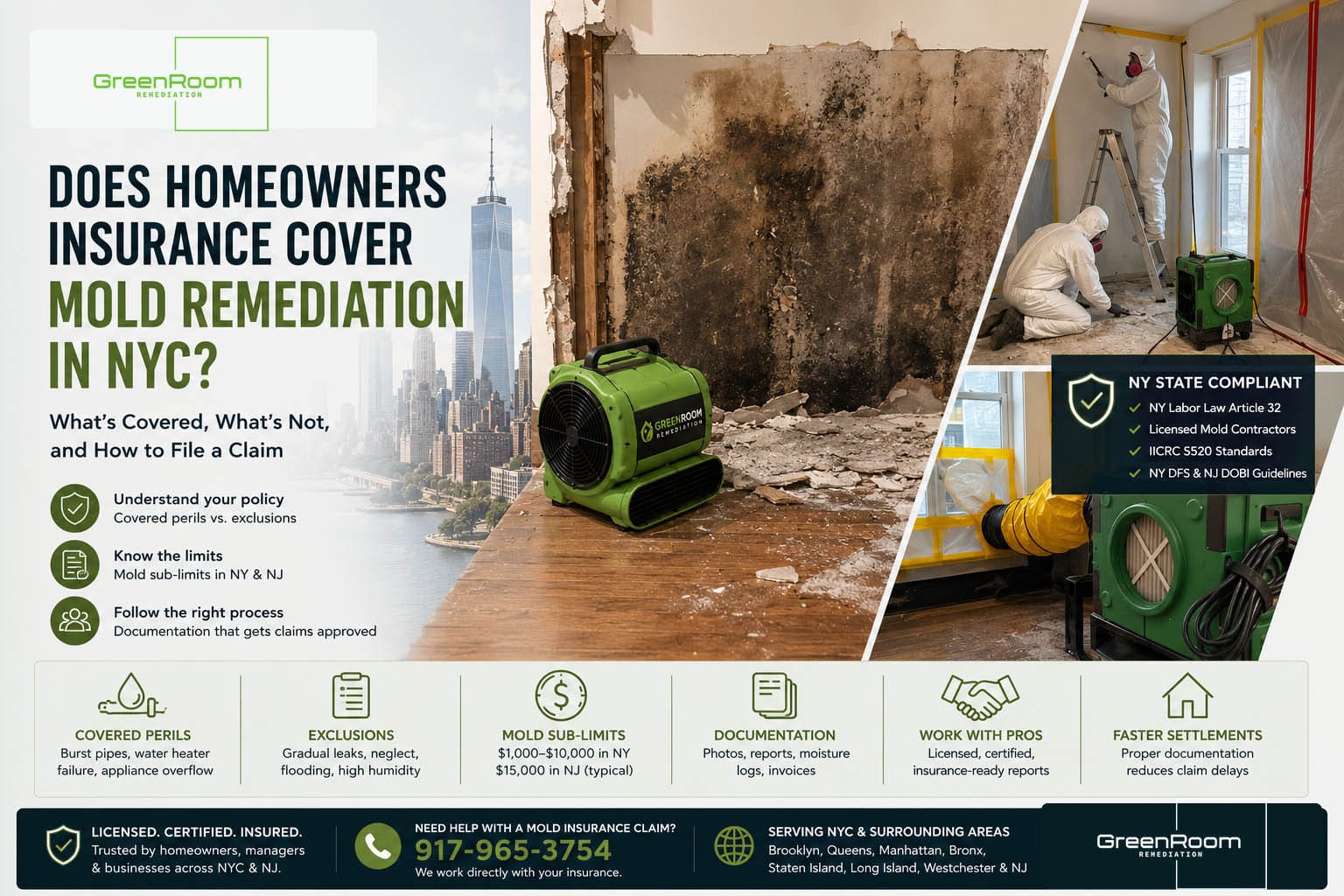
Quick answer: Homeowners insurance in New York covers mold remediation when the mold results directly from a covered peril, most commonly a burst pipe, water heater failure, or accidental appliance overflow but not when caused by gradual leaks, neglect, or flooding from rising water. New York’s Department of Financial Services (NY DFS) confirms that while covered-peril mold claims are eligible, many policies include a mold sub-limit that caps payouts between $1,000 and $10,000, and New Jersey policies often sub-limit mold remediation at $15,000. Under NY State Labor Law Article 32, mold remediation on areas of 10 square feet or more must be performed by a licensed contractor — a requirement that directly affects whether your claim gets paid. GreenRoom Remediation works directly with insurance adjusters, providing the documentation package insurers require to process and settle claims faster.
Mold insurance claims in New York and New Jersey are among the most frequently disputed property damage claims, and the gap between what homeowners expect to receive and what their policy actually covers is often significant. The rules are specific, the paperwork matters enormously, and the timeline from the water event to the mold discovery can work either for or against your claim depending on how you handle the first 48 hours.
A mold insurance claim is a formal request under your homeowners, condo, or co-op policy for coverage of mold remediation costs when mold develops as a direct result of a covered water damage event. Understanding what qualifies as covered, what documentation your insurer requires, and how a licensed remediation contractor fits into the process is the difference between a settled claim and a denial letter.
What Does “Covered Peril” Actually Mean for a Mold Claim?
A covered peril is a specific cause of loss that your policy explicitly insures against. For mold claims in New York and New Jersey, coverage hinges entirely on whether the water event that caused the mold qualifies as a covered peril under your policy language.
The events that most reliably qualify as covered perils include burst or frozen pipes, water heater tank ruptures, washing machine or dishwasher overflow, accidental discharge from plumbing fixtures, and in some policies, sewer backup when a separate endorsement is in place. What connects all of these is the “sudden and accidental” standard: the water event happened without warning, could not have been prevented through routine maintenance, and was not the result of gradual deterioration.
The events that insurers most commonly use to deny mold claims include slow plumbing leaks that developed over weeks or months, roof leaks attributed to deferred maintenance, rising floodwater from storms or street drainage (which requires a separate National Flood Insurance Program policy through NFIP/FEMA), and condensation or humidity buildup in poorly ventilated spaces. Insurers treat these as maintenance issues or gradual damage, and the standard homeowners policy in both New York and New Jersey excludes gradual damage explicitly.
The practical consequence for NYC property owners is this: mold that appears three weeks after a burst pipe in a Brooklyn apartment may still be claim-eligible, but mold that developed slowly behind a bathroom wall over six months almost certainly is not. The cause and the timeline both matter, and both need to be documented by a licensed professional before remediation begins.
How New York State Law and NY DFS Rules Govern Your Mold Claim
New York has one of the most specific regulatory frameworks for mold claims in the country, and knowing these rules gives policyholders meaningful leverage when an insurer is slow to respond or disputes coverage.
Under NY State Labor Law Article 32, any mold assessment or mold remediation involving an area of 10 square feet or more must be performed by a licensed professional. The state also requires that the mold assessor and the mold remediation contractor be separate, independently licensed entities. This separation of duties protects the policyholder by ensuring the assessment is objective and not influenced by whoever benefits from the remediation contract. When you hire an unlicensed contractor to remove mold, even if the work appears successful, your insurer has grounds to deny the claim on procedural grounds alone.
Under NY Regulation 64 (11 NYCRR 216), insurers operating in New York must acknowledge receipt of a property damage claim within 15 business days, begin investigating promptly, and issue either a settlement offer or a written denial with stated reasons within 15 business days of receiving all required documentation. This regulation applies to homeowners, co-op, and condo property claims across all five boroughs, Long Island, and Westchester. For NJ policyholders, the New Jersey Department of Banking and Insurance (DOBI) enforces similar prompt-payment standards, though timelines and sub-limit structures differ by carrier.
The NY DFS explicitly warns in its homeowners insurance FAQ that many New York policies contain a mold limitation: a sub-limit that caps the total payout for mold remediation even when the underlying cause is a covered peril. These sub-limits commonly range from $1,000 to $10,000 in standard HO-3 policies, and policyholders who have not purchased an additional mold endorsement frequently discover this cap only after filing. In New Jersey, many admitted carriers sub-limit mold remediation at $15,000, and some offer endorsements that raise that ceiling. Reviewing your policy’s specific mold or “fungus” clause before an event — not after — is the only reliable way to know your actual coverage ceiling.
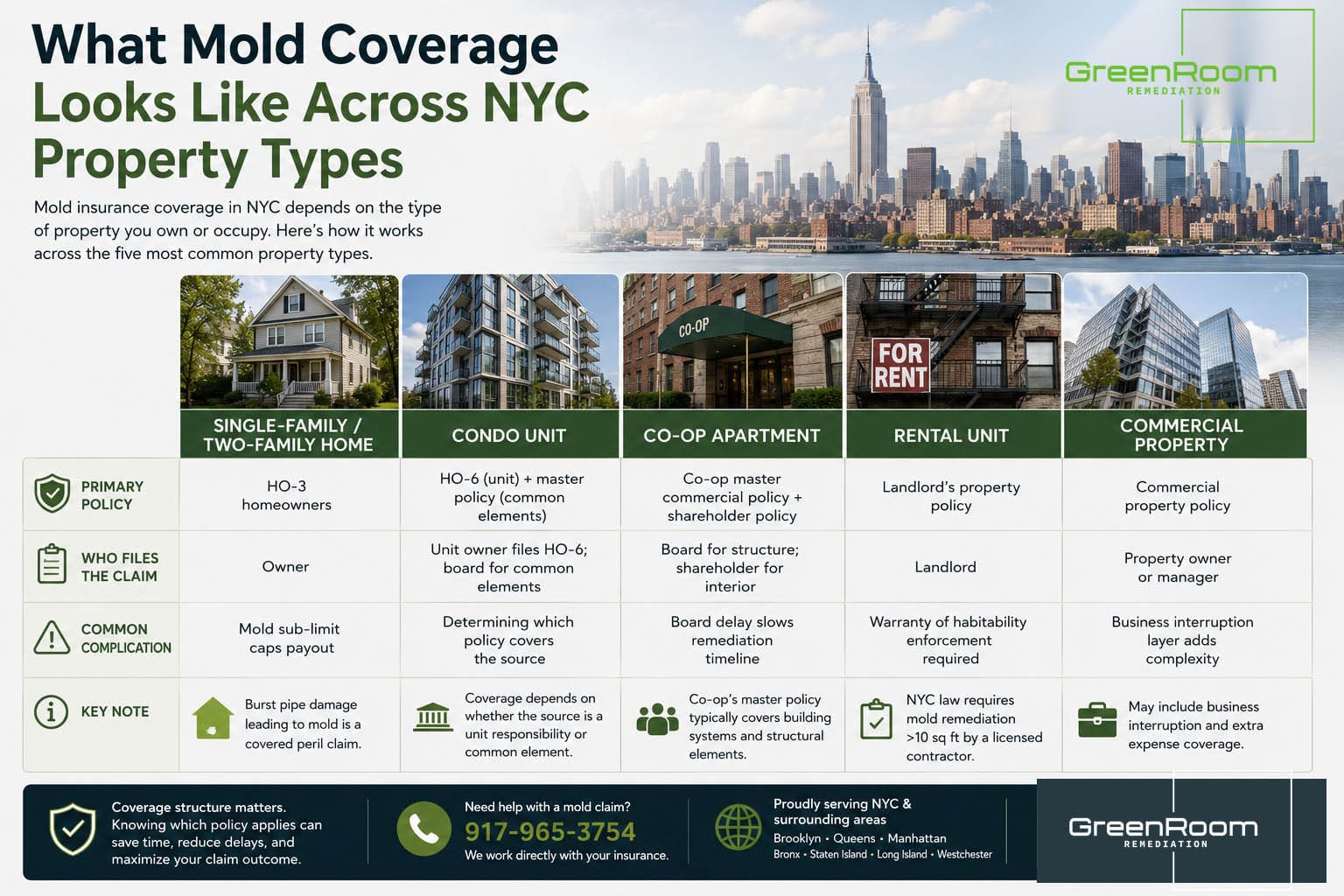
What Mold Coverage Looks Like Across NYC Property Types
Does Homeowners Insurance Cover Mold Remediation in NYC | NYC Mold Remediation & Water Damage Restoration
Coverage structure varies significantly depending on whether you own a house, a condo unit, a co-op apartment, or a rental unit. This is a dimension of NYC mold claims that trips up even experienced property owners.
Single-family and two-family homes in Brooklyn, Queens, Staten Island, and the surrounding suburbs follow the most straightforward coverage model. The standard HO-3 homeowners policy covers the structure and its systems. A burst pipe that leads to mold in the walls is a covered peril claim. The homeowner files, the adjuster inspects, and the mold sub-limit determines the ceiling.
Condo unit owners carry an HO-6 policy that covers the interior of their unit from the walls inward. The condo association’s master policy covers common elements like exterior walls, roof, and shared plumbing within walls. Under this structure, if a pipe within a common wall fails and mold grows in your unit, the question of which policy responds first depends on the condo’s Declaration of Condominium. In many cases, the unit owner files under their own HO-6 policy first, and their insurer subrogates against the association’s master policy if the source was a common element. If a neighbor’s unit is the source of the water intrusion, your HO-6 covers your unit while the neighbor’s policy covers theirs.
Co-op shareholders operate under a proprietary lease that typically assigns the co-op corporation responsibility for structural elements and building systems. The co-op’s master commercial property policy covers these elements. Individual shareholders are generally responsible for interior finishes and their personal property. When mold develops from a building-system failure in a Manhattan, Brooklyn, or Queens co-op, the co-op board’s insurer is typically the first line of coverage but delays in board action can complicate both the remediation timeline and the claim.
Renters in NYC have no property insurance for the structure itself. The landlord’s policy covers the building. However, under the NYC warranty of habitability (NYC Admin Code § 24-154), landlords are legally required to remediate mold in rental units where the mold covers more than 10 square feet, and this remediation must be performed by a licensed contractor. Tenants who experience mold from a building system failure can file complaints with the NYC Department of Housing Preservation and Development (HPD), which documents violations that can support insurance claims or legal action.
| Property Type | Primary Policy | Who Files the Claim | Common Complication |
|---|---|---|---|
| Single-family / two-family home | HO-3 homeowners | Owner | Mold sub-limit caps payout |
| Condo unit | HO-6 (unit) + master policy (common elements) | Unit owner files HO-6; board for common elements | Determining which policy covers the source |
| Co-op apartment | Co-op master commercial policy + shareholder policy | Board for structure; shareholder for interior | Board delay slows remediation timeline |
| Rental unit | Landlord’s property policy | Landlord | Warranty of habitability enforcement required |
| Commercial property | Commercial property policy | Property owner or manager | Business interruption layer adds complexity |
What Insurers Actually Need to Process Your Mold Claim
The single most common reason mold claims are delayed or denied in New York and New Jersey is incomplete or improperly formatted documentation. Insurance adjusters reviewing mold claims need a specific package of materials, and when that package arrives incomplete, the 15-business-day response clock under NY Regulation 64 does not begin running against the insurer it begins only after they have everything they need.
The documentation package that supports a successful mold claim includes pre-remediation moisture readings using calibrated moisture meters across all affected substrates, infrared thermal imaging that confirms hidden moisture behind walls or under flooring, air quality testing results with identified mold species and spore count concentrations, and a written scope of work from a licensed contractor that itemizes containment setup, materials to be removed, antimicrobial treatment specifications, and structural drying plans. It also requires daily logs during remediation, waste disposal manifests documenting how contaminated materials were removed, and post-remediation clearance testing results from a third-party certified industrial hygienist confirming that air quality has returned to baseline.
We produce this entire documentation package as part of every claim-related project. Our team works directly with your adjuster from the first walkthrough through final clearance, providing reports formatted to meet carrier review standards and following up on information requests so the process does not stall on your end. In our experience across hundreds of NYC remediation projects, the claims that resolve fastest are the ones where the documentation is complete and organized before the adjuster’s first inspection.
If you have water damage or mold and need to file an insurance claim, call GreenRoom Remediation at (917) 965-3754. We respond 24/7, assess the damage, and begin coordinating with your insurer immediately.
Does Flood Damage Qualify for a Mold Claim?
Flooding from external sources like storm surge, street drainage backup, overflowing rivers is not covered under standard homeowners or condo policies in New York or New Jersey. This is one of the most expensive misunderstandings we encounter, particularly after heavy rain events that affect basement apartments and ground-floor units across Brooklyn, Queens, and Northern New Jersey.
Flood coverage requires a separate policy through the National Flood Insurance Program (NFIP), administered by FEMA, or through a private flood insurer. NFIP policies have a standard 30-day waiting period from purchase to effective date, which means flood insurance cannot be purchased reactively once a storm is forecast. An NFIP policy does cover mold remediation when the mold results directly from covered flood damage, but the documentation requirements under NFIP differ from standard homeowners claims and involve a FEMA-assigned adjuster with specific scope review processes.
The distinction between external flooding and internal plumbing failure matters enormously in NYC. A burst pipe in a Bronx apartment building is a covered peril under a homeowners or landlord policy. Water entering that same apartment from a storm drain overflow outside the building is a flood event requiring NFIP coverage. Insurers send adjusters specifically trained to determine the water source, and the source dictates which policy — if any — responds.
How GreenRoom Works with Your Insurance Company Directly
Most homeowners approach a mold or water damage claim reactively – they call their insurer, wait for an adjuster, and then try to find a contractor. We recommend reversing that sequence. Calling a licensed remediation contractor before or simultaneously with your insurer serves your claim in two ways: it establishes the damage timeline authoritatively, and it allows protective measures such as containment and moisture extraction to begin immediately without jeopardizing the claim.
NY DFS Circular Letter No. 8 (2021) confirmed that insurers in New York must allow policyholders to make immediate protective repairs when necessary for health or safety, and that photographic and video documentation can serve as reasonable proof of loss. This means you are not required to wait passively for an adjuster before protecting your property. What matters is that those protective measures are performed by a licensed contractor and documented thoroughly.
Our process on claim-related projects starts with a comprehensive assessment that produces the full documentation package described above. We then make direct contact with your insurer’s claims team or adjuster, provide the inspection report, answer technical questions about scope and methodology, and submit supplemental line items when the initial adjuster estimate misses covered work. Restoration estimates from licensed remediation companies frequently identify covered scope items that initial adjuster assessments omit and those supplemental items belong in your settlement.
We do not act as a public adjuster, and we are not attorneys. For claim disputes or denials that require legal escalation, we recommend consulting an insurance attorney familiar with NY Insurance Law § 2601 and the consumer protection provisions that apply to property claim handling. What we do is ensure that the remediation side of your claim is airtight, licensed, documented, and presented in a way that supports the maximum eligible settlement.
When Is Mold Remediation Not Worth Filing a Claim For?
This is a question we answer honestly, because filing a claim is not always the right move even when coverage technically exists.
Mold remediation costs in NYC typically range from $1,500 to $6,500 for small to mid-sized contamination areas, and from $6,500 to $30,000 or more for large or complex projects involving multiple rooms, HVAC systems, or structural removal. If your mold sub-limit is $2,500 and the remediation cost is $1,800, filing a claim may cost you more in premium increases over the next three to five years than simply paying out of pocket. New York insurers can consider claim history when setting renewal premiums, and a mold claim, even a small, legitimate one, becomes part of your CLUE (Comprehensive Loss Underwriting Exchange) report for seven years.
We tell clients directly when their situation falls into this category. If the contamination is small, contained, and clearly within a range where out-of-pocket payment makes more financial sense over time, we say so. Our goal is to remediate the mold correctly and give you accurate information not to maximize claim volume.
The situations where filing is clearly worth it: contamination spanning multiple rooms or structural systems, damage that requires significant material removal and reconstruction, projects where the adjuster estimate will approach or exceed the sub-limit (supporting a supplemental claim), or situations where the water source was a building system failure in a co-op or condo where the board’s insurer should be the primary payer.
Frequently Asked Questions
Does homeowners insurance always cover mold in NYC? No. Homeowners insurance in New York covers mold only when it results directly from a covered peril such as a burst pipe, water heater failure, or accidental appliance overflow. Mold from gradual leaks, neglect, rising floodwater, or high humidity is typically excluded. Many policies also include a mold sub-limit that caps the payout even on covered claims.
How much does mold remediation cost in NYC, and will insurance cover all of it? Mold remediation in NYC typically ranges from $1,500 for small contained areas to $30,000 or more for large or complex projects. Standard homeowners policies often sub-limit mold coverage between $1,000 and $10,000. New Jersey carriers commonly sub-limit at $15,000. Policyholders who have purchased a mold endorsement may have higher limits. These ranges reflect current NYC and metro-area market pricing and are reviewed regularly as labor and material costs shift.
What documentation does my insurer need for a mold claim? Insurers require pre-remediation moisture readings, infrared imaging, air quality testing with species identification and spore counts, a licensed contractor’s written scope of work, daily remediation logs, waste disposal manifests, and post-remediation clearance testing from a third-party industrial hygienist. GreenRoom produces this full package on all claim-related projects.
Does mold remediation in NYC have to be done by a licensed contractor for insurance purposes? Yes. Under NY State Labor Law Article 32, mold remediation covering 10 or more square feet must be performed by a NY State-licensed mold remediation contractor. Insurers can and do deny claims where remediation was performed by an unlicensed contractor, even if the work appears satisfactory.
How long does an insurer have to respond to a mold claim in New York? Under NY Regulation 64 (11 NYCRR 216), New York insurers must acknowledge your claim within 15 business days and issue a settlement offer or written denial within 15 business days of receiving all required documentation.
Who pays for mold in a NYC co-op or condo? It depends on the source of the water. In condos, the unit owner’s HO-6 policy covers interior damage; the association’s master policy covers common elements. In co-ops, the building’s commercial property policy typically covers structural systems, while shareholders carry coverage for interior finishes. When water crosses unit lines, multiple policies may be involved.
What is the difference between a homeowners policy and flood insurance for mold claims? A standard homeowners policy covers mold from internal water events such as plumbing failures and appliance overflows. It does not cover mold from external flooding. External flood damage requires a separate NFIP policy through FEMA or a private flood insurer. NFIP policies have a 30-day waiting period and their own adjuster process.
Can I start mold remediation before my adjuster arrives? Yes. NY DFS Circular Letter No. 8 (2021) confirms that insurers must allow policyholders to make immediate protective repairs when necessary for health or safety. Calling a licensed remediation contractor immediately and documenting everything before and during protective measures does not jeopardize your claim.
What happens if my mold insurance claim is denied? Request the written denial with stated reasons, which NY Regulation 64 requires. Review whether the denial cites the cause of loss, the policy’s mold exclusion, or a documentation deficiency. Incomplete documentation is often fixable by submitting additional materials. Disputes over coverage interpretation may warrant consultation with an insurance attorney familiar with NY Insurance Law § 2601.
Is it worth filing a mold insurance claim for a small remediation job? Not always. If your mold sub-limit is low and the remediation cost is near or below your deductible, paying out of pocket may cost less over time than the premium impact of a filed claim on your CLUE report. We give clients honest guidance on this tradeoff based on their specific situation.
For emergency mold assessment and insurance claim coordination in Brooklyn, Manhattan, Queens, the Bronx, Staten Island, Long Island, Westchester, or Northern New Jersey, call GreenRoom Remediation at (917) 965-3754. We are available 24 hours a day, 7 days a week.
GreenRoom Remediation | NY State Licensed Mold Remediation Contractor (License #24-6S44B-SHMO) | IICRC-Certified | OSHA-Trained | BBB Accredited | Serving NYC, Brooklyn, Queens, Manhattan, the Bronx, Staten Island, Long Island, Westchester, and Surrounding Areas.
view related content