table of contents
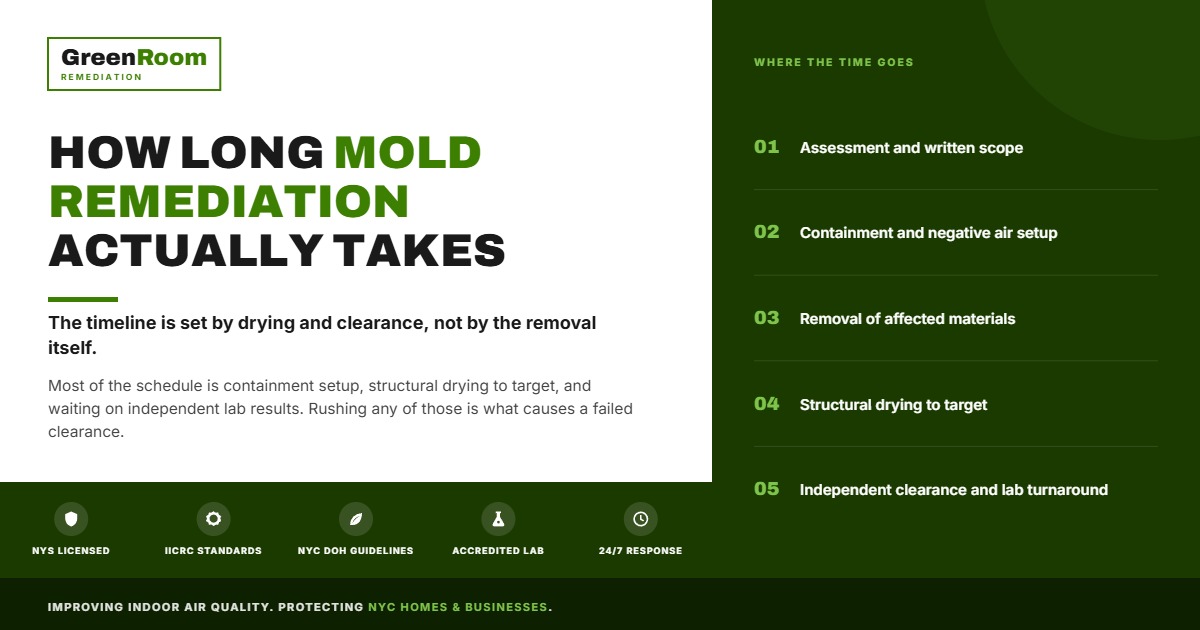
Quick answer: Mold remediation in NYC typically takes 1 to 3 days for small contained projects under 25 square feet, 3 to 7 days for mid-sized projects involving one to two rooms, and 1 to 3 weeks for larger projects requiring structural removal, multi-room containment, or HVAC involvement. Post-remediation clearance testing adds 5 to 7 business days for laboratory results and the written clearance report. Insurance claim processing runs on a parallel timeline and does not necessarily delay remediation start. The most common cause of project delays in NYC is hidden moisture discovered after initial material removal that extends the structural drying phase beyond the original estimate. GreenRoom Remediation provides detailed project timelines at the start of every engagement. Call (917) 965-3754 for an assessment and timeline estimate.
Timeline is one of the first questions property owners ask when mold is confirmed, and the honest answer is that it depends on factors that cannot be fully assessed until a licensed assessor has inspected the property. What can be established before the project starts is a realistic range based on contamination scope, building type, and moisture conditions, along with a clear explanation of what drives timelines in each direction. Understanding those factors helps property owners plan realistically rather than being surprised by extensions that experienced remediation teams anticipate from the start.
What Determines How Long Mold Remediation Takes?
Five factors drive mold remediation timelines in NYC, and each one can extend or compress the schedule depending on the specific project conditions.
The first is contamination scope, measured in square footage of affected material and the number of distinct locations requiring remediation. A single bathroom wall is a fundamentally different project than contamination spanning two rooms, a ceiling assembly, and a shared wall cavity in a Brooklyn brownstone. Scope is established by the licensed mold assessor’s inspection and is the primary basis for timeline estimation.
The second is material type. Mold on non-porous surfaces such as tile, glass, or metal is removed by cleaning and antimicrobial treatment without demolition. Mold in porous materials such as drywall, insulation, wood framing, and subfloor assemblies requires physical removal of those materials, which adds both labor time and the need for structural drying before the project can move to clearance testing. Most NYC mold projects involve some porous material removal because water events that cause mold typically saturate drywall and insulation before the moisture is addressed.
The third is structural drying time. After contaminated materials are removed, the underlying structural components must dry to acceptable moisture content levels before clearance testing and reconstruction can proceed. In NYC’s older building stock, particularly pre-war construction with thick masonry walls and dense framing assemblies, structural drying can take longer than in newer lightweight construction. Drying timelines are measured by daily moisture readings rather than calendar days, and they cannot be accurately estimated before the project begins.
The fourth is building access and scheduling constraints. NYC buildings impose access requirements that directly affect project scheduling. Freight elevator availability, noise restrictions, superintendent access hours, and tenant coordination in multi-unit buildings all affect when work can proceed and at what pace. After-hours and weekend work addresses some of these constraints but adds cost.
The fifth is HVAC involvement. When mold has reached HVAC systems or when remediation in occupied buildings requires HVAC shutdown for containment integrity, coordination with HVAC contractors and building management extends the project timeline. HVAC sanitation and inspection is a separate scope from structural remediation and adds both time and cost to the overall project. For more on HVAC contamination specifically, see our article on indoor air quality testing and duct contamination in NYC properties.
Small Projects: 1 to 3 Days
Small mold remediation projects involving a single contained area under approximately 25 square feet with no structural material removal typically complete in 1 to 3 days. These projects are most common in bathroom tile grout and caulking, small sections of basement wall, isolated bathroom ceiling areas, and under-sink cabinet interiors where moisture from slow plumbing drips has created limited surface mold growth on non-porous or semi-porous surfaces.
For small projects involving any porous material removal, even a single section of drywall, the timeline extends because structural drying must be verified before the opening can be closed. A small bathroom mold project that requires removal of a 2-foot by 4-foot section of drywall may take 3 to 5 days total when drying verification is included, even though the actual remediation work is completed in a few hours. Property owners who receive estimates for small projects without any mention of structural drying time should ask specifically how drying is handled and verified, because skipping drying verification is one of the most common shortcuts that leads to mold recurrence. For more on why mold comes back after inadequate treatment, see our guide on hidden moisture and recurring mold problems in NYC.
Mid-Sized Projects: 3 to 7 Days
Mid-sized projects involving one to two rooms, affected areas between 25 and 100 square feet, or contamination discovered to extend behind walls or under flooring during initial removal typically take 3 to 7 days from remediation start through structural drying verification. These are the most common project size in NYC residential remediation, covering bathroom and adjacent bedroom contamination from leaking plumbing, kitchen ceiling mold from roof leaks or upstairs unit plumbing failures, and basement areas with foundation moisture-related growth.
Mid-sized projects in NYC apartments and co-ops frequently encounter scope extensions during material removal when contamination behind walls is larger than the pre-remediation assessment indicated. This is not a failure of the assessment process. Infrared imaging and moisture meters identify elevated moisture conditions behind walls, but the full extent of mold growth inside wall cavities cannot be confirmed until materials are opened. Scope extensions discovered during remediation are documented by the remediation team, reviewed with the property owner, and incorporated into the insurance claim when applicable. The additional scope also requires the assessor to update the remediation protocol before the extended work proceeds, which adds a coordination step.
Large Projects: 1 to 3 Weeks
Large mold remediation projects involving multiple rooms, structural framing removal, HVAC system involvement, or multi-unit coordination in NYC apartment buildings typically take 1 to 3 weeks from remediation start through drying verification. These projects are most common following significant water damage events including burst pipes that saturated multiple floor assemblies, roof failures that affected multiple units, and basement flooding that affected both below-grade living spaces and adjacent structural components.
Large projects in NYC high-rise buildings face additional timeline pressures from building logistics. Multi-floor projects require careful sequencing to maintain containment integrity across multiple work zones, coordinate with building management for access across multiple units or floors, and manage the volume of contaminated material removal through freight elevator systems that may have restricted hours. Projects in Manhattan commercial buildings with strict after-hours access rules and in Brooklyn co-ops with building management approval requirements for contractor access are consistently the most logistically complex.
The structural drying phase on large projects is particularly variable. Projects involving significant water events in pre-war construction with masonry walls, plaster, and old-growth wood framing may require 10 to 14 days of active drying to reach acceptable moisture levels across all affected assemblies. Daily moisture readings track progress and determine when drying is complete, not a predetermined calendar date.
Clearance Testing: Adding 5 to 7 Business Days
Post-remediation clearance testing adds 5 to 7 business days to the overall project timeline after remediation and structural drying are complete. The clearance inspection itself takes 1 to 2 hours on site. Samples are submitted to an accredited laboratory, and results are typically returned within 3 to 5 business days. The licensed assessor then produces the written clearance report, which is typically delivered within 1 to 2 business days of receiving the lab results.
Clearance testing that produces a failed result, meaning indoor spore counts remain elevated above outdoor baseline levels, requires the remediation contractor to address the identified deficiency and schedule a follow-up clearance test. This adds another round of remediation work plus another 5 to 7 business days for the repeat clearance test. Failed first clearances are not uncommon on larger projects or projects where initial scope definition underestimated the extent of contamination. They are a normal part of a rigorous remediation process rather than a project failure. For a complete breakdown of what clearance testing involves, see our article on post-remediation clearance testing and why insurers require it.
How Does Insurance Claim Processing Fit Into the Timeline?
Insurance claim processing and mold remediation run on parallel rather than sequential timelines when the project is managed correctly. A common misconception is that remediation cannot begin until the insurance adjuster has inspected and approved the scope. This is not accurate under New York insurance law.
Under NY DFS Circular Letter No. 8 (2021), New York insurers must allow policyholders to make immediate protective repairs when necessary for health or safety. This means that containment, moisture extraction, and protective measures can and should begin immediately, before the adjuster arrives, as long as the condition is documented thoroughly before and during the work. GreenRoom Remediation documents all pre-remediation conditions with photographs, moisture readings, and infrared imaging at the start of every project, which satisfies the adjuster’s evidence requirements regardless of when the adjuster inspection occurs.
Under NY Regulation 64 (11 NYCRR 216), insurers must acknowledge claims within 15 business days and issue a settlement or denial within 15 business days of receiving complete documentation. A remediation project that produces complete documentation, including the pre-remediation assessor’s report, daily logs, moisture readings, and clearance testing results, gives the adjuster everything needed to process the claim without additional back-and-forth. Claims with complete documentation consistently resolve faster than claims where documentation must be gathered after the fact. For more on what documentation insurers require, see our guide on whether homeowners insurance covers mold remediation in NYC.
Real Estate Transaction Timelines
Mold discovered during a real estate transaction creates a time-sensitive remediation requirement that does not exist in standard remediation projects. NYC residential transactions typically have closing timelines of 30 to 60 days from contract signing, and mold discovered during the inspection period must be remediated, cleared, and documented before closing for the deal to proceed on schedule.
Small to mid-sized mold projects discovered during due diligence can typically be completed within a standard closing window when remediation begins immediately after the inspection period. Large projects or those involving scope extensions discovered during material removal may require closing extensions, which both parties must agree to contractually. GreenRoom prioritizes real estate transaction projects and provides expedited scheduling and daily status updates to keep buyers, sellers, and their attorneys informed of progress against the closing timeline. For more on how mold intersects with real estate transactions in NYC, see our article on mold disclosure laws for NYC buyers and sellers.
Frequently Asked Questions
Can I stay in my home during mold remediation?
For small contained projects with proper containment barriers in place, occupancy in unaffected areas of the home is often possible. For larger projects or those involving HVAC systems, temporary relocation is typically recommended. The licensed assessor and remediation contractor will advise on occupancy based on the specific project conditions, the health status of occupants, and the containment configuration. Families with young children, elderly members, or individuals with respiratory conditions should discuss occupancy with their physician as well as the remediation team.
Why did my mold remediation take longer than the initial estimate?
The most common reason for timeline extensions is hidden contamination discovered when materials are opened during remediation. Pre-remediation assessments identify moisture conditions and likely contamination zones, but the actual extent of mold growth inside wall cavities and structural assemblies cannot be confirmed until demolition begins. Extended structural drying timelines in older NYC buildings are the second most common cause, particularly in masonry-heavy pre-war construction that retains moisture longer than modern lightweight framing.
How long before I can move back into a remediated space?
Occupancy after remediation depends on clearance testing results rather than calendar time. Once the clearance report confirms that air quality has returned to acceptable baseline levels, the remediated space is safe for occupancy. Reconstruction to close wall openings and restore finishes can begin simultaneously with or after clearance, depending on the project scope and building requirements. GreenRoom provides specific occupancy guidance at the close of every project based on clearance results and project conditions.
Does remediation timeline affect my insurance claim?
Extended remediation timelines can affect business interruption claims for commercial properties, temporary relocation cost claims for displaced residential occupants, and the overall claim settlement timeline. Accurate daily documentation throughout the project, including moisture readings, equipment logs, and progress photographs, provides the adjuster the evidence needed to approve extended timeline costs without dispute. Undocumented timeline extensions are the most common source of insurance disputes on remediation claims.
How long does mold remediation take in a NYC apartment building?
Multi-unit building projects add coordination time to any baseline remediation timeline. Board approval processes in co-ops, super scheduling in rental buildings, and freight elevator access windows all extend practical project timelines beyond what the remediation work itself requires. A 3-day remediation scope in a Manhattan co-op may take 7 to 10 calendar days when building logistics are factored in. GreenRoom accounts for building-specific access requirements in every project estimate for NYC multi-unit properties.
For a project assessment and realistic timeline estimate in Brooklyn, Manhattan, Queens, the Bronx, Staten Island, Long Island, Westchester, or Northern New Jersey, call GreenRoom Remediation at (917) 965-3754. Available 24 hours a day, 7 days a week.
GreenRoom Remediation | NY State Licensed Mold Remediation Contractor (License #24-6S44B-SHMO) | IICRC-Certified | OSHA-Trained | BBB Accredited | Serving NYC, Brooklyn, Queens, Manhattan, the Bronx, Staten Island, Long Island, Westchester, and Surrounding Areas.
view related content