table of contents
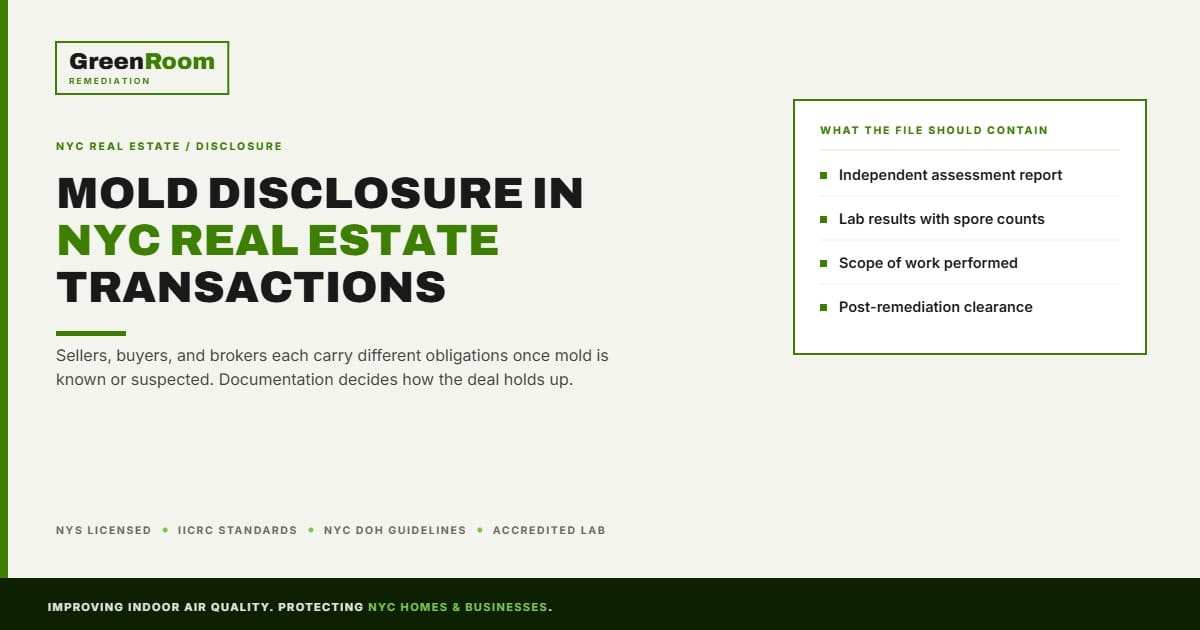
Quick answer: New York requires sellers to disclose known mold history on the Property Condition Disclosure Statement (PCDS) under NY Real Property Law Section 462, as amended effective June 14, 2023. Sellers must also disclose known water damage, flooding, and moisture conditions that could indicate mold. As of March 20, 2024, the PCDS is mandatory — sellers can no longer substitute a $500 credit to the buyer in lieu of completing the disclosure statement. Buyers who discover undisclosed mold after closing may have legal recourse against the seller. Licensed mold testing before listing or before making an offer is the most reliable way to establish the property’s condition before the transaction closes. GreenRoom Remediation provides certified mold inspections and post-remediation clearance testing for real estate transactions across NYC, Long Island, Westchester, and Northern New Jersey. Call us at (917) 965-3754 to schedule.
Mold discovered during a real estate transaction is one of the most disruptive findings a buyer or seller can face. It can kill a deal, delay a closing, reduce a sale price, or generate legal liability that follows a seller long after the property changes hands. Understanding what New York law actually requires, what buyers and sellers should do when mold is found, and how testing and remediation fit into a transaction timeline is what separates a deal that closes cleanly from one that falls apart at inspection.
What Does New York Law Require Sellers to Disclose About Mold?
New York State does not have a specific mold disclosure statute that requires sellers to affirmatively test for mold or certify that a property is mold-free. However, the New York Property Condition Disclosure Act (PCDA), codified at NY Real Property Law Section 462, requires sellers of residential real property to complete a Property Condition Disclosure Statement that addresses conditions relevant to mold growth.
The PCDA disclosure statement asks sellers directly about water intrusion, flooding, drainage problems, and material defects in the property. A seller who knows about prior water damage, recurring moisture problems, or past mold issues and fails to disclose them on the PCDA creates legal exposure for misrepresentation or fraudulent concealment. Courts in New York have awarded damages to buyers who proved that sellers had actual knowledge of conditions they failed to disclose, even when the mold itself was not visible at the time of sale.
Prior to March 20, 2024, sellers could substitute a $500 credit to the buyer in lieu of completing the PCDA, bypassing the statutory disclosure requirement. That option was eliminated by amendment to RPL §462 effective March 20, 2024. Sellers are now required to complete and deliver the PCDS before the buyer signs a contract of sale, and cannot opt out with a credit. Sellers still do not avoid common law fraud liability for active concealment of known material defects regardless of PCDA compliance.
Co-op and condo transactions in NYC involve additional disclosure dimensions. The co-op’s proprietary lease and building financials may reveal prior water damage assessments or building-wide remediation expenses. Condo offering plans and board minutes may contain references to moisture or mold conditions affecting common elements. Buyers’ attorneys conducting due diligence on NYC co-ops and condos should request these documents specifically.
What Should Buyers Do When They Suspect Mold Before Closing?
Buyers who notice musty odors, visible staining, water damage evidence, or any indicator of moisture problems during a property showing or home inspection should request a certified mold inspection before proceeding to closing. A standard home inspection provides a general assessment of property condition but does not include the air sampling, surface testing, or moisture mapping that a licensed mold assessor performs.
Ordering a certified mold inspection during the due diligence period gives buyers three things: an objective assessment of current conditions, a baseline document that establishes the property’s mold status before the transfer, and negotiating leverage if contamination is found. A mold inspection that returns clean results is also useful to the buyer as documentation that the property was tested and cleared before purchase.
When mold is confirmed by testing, buyers in New York typically have several options depending on the purchase contract language and the stage of the transaction. They may negotiate a price reduction that accounts for the cost of remediation, require the seller to complete licensed remediation and produce clearance testing results before closing, or in some cases, exercise a right to terminate the contract if a material defect clause applies. Real estate attorneys in New York routinely include inspection contingencies that allow buyers to address mold findings without forfeiting their deposit.
What Should Sellers Do When Mold Is Found Before Listing?
Sellers who discover mold before listing have a straightforward strategic choice: remediate before listing and document the remediation with clearance testing, or disclose the condition and price the property accordingly. From a legal and financial standpoint, remediating before listing is almost always the better outcome.
A property listed with known mold and a price reduction will attract buyers who demand additional discounts at inspection, factor remediation uncertainty into their offers, and often walk away when the remediation scope turns out larger than the initial estimate suggested. A property where licensed remediation has been completed and independently cleared with a certified assessor’s clearance report commands a stronger negotiating position because the condition has been resolved and documented.
In Brooklyn brownstones, Queens multifamily properties, Manhattan co-op units, and Staten Island single-family homes, pre-listing mold remediation followed by clearance testing has become an increasingly common seller strategy because buyers and their attorneys are more sophisticated about mold liability than they were a decade ago. The $499 clearance test cost is minimal relative to the negotiating leverage it provides at the table. For more on what the clearance testing process involves, see our article on post-remediation clearance testing and why insurers require it.
How Mold Testing Fits Into the Real Estate Transaction Timeline
Real estate transaction timelines in NYC are tight, and mold testing and remediation need to be sequenced correctly to avoid closing delays.
For Buyers: The Due Diligence Window
Buyers should order a certified mold inspection immediately after the home inspection, within the same due diligence window. The standard $499 inspection includes air sampling, surface testing where warranted, and a written report. Laboratory results return within 3 to 5 business days. If the results require negotiation with the seller, that conversation needs to happen before the inspection contingency deadline. Buyers who wait until the end of the due diligence window to schedule mold testing frequently find that lab results arrive after their contingency has expired.
For Sellers: The Pre-Listing Window
Sellers planning to list should order a mold inspection 4 to 6 weeks before their target listing date if they have any reason to suspect moisture or contamination issues. This provides enough time to receive the assessment results, complete any necessary remediation, schedule clearance testing, receive the clearance report, and have all documentation in hand before the first showing. A clean mold inspection report or a post-remediation clearance report can be provided to serious buyers as part of the disclosure package, which reduces the likelihood of mold becoming a negotiating issue after the property goes into contract.
When Mold Is Found Mid-Transaction
When mold is discovered during the inspection period on a property already in contract, timeline pressure increases significantly. Licensed mold remediation in NYC typically takes 1 to 7 days depending on the scope, with clearance testing adding another 5 to 7 business days for the lab results and written report. On a standard NYC transaction with a 30 to 45 day closing timeline, a mid-inspection mold discovery requires immediate action to avoid a closing extension. GreenRoom Remediation prioritizes real estate transaction projects specifically because we understand that delays have direct financial consequences for all parties in a NYC transaction.
Does Mold Affect Property Value in NYC?
The financial impact of a mold finding on a real estate transaction depends on three factors: the scope of the contamination, whether remediation has been completed and cleared, and how the condition is disclosed and positioned in the negotiation.
Unresolved mold of any size discovered at inspection typically results in buyer requests for price reductions that exceed the actual remediation cost, because buyers factor in uncertainty, inconvenience, and the possibility that the visible contamination indicates a larger hidden problem. A small bathroom mold issue that would cost $2,000 to $3,000 to remediate properly often generates buyer demands for $5,000 to $10,000 in price reductions because the buyer cannot independently verify scope without their own assessment.
Resolved mold where the seller can produce a licensed assessor’s inspection report, a licensed remediation contractor’s completion documentation, and an independent clearance testing report typically has minimal impact on transaction value. The documentation demonstrates that a professional process was followed, that the outcome was independently verified, and that there is no ongoing condition. Buyers and their attorneys who review a complete remediation and clearance package rarely push for significant price adjustments on a condition that has been fully resolved and documented. For more on what a complete remediation documentation package includes, see our guide on why professional mold remediation costs what it does.
Mold in NYC Co-ops and Condos: Additional Considerations
Co-op and condo transactions in NYC involve additional mold-related considerations that do not apply to standalone home sales.
In a co-op transaction, the co-op board’s approval process provides an additional layer of disclosure. Board packages typically include financial disclosures, and a unit that has had significant mold remediation work may reflect that in assessment history or building maintenance records that the board has access to. Buyers’ attorneys should request a copy of all board meeting minutes for the prior 2 to 3 years as part of co-op due diligence, as these minutes often contain references to water damage events, remediation projects, and HPD violations that may not appear in the seller’s disclosure.
In a condo transaction, the distinction between common element coverage and unit coverage discussed in our guide on insurance claims for mold in NYC co-ops, condos, and rentals matters to buyers because it determines who is financially responsible for future mold events originating from building systems versus unit conditions. A buyer who purchases a condo unit with a history of water intrusion from a common element should understand that future similar events may involve the association’s insurance before their own HO-6 policy.
Frequently Asked Questions
Is mold testing required to buy or sell a home in NYC?
No. There is no legal requirement in New York State that mold testing be performed before a real estate transaction. However, it is strongly advisable when there is any history of water damage, musty odors, visible staining, or prior remediation work. Buyers who discover mold after closing without adequate disclosure may have legal recourse against the seller under New York common law fraud and misrepresentation standards.
Who pays for mold testing in a real estate transaction?
Buyers typically pay for mold testing ordered as part of their due diligence, just as they pay for the home inspection. Sellers who order pre-listing mold testing pay for it directly. When mold is found and the seller agrees to remediate as a condition of closing, the remediation and clearance testing costs are typically negotiated as part of the transaction, often paid by the seller or credited to the buyer at closing.
How long does mold remediation take in a real estate transaction context?
Small to mid-size mold remediation projects in NYC typically take 1 to 5 business days for the actual remediation work. Clearance testing adds another 5 to 7 business days for the site visit, lab analysis, and written report. A buyer or seller who needs remediation and clearance completed within a standard 30-day closing window should initiate the process within the first 7 to 10 days of the inspection period to avoid a closing extension request.
What is the NY Property Condition Disclosure Act?
The New York Property Condition Disclosure Act (NY Real Property Law Section 462) requires sellers of residential real property to complete and deliver a written disclosure statement covering known material defects including water intrusion, flooding, drainage problems, and other conditions relevant to mold growth. Sellers who choose to provide a $500 credit in lieu of the disclosure avoid the statutory form requirement but do not eliminate common law liability for active concealment of known material defects.
Can a seller be held liable for mold discovered after closing?
Potentially yes, if the seller had actual knowledge of the mold condition or the moisture conditions that caused it and failed to disclose that knowledge on the Property Condition Disclosure Statement or through other representations made during the transaction. The buyer would need to establish that the seller knew about the condition, that the condition was material to the transaction, and that the non-disclosure caused the buyer’s damages. These cases are fact-specific and require consultation with a real estate attorney familiar with New York property law.
Does homeowners insurance cover mold found during a real estate inspection?
Mold found during a real estate inspection is typically not directly covered by insurance because coverage requires a triggering event such as a burst pipe or appliance overflow that occurred during the policy period. Mold discovered at inspection without a documented covered cause of loss is generally treated as a property condition issue rather than an insured loss. For a full breakdown of what homeowners insurance covers for mold, see our guide on whether homeowners insurance covers mold remediation in NYC.
To schedule a certified mold inspection for a real estate transaction in Brooklyn, Manhattan, Queens, the Bronx, Staten Island, Long Island, Westchester, or Northern New Jersey, call GreenRoom Remediation at (917) 965-3754. We prioritize real estate transaction timelines and can typically schedule within 24 to 48 hours.
GreenRoom Remediation | NY State Licensed Mold Remediation Contractor (License #24-6S44B-SHMO) | IICRC-Certified | OSHA-Trained | BBB Accredited | Serving NYC, Brooklyn, Queens, Manhattan, the Bronx, Staten Island, Long Island, Westchester, and Surrounding Areas.
view related content