table of contents
Quick answer: The most useful questions to ask a NYC mold company are about licensing, independence, and documentation, not price. Ask which New York State Article 32 license they hold, who is performing the assessment and clearance if they are doing the removal, whether the quote is based on a written assessment protocol or a visual guess, and what documentation you will hold when the job closes. A company that answers those four clearly is usually worth hiring. GreenRoom Remediation serves all five boroughs, Long Island, Westchester, and Northern New Jersey. Call (917) 965-3754 to talk through a specific property.
Why Comparing Quotes Alone Tells You Almost Nothing
Three mold quotes on the same property can differ by thousands of dollars and all be honest. One assumes surface cleaning of visible growth. Another assumes opening the wall cavity to find the moisture source. A third includes structural drying and independent clearance testing. Unless the scope behind each number is defined the same way, you are not comparing anything.
This is why the lowest quote is so often the most expensive outcome. Work priced against a visual glance frequently discovers more contamination once materials come off, at which point the scope changes and so does the price. We cover the underlying economics in more detail in our piece on why professional mold remediation costs what it does.
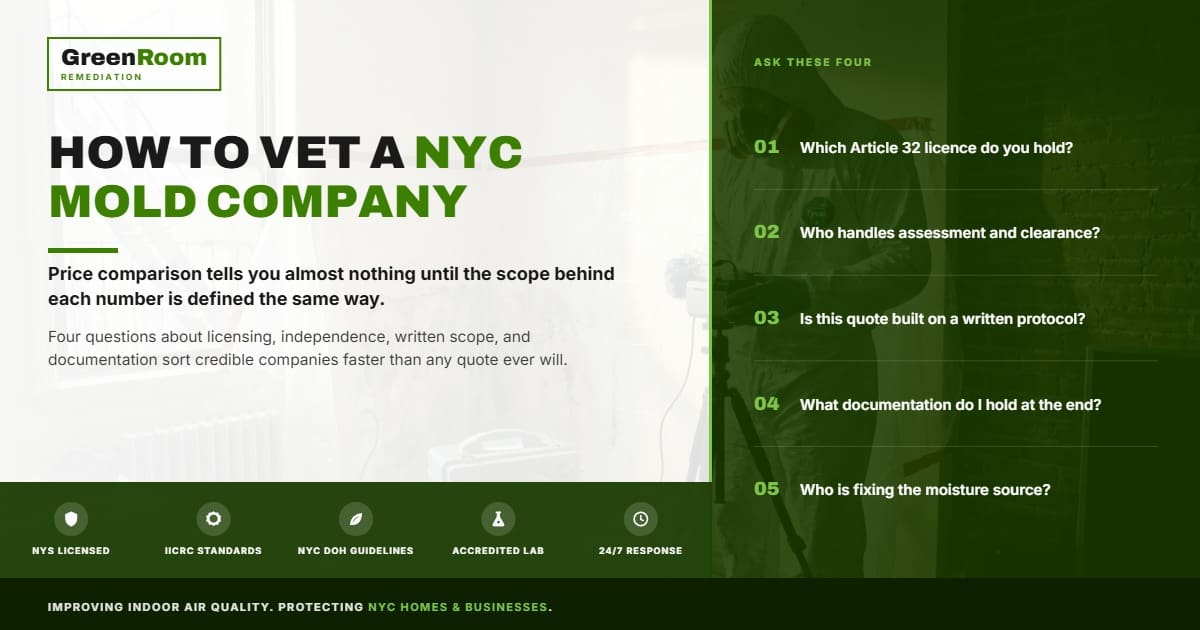
The questions below sort companies faster than any price comparison, because they test whether a defined scope exists at all.
Question One: Which Article 32 Licence Do You Hold?
New York State licenses mold assessors and mold remediation contractors separately under Labor Law Article 32. A competent company will answer this immediately and without hedging, because it is the basic legal framework they operate inside every day.
The answer also tells you where the conversation should go next. If they hold a remediation contractor license, they need an independent assessor’s protocol before they can scope your job properly. If they hold an assessor license, they will be producing that protocol and you will take it to a contractor. Vagueness here, or an answer along the lines of being fully licensed and certified without naming which license, is the single strongest signal to keep calling.
Question Two: Who Is Doing the Assessment and the Clearance?
If the company quoting your removal also proposes to test beforehand and certify afterwards, that arrangement is not permitted on the same project under Article 32. The separation exists specifically so that nobody grades their own work.
Some companies hold both licenses, which is legal and often convenient, but they must apply only one of them to your project. Ask directly which half they are doing and who is doing the other. A straight answer sounds like naming the independent party, or explaining that you are free to take the protocol to any licensed contractor you choose.
Question Three: Is This Quote Based on a Written Protocol?
A remediation quote should trace back to a document produced during a proper mold inspection: an assessor’s report that states where the contamination is, how far it extends, what the moisture source is, and what scope of work is required. Without that, the contractor is pricing a guess.
Ask to see the protocol the quote is built on. If one does not exist yet, that is not disqualifying, but it does mean the number you have been given is provisional and should be treated as such. The honest version of this conversation is a company telling you the price will firm up after assessment, not one presenting a guess as a fixed figure.
Question Four: What Documentation Do I Hold at the End?
This question matters more than most property owners realize at the time and more than anything else eighteen months later, when an insurer, a buyer’s attorney, a co-op board, or HPD asks for proof.
A complete file contains the assessment report with lab results, the written remediation protocol, the contractor’s scope and completion record, and an independent clearance report. If clearance is not mentioned, ask why. Post-remediation clearance testing is what converts finished work into provable work.
Signals Worth Noticing
- A quote given over the phone without anyone seeing the property, on a job larger than a small isolated patch.
- Pressure to sign the same day, or a discount that expires within hours.
- Reluctance to name the independent assessor or contractor handling the other half of the project.
- Mold removal quoted with no reference to finding or fixing the moisture source. Mold that is removed without correcting the water problem returns, as we explain in hidden moisture and recurring mold.
- Claims that a chemical treatment or fogging alone will resolve contamination without physical removal of affected materials.
- No mention of containment or negative air on a job large enough to require it.
None of these individually proves bad faith. Several together usually means the company is selling a product rather than scoping a problem.
Frequently Asked Questions
Should I always get three quotes?
Get more than one, but make them comparable. The productive approach is to obtain an independent assessment first, then take that single written protocol to two or three licensed remediation contractors. They are then all pricing identical scope, and the comparison becomes meaningful.
Is a cheaper company necessarily cutting corners?
Not necessarily. Overheads, crew size, and scheduling all legitimately affect price. What matters is whether the cheaper quote covers the same scope, includes containment and drying where required, and ends in independent clearance. A lower number for identical documented scope is a better deal. A lower number for undefined scope is not a number at all.
How do I verify a license?
New York State Department of Labor maintains the licensing records for mold assessors, remediation contractors, and abatement workers. Ask for the license number and check it rather than accepting a logo on a website. Certification from a body such as the IICRC is a useful additional signal of training standards, but it is separate from and does not substitute for the state license.
If you want an independent read on a property before committing to any scope of work, GreenRoom Remediation performs licensed assessment across NYC, Long Island, Westchester, and Northern New Jersey. Call (917) 965-3754.
GreenRoom Remediation | NY State Licensed Mold Remediation Contractor (License #24-6S44B-SHMO) | IICRC-Certified | OSHA-Trained | BBB Accredited | Serving NYC, Brooklyn, Queens, Manhattan, the Bronx, Staten Island, Long Island, Westchester, and Surrounding Areas.
view related content