table of contents
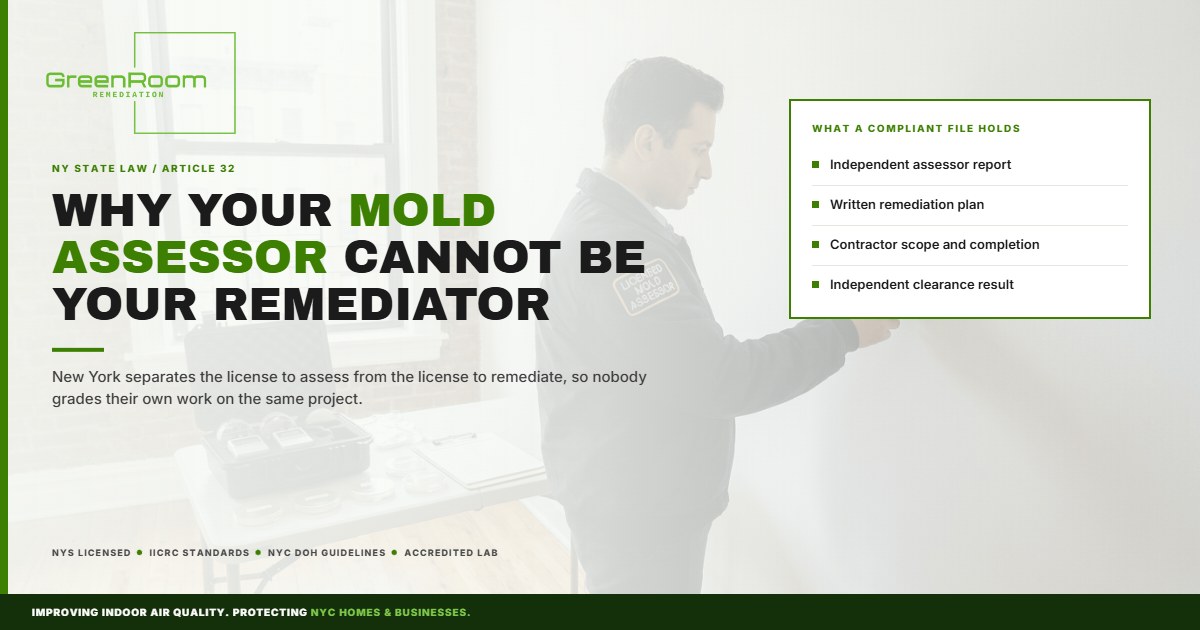
Quick answer: New York State Labor Law Article 32 requires that mold assessment and mold remediation on the same project be performed by separately licensed parties. The company that tests your property cannot also remove the mold it found, and the company that removes it cannot certify its own work. State licensing rules and NYC building requirements are related but distinct. The state’s definition of a mold project includes areas greater than ten square feet, with statutory exemptions. NYC adds requirements for covered buildings; the state program is not limited to buildings with ten or more units. GreenRoom Remediation holds both licenses and keeps them strictly separated, never performing assessment and remediation on the same job. Call (917) 965-3754 to arrange an independent assessment.
The Conflict of Interest the Law Was Written to Remove
Before 2016, a single company could inspect your property, tell you how much mold it found, quote you to remove it, and then confirm its own work had succeeded. Every financial incentive in that arrangement pushed one direction. A larger reported problem meant a larger job, and the same firm that stood to profit was the only party verifying whether the problem was real or whether it had been solved.
New York State Labor Law Article 32 took effect on January 1, 2016 and ended that structure. Administered by the New York State Department of Labor, it created three separate licenses: mold assessor, mold remediation contractor, and mold abatement worker. The central provision is separation. On any given project, the licensed assessor and the licensed remediator must be different entities.
This is not a technicality that only affects paperwork. It changes who you should be calling first, what a legitimate quote looks like, and what documentation you should expect to hold at the end.
What Triggers the Requirement
The licensing requirement attaches to projects involving more than ten square feet of visible mold. Ten square feet is roughly a patch a little over three feet by three feet, the same threshold we use in our guide to when DIY mold removal is safe. The threshold is part of the legal project definition, not proof that smaller growth is harmless or that other property-maintenance duties disappear. Check the NYS Department of Labor mold FAQ for definitions and exemptions.
There is also a real exemption for property owners performing the work themselves on their own property. An owner handling a problem in their own house is not required to hire licensed parties. New York City then layers its own rule on top through Administrative Code section 24-154, which reaches buildings with ten or more dwelling units and lots carrying 25,000 square feet or more of non-residential floor area. For qualifying projects in these covered buildings, review the NYC DEP mold-abatement requirements, including required filings.
Where people most often get caught out is scope creep. A job that looked like four square feet of surface growth becomes forty once the drywall comes off. At that point the project has crossed the threshold and the licensing rules apply, regardless of what anyone estimated at the start.
What Separation Looks Like in Practice
A compliant project runs in a fixed sequence. An independent licensed assessor inspects the property, identifies the moisture source, determines whether sampling is useful, as we explain in what happens during a mold inspection, and produces a written remediation protocol that defines the scope of work. That protocol is the specification. A licensed remediation contractor then works to it.
The assessor is not guessing at what the contractor will charge, and the contractor is not deciding how much contamination exists. When the removal is complete, an independent assessor returns to perform post-remediation assessment and checks the applicable completion criteria. If it fails, the contractor goes back in.
That last step is the one that protects you most. Clearance testing performed by the same company that did the removal is a self-graded exam. Ask your insurer which documents it requires; coverage and claim decisions depend on the policy and circumstances.
Holding Both Licences Is Legal. Using Both on One Job Is Not.
A point that confuses a lot of property owners: a company is permitted to hold both an assessor license and a remediation contractor license. What it cannot do is apply both to the same project. GreenRoom Remediation is licensed for both and performs them independently, never both on the same mold project.
In practice that means if we assess your property and find contamination, we hand you a protocol and you are free to take it to any licensed remediation contractor you choose. If we perform remediation, the assessment and the clearance were done by someone else. Either way you end up with two independent sets of eyes, which is exactly what the statute intends.
If a company offers to inspect and remediate as a single package on one project, that is not a convenience. It is a signal to ask which license they are operating under and who is performing the other half.
The Documentation You Should End Up Holding
Keep the assessor’s report and remediation plan, the contractor’s agreed scope and completion records, and the independent post-remediation assessment. Include lab results if sampling was performed. Air sampling is not automatically required for every project; ask the assessor which criteria and methods apply. These documents can support later review, but acceptance by an insurer, agency or buyer is not guaranteed.
Reading those lab numbers is its own skill, and we cover it in detail in our guide on how to read a mold lab report. What matters here is that the assessment and clearance carry a different license number from the remediation. If they carry the same one, the file has a problem.
Frequently Asked Questions
Does Article 32 apply to my own house?
If you own the property and perform the work yourself, the state licensing requirement does not attach to you. For hired work, check the applicable project definition and licensing requirements with NYS DOL; do not assume an owner exemption covers a contractor. Separately, New York City requires licensed and independent parties in buildings of ten or more units once mold exceeds ten square feet, and landlords carry a wider set of duties covered in our guide to NYC landlord mold obligations.
Can the same company test and remove mold if I sign a waiver?
No. The separation is a statutory licensing requirement, not a contractual protection that a client can waive. A waiver does not make a non-compliant project compliant, and it will not help you if an insurer or a regulator later reviews the file.
What happens if work was done without licensed parties?
Gather the scope, invoices, photographs and any assessment or completion reports. Ask NYS DOL about licensing compliance and an independent licensed assessor about the property’s current condition. Missing paperwork does not, by itself, establish the quality of the work or determine an insurance, sale or enforcement outcome.
Related service: water damage restoration in NYC.
If you are unsure whether a past project met the requirement, or you want an independent assessment before committing to any scope of work, GreenRoom Remediation performs licensed mold assessment across Brooklyn, Manhattan, Queens, the Bronx and Staten Island. Call (917) 965-3754 to book an inspection.
GreenRoom Remediation | NY State Licensed Mold Remediation Contractor (License #24-6S44B-SHMO) | IICRC-Certified | OSHA-Trained | BBB Accredited | Serving NYC, Brooklyn, Queens, Manhattan, the Bronx, Staten Island, Long Island, Westchester, and Surrounding Areas.
view related content