table of contents
Quick answer: NYC landlords of multiple dwellings carry an affirmative duty to address indoor mold, not merely to respond when a tenant complains. Under the Asthma Free Housing Act, owners must inspect units annually for indoor allergen hazards including mold, remediate what they find using safe work practices, and keep records. HPD issues violations by class with correction deadlines of 21 to 90 days, and in buildings with ten or more units any mold over ten square feet must be handled by a licensed assessor and a separately licensed remediator. GreenRoom Remediation works with owners and managing agents across NYC, Long Island, Westchester, and Northern New Jersey. Call (917) 965-3754.
The Duty Is Affirmative, Not Reactive
The most common and most expensive misunderstanding among smaller owners is treating mold as a complaint-driven issue. The framework in NYC does not work that way for multiple dwellings.
Buildings with shared systems complicate this further, as we cover in mold remediation for multi-unit properties. The Asthma Free Housing Act, Local Law 55 of 2018, requires owners of multiple dwellings to inspect dwelling units annually for indoor allergen hazards, mold among them, and to remediate conditions found. Two further duties are frequently overlooked. A vacant unit must be thoroughly cleaned and free of mold before a new tenant moves in, and the owner must supply the Health Department indoor allergen fact sheet together with a notice of the owner’s responsibilities alongside every lease.
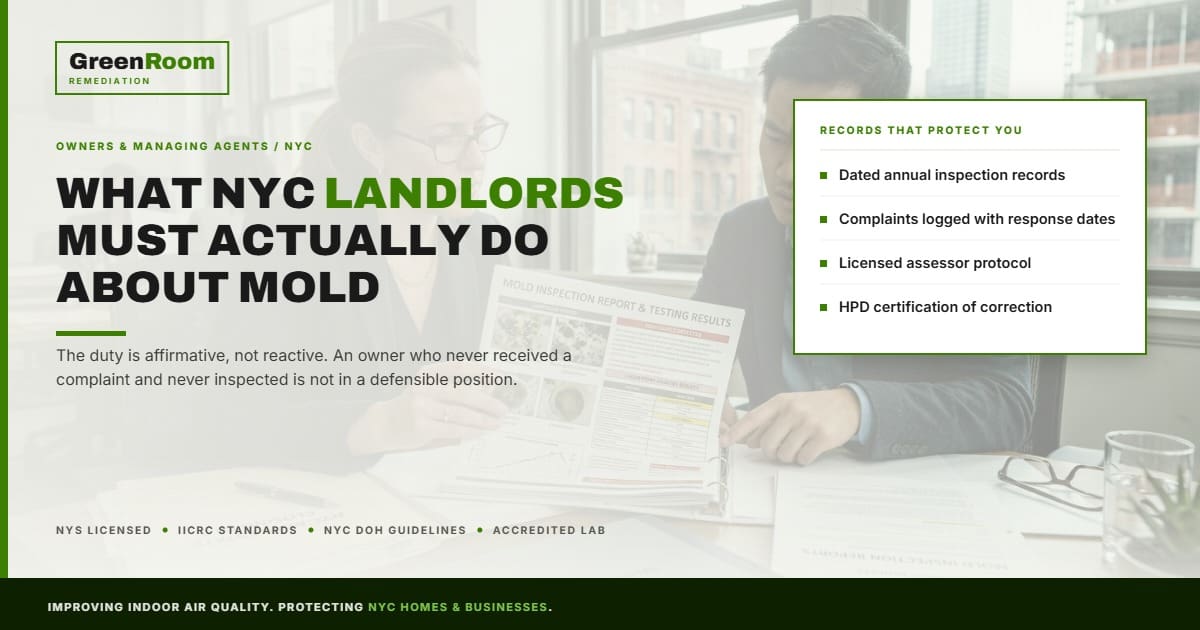
Practically, that means an owner who never received a complaint and never inspected is not in a defensible position. The absence of a complaint is not evidence of compliance, and in a dispute the records are what count. Owners who inspect on a schedule and document what they found and what they did are in a substantially stronger position than owners who can only point to a quiet inbox.
Safe Work Practices Are Part of the Requirement
The law does not only require that mold be dealt with. It requires that the work be done in a way that does not create a new hazard for occupants.
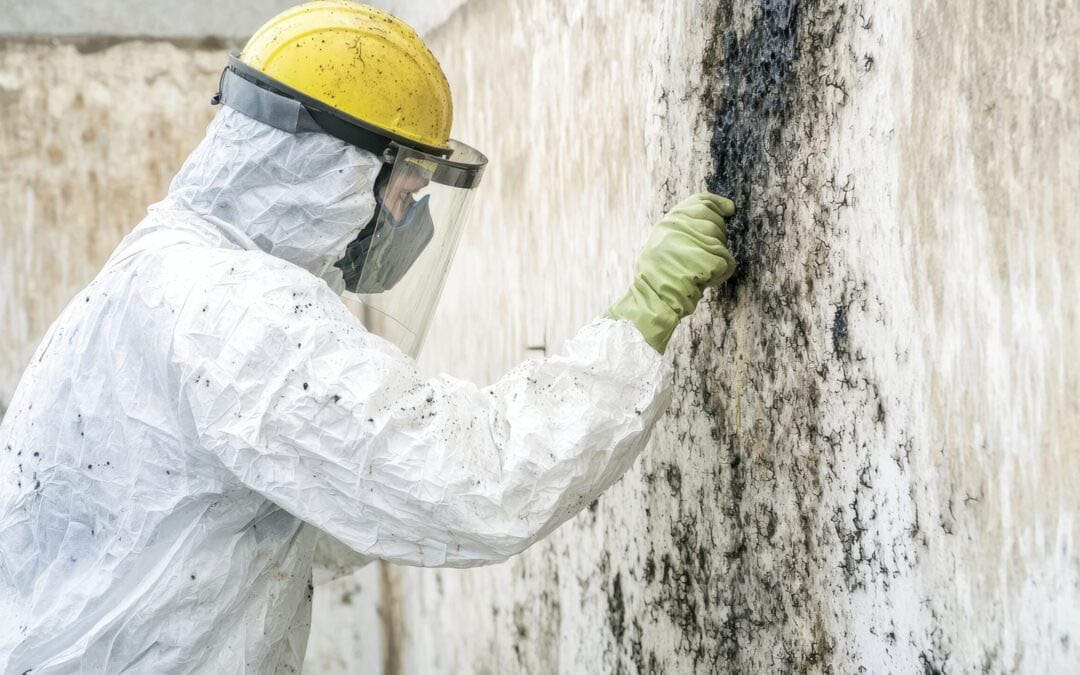
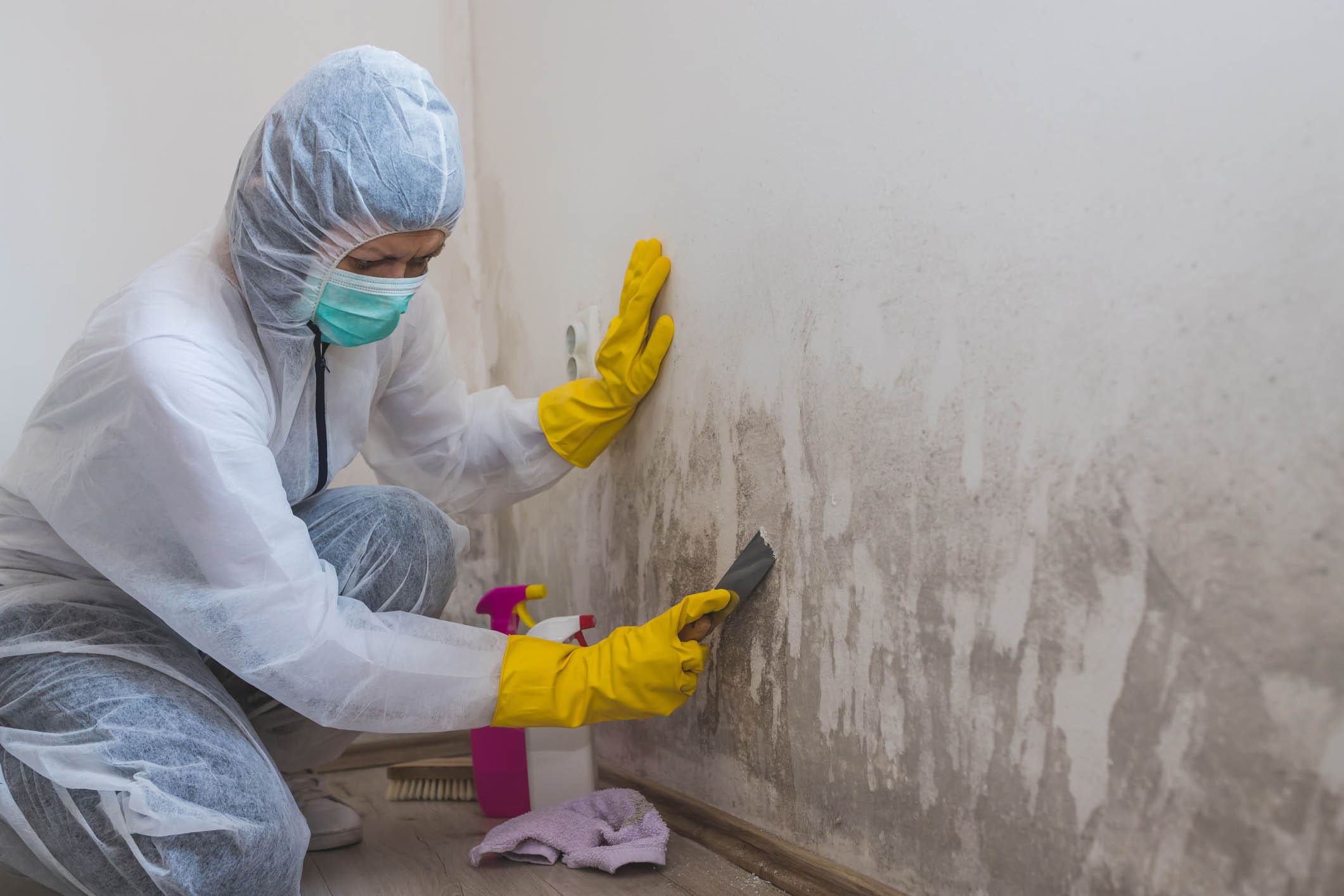
That means containment of the work area, methods that avoid dispersing spores and dust, correcting the underlying moisture rather than cleaning the surface, and cleanup that removes rather than redistributes contamination. Dry sanding or dry scraping of contaminated surfaces is exactly the kind of practice the safe work standard exists to prevent.
Sending a handyman with bleach and a scraper into an occupied unit fails on both limbs. It usually does not resolve the condition, and the method itself can be the violation.
Where Article 32 Licensing Bites
This is the point most often got wrong, in both directions. The Article 32 exemption covers a residential property owner performing the work on their own property, which is broader than many owners assume. What narrows it in New York City is the unit count, not the presence of a tenant.
For residential properties with ten or more units, HPD requires the owner to engage a New York State licensed mold assessor and a licensed mold remediator, entirely independent of one another, whenever there is more than ten square feet of mold. Below ten units the owner is not obliged to bring in licensed professionals at all, though the safe work practice standard still governs how the work is done. Our explainer on Article 32 and the assessor-remediator separation covers the mechanics.
So the practical question for an owner is the size of the building first and the size of the patch second. In a twelve unit building, thirty square feet of mold means two independent licensed firms. In a six unit building the same condition can be handled in house, provided safe work practices are followed, as covered in our guide to DIY mold removal. Either way the documentation is what allows the owner to demonstrate the work was done properly.
HPD Violations and Certification of Correction
When HPD inspects and finds mold, it issues a violation classed by the affected area. Under ten square feet in a room is Class A with 90 days to correct. Ten to twenty-nine square feet is Class B with 30 days. Thirty square feet or more is Class C with 21 days. The owner must correct the condition and then certify the correction to HPD within the required period. Failing to certify carries penalties independent of whether the physical work was done.
This is where owners most often lose money on an otherwise manageable problem. The remediation gets completed, nobody files the certification, and the violation stays open on the building record where it surfaces during refinancing or sale. We cover the process in detail in how to clear an HPD mold violation.
Certification also needs to be truthful. A falsely certified violation is upgraded a class automatically, as is one that is still present when HPD re-inspects within 70 days of the certification period. Cosmetically covering a condition therefore converts a Class A into a Class B, and a Class B into a Class C, which is a materially worse exposure than the original violation.
Documentation That Protects the Owner
Whether the counterparty is HPD, an insurer, a tenant’s attorney, or a lender in diligence, the owner is asked the same question: what did you know, and what did you do about it.
- Dated annual inspection records for each unit, including units where nothing was found.
- Tenant complaints logged with the date received and the date responded to.
- The licensed assessor’s report and written remediation protocol for any substantial project.
- The remediation contractor’s scope and completion record, with license numbers.
- Independent clearance testing confirming the work passed.
- Records of the moisture source repair, which is what demonstrates the condition was resolved rather than cleaned.
- HPD certification of correction filings, with confirmation of receipt.
Tenants have a parallel set of rights and their own documentation path, which we set out in our tenant guide to mold in NYC rentals. Owners benefit from understanding that side, because a well-documented tenant is the scenario where owner records matter most.
Frequently Asked Questions
Does this apply to a two-family house I rent out?
HPD applies Local Law 55 to buildings with three or more apartments, so a two-family generally sits outside that regime, while the warranty of habitability and other Housing Maintenance Code duties still apply. The Article 32 licensing mandate in New York City is keyed to buildings of ten or more units. Because these thresholds interact and some guidance reads the coverage of one and two family rentals differently, confirm the position for a specific property with counsel rather than assuming.
The tenant caused the moisture. Am I still responsible?
Tenant conduct such as blocking ventilation or chronic overwatering of plants can be relevant to who ultimately bears cost, but it does not remove the owner’s obligation to address a hazardous condition in the unit. The practical sequence is to remediate first and resolve the cost question separately. Refusing to act pending a dispute over cause is how owners accumulate violations.
Can my superintendent handle mold remediation?
It depends on the building. In a property with fewer than ten units, the owner or the owner’s representative may perform the removal at any size, so long as safe work practices are followed. In a building with ten or more units, anything over ten square feet must go to a licensed assessor and a separately licensed remediator. The safe work practice standard applies in every case, so training and method matter regardless of who does the work.
For annual inspection program, violation response, or an independent assessment on a specific unit, GreenRoom Remediation works with owners and managing agents throughout the city. Call (917) 965-3754.
GreenRoom Remediation | NY State Licensed Mold Remediation Contractor (License #24-6S44B-SHMO) | IICRC-Certified | OSHA-Trained | BBB Accredited | Serving NYC, Brooklyn, Queens, Manhattan, the Bronx, Staten Island, Long Island, Westchester, and Surrounding Areas.
view related content