table of contents
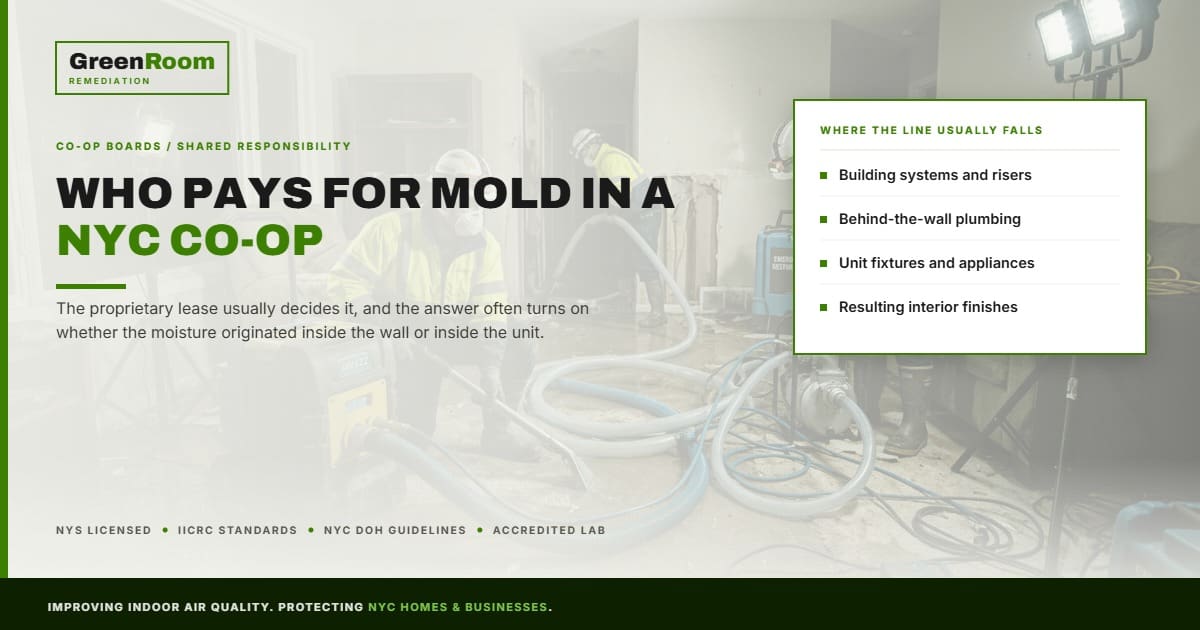
Quick answer: In a NYC co-op, mold responsibility follows the same general principle as maintenance responsibility under the proprietary lease: if the mold source is a building system or common element, the co-op corporation is responsible for remediation; if the source is within the shareholder’s unit, the shareholder bears responsibility. The complication is that many mold situations involve sources in the gray zone between building and unit responsibility, proprietary leases vary in how they define this boundary, and the applicable insurance policies may determine who actually pays regardless of where legal responsibility falls. GreenRoom Remediation has extensive experience coordinating mold assessment and remediation in NYC co-op buildings and working directly with co-op boards, managing agents, and insurance adjusters. Call (917) 965-3754 for an assessment.
Co-op mold disputes are among the most procedurally complex mold situations in NYC real estate because they involve multiple parties with overlapping and sometimes conflicting interests: the shareholder, the co-op corporation, the building’s underlying master insurance policy, the shareholder’s HO-6 policy, and in rental-within-co-op situations, potentially a tenant as well. Understanding how responsibility is allocated requires reading the proprietary lease carefully, understanding which insurance policy responds to the underlying water event, and knowing what remediation standards the co-op’s board expects before it will approve reconstruction work in the affected unit.
The Proprietary Lease Controls Initial Responsibility Allocation
The proprietary lease is the foundational document for mold responsibility in any NYC co-op. Most proprietary leases follow a general structure in which the co-op corporation is responsible for maintaining the building’s structure, common elements, and building-wide systems including plumbing risers, steam or hot water heating systems, electrical systems serving common areas, and building envelope components. The shareholder is responsible for maintaining the interior of the unit including individual unit plumbing branches, appliances, interior finishes, and any systems that serve only that unit.
When mold develops from a building system failure, the analysis is relatively straightforward. A leaking riser pipe in the wall shared between two units, a roof failure that allows water into the top-floor unit, or a failed building boiler that saturates a wall are all building system issues for which the co-op corporation bears remediation responsibility. When mold develops from a condition within the shareholder’s unit, including a shareholder’s own plumbing fixture failure, an improperly sealed shower, or inadequate ventilation in the shareholder’s bathroom, the shareholder’s HO-6 policy is the first line of coverage. The shareholder is also responsible for any mold that migrates from their unit into adjacent units or common elements, which creates significant liability exposure for shareholders who delay addressing mold conditions in their own units.
Gray Zone Situations That Generate Co-op Disputes
Most co-op mold disputes arise in situations where the source is not clearly a building system or a unit condition. Condensation-related mold on exterior walls is a persistently contested situation. Moisture that condenses on the interior surface of exterior walls in cold weather can originate from inadequate wall insulation (a building responsibility), from the shareholder’s interior humidity management (a unit responsibility), or from some combination of both.
Mold from a neighbor’s unit water event is another common dispute source. When the unit above has a plumbing failure that sends water into the unit below and generates mold, responsibility depends on whether the upstairs shareholder’s failure was negligent and whether the co-op’s building systems were a contributing factor. For more on how insurance allocation works across co-op units, see our guide on insurance claims for mold in NYC co-ops, condos, and rentals.
HVAC system mold is particularly complex in co-op buildings with central or semi-central HVAC systems. Fan coil units that serve individual apartments may be building responsibility in some co-ops and shareholder responsibility in others. The proprietary lease and the co-op’s house rules together define this boundary. For more on HVAC mold issues, see our article on indoor air quality testing and duct contamination in NYC properties.
What the Co-op Board Can and Cannot Do
Co-op boards have authority under the proprietary lease and corporate bylaws to enforce maintenance and repair obligations, access units for inspection and emergency repairs, and require shareholders to address conditions that affect other units or common elements. What co-op boards cannot do is require shareholders to use specific unlicensed contractors for mold remediation, waive the Article 32 licensing requirements that apply to any significant mold project, or treat a managing agent’s or superintendent’s self-assessment as a substitute for a licensed mold assessor’s inspection. NY State Labor Law Article 32 applies to mold remediation in co-op buildings exactly as it does to any other residential property, and remediation projects of 10 square feet or more require licensed contractors regardless of building management preferences.
How GreenRoom Coordinates With Co-op Boards
GreenRoom Remediation works directly with co-op boards, managing agents, and shareholders on mold assessment and remediation projects throughout NYC. In co-op situations, we coordinate with all relevant parties from the start, document our findings in a format that serves the co-op’s insurance claim requirements and the shareholder’s own claim, and work with the building’s preferred reconstruction contractors to ensure the post-remediation reconstruction is approved by the board before work begins.
Frequently Asked Questions
My co-op board says I have to fix the mold even though it came from the building’s pipes. What can I do?
If you believe the mold source is a building system rather than a unit condition, the first step is to get a licensed mold assessor’s written assessment that documents the moisture source. A licensed assessor’s professional determination that the source is a building riser pipe carries more weight in a dispute with the board than a personal assertion. Review your proprietary lease’s maintenance responsibility language and consult a co-op attorney if the board disputes the assessor’s findings.
Can a co-op board deny a renovation permit because of mold discovered during alteration work?
Yes. Co-op boards routinely require mold remediation documentation and post-remediation clearance testing as a condition of approving reconstruction after mold is discovered during alteration work. Presenting the board with a licensed assessor’s clearance report is typically what resolves the permit hold. For more on clearance testing, see our article on post-remediation clearance testing and why it is required.
For mold assessment, remediation, and co-op board documentation in Manhattan, Brooklyn, Queens, the Bronx, Staten Island, Long Island, or Westchester, call GreenRoom Remediation at (917) 965-3754. We are available 24 hours a day, 7 days a week.
GreenRoom Remediation | NY State Licensed Mold Remediation Contractor (License #24-6S44B-SHMO) | IICRC-Certified | OSHA-Trained | BBB Accredited | Serving NYC, Brooklyn, Queens, Manhattan, the Bronx, Staten Island, Long Island, Westchester, and Surrounding Areas.
view related content