table of contents
Quick answer: Post-remediation clearance testing is an independent inspection performed by a licensed mold assessor after remediation work is complete. It confirms that airborne mold spore counts have returned to acceptable levels, that no visible contamination remains, and that structural moisture conditions have been corrected. In New York, clearance testing is a required step on any project involving licensed remediation under New York State Labor Law Article 32. The ANSI/IICRC S520 Standard for Professional Mold Remediation establishes the industry framework for post-remediation verification, including both visual inspection and air sampling criteria. S520 is an industry consensus standard rather than a statutory mandate, but it is the benchmark that insurance carriers, courts, and professional certification bodies use to evaluate whether remediation was completed properly. Insurance carriers require clearance documentation before closing a mold claim, and without it, insurers have grounds to dispute whether the remediation was completed correctly. GreenRoom Remediation coordinates licensed independent assessors for post-remediation clearance testing at $499 per inspection. Call us at (917) 965-3754 to schedule.
Most property owners understand that mold remediation removes the contamination. Fewer understand that remediation alone does not close the file with their insurer. The step that does close it is clearance testing, and skipping it or delaying it creates problems that range from a stalled insurance claim to a future mold recurrence that nobody can prove was addressed the first time.
What Is Post-Remediation Clearance Testing?
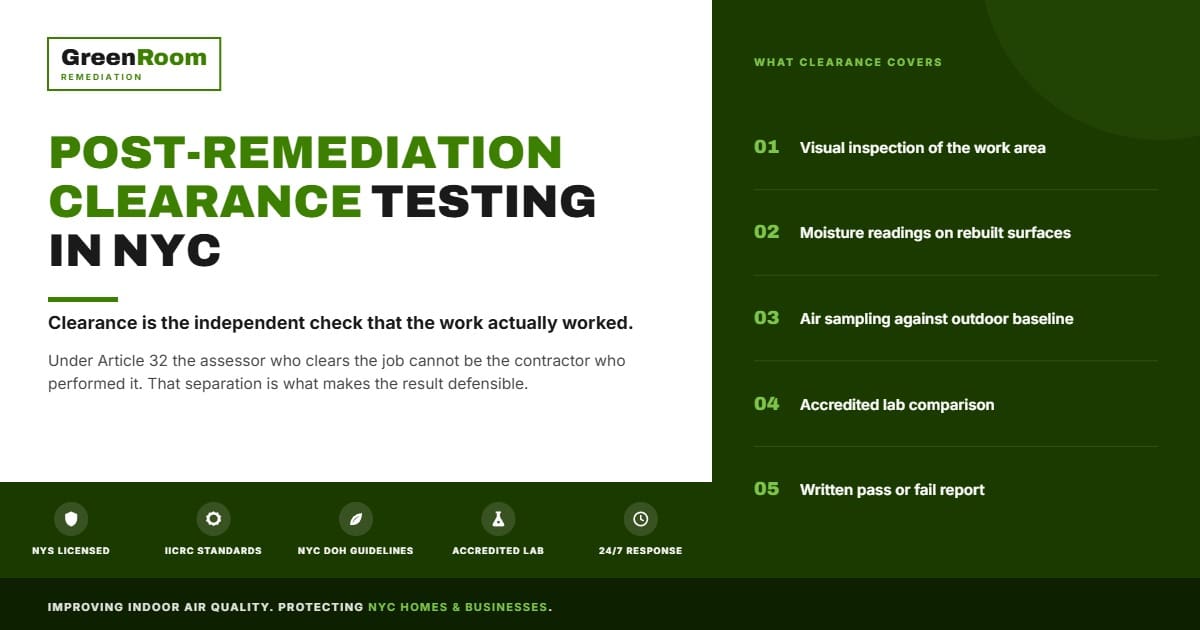
Post-remediation clearance testing is a structured assessment performed by a licensed mold assessor who was not involved in the remediation work. The assessor returns to the property after remediation is complete, inspects the remediated areas for visible contamination, collects air samples from affected and adjacent spaces, and submits those samples to an accredited laboratory. The lab results confirm whether airborne mold spore concentrations have returned to levels consistent with outdoor baseline conditions and whether any species detected during the pre-remediation inspection are still present at elevated levels.
Clearance testing is not the same as a follow-up visual inspection. A visual check can confirm that visible mold has been removed, but it cannot detect airborne spores that may remain from disturbed contamination, spores that migrated to adjacent spaces during remediation, or hidden moisture that was not fully dried and may support new growth within weeks. Air sampling after remediation is the only method that provides objective, lab-verified confirmation that the indoor environment has been restored to acceptable conditions.
Under New York State Labor Law Article 32, the assessor who performs clearance testing must be independently licensed and separate from the company that performed the remediation. This separation protects property owners by ensuring the clearance evaluation is objective rather than performed by the same contractor who has a financial interest in the project being declared complete. For more on how the assessor and remediator separation works, see our guide on mold testing in NYC and what the $499 inspection includes.
Why Do Insurance Carriers Require Clearance Testing?
Insurance carriers require post-remediation clearance documentation for a straightforward reason: without it, they have no objective evidence that the contamination was actually resolved. A remediation contractor’s invoice and completion certificate tell an adjuster that work was performed. Clearance testing results from an independent licensed assessor tell the adjuster that the work achieved its intended outcome.
In New York, insurers operating under NY Regulation 64 (11 NYCRR 216) can and do require specific documentation before settling a mold remediation claim. Clearance testing results, along with the pre-remediation assessor’s report, the remediation contractor’s scope of work, daily logs, moisture readings, and disposal manifests, form the complete documentation package that satisfies a claim file. When clearance testing is missing from that package, adjusters have grounds to hold payment pending the documentation or to dispute whether the remediation scope was completed as claimed.
New Jersey carriers operating under NJ DOBI guidelines follow the same principle. For properties in Northern New Jersey where GreenRoom Remediation provides services, the clearance testing requirement applies consistently regardless of which state the claim falls under. Carriers in both markets have become more rigorous about documentation requirements in recent years, and clearance testing has shifted from a recommended practice to an expected standard on any claim involving professional mold remediation.
For a full breakdown of what documentation insurers require across the claim lifecycle, see our guide on whether homeowners insurance covers mold remediation in NYC.
What Does the Clearance Testing Process Include?
A post-remediation clearance inspection follows a defined sequence that mirrors the pre-remediation assessment process.
Visual Inspection of Remediated Areas
The licensed assessor performs a thorough visual inspection of all areas included in the remediation scope. This confirms that contaminated materials were removed as specified, that containment barriers have been properly dismantled, that no visible mold growth or staining remains on structural surfaces, and that the space has been returned to a clean, dry condition. Any visible deficiencies identified during the clearance inspection must be addressed by the remediation contractor before air sampling proceeds.
Moisture Verification
The assessor uses calibrated moisture meters to verify that structural materials in remediated areas have returned to acceptable moisture content levels. In NYC brownstones, Manhattan co-op apartments, and Queens multifamily buildings, structural materials often retain moisture longer than expected due to building age, limited ventilation, and dense construction. Clearance is not appropriate until moisture readings confirm that drying is complete, because elevated moisture at clearance time indicates conditions that could support new mold growth within weeks of the project closing.
Air Sampling
Air samples are collected from remediated areas and from adjacent spaces that may have been affected by spore migration during the remediation process. An outdoor baseline sample is collected simultaneously. The samples are submitted to an accredited laboratory under documented chain of custody. Results are compared to the outdoor baseline and to the pre-remediation sampling data. A successful clearance result shows indoor spore counts at or below outdoor levels, with no elevated concentrations of species identified during the original assessment.
Written Clearance Report
The assessor produces a written clearance report that documents the visual inspection findings, moisture readings, sampling locations, laboratory results, and a professional determination of whether the remediation achieved clearance. This report is the document that goes into the insurance claim file, the HPD compliance package when violations are involved, and the property owner’s permanent record. For projects involving HPD mold violations, the clearance report and the remediator’s Affidavit of Mold Remediation are both required components of the certification package. See our guide on how to clear an HPD mold violation in NYC for the full compliance process.
What Happens If Clearance Testing Fails?
A failed clearance result means the remediation did not achieve the required outcome, and additional work is needed before the project can be closed. This is not an uncommon outcome, and it is one of the reasons clearance testing exists rather than relying on the remediation contractor’s self-certification.
Common reasons clearance testing fails include incomplete removal of contaminated materials in concealed spaces such as wall cavities or ceiling assemblies, inadequate structural drying that left elevated moisture behind, containment failures that allowed spore migration to adjacent areas during remediation, or HVAC systems that were not properly addressed and redistributed spores after the contained remediation work concluded.
When clearance fails, the remediation contractor returns to address the identified deficiencies. A follow-up clearance test is then conducted after the additional work is complete. The additional clearance test costs $499 per inspection. From an insurance perspective, a failed clearance result that is documented and addressed correctly actually strengthens the claim record because it demonstrates that the process was thorough and that the final outcome was verified independently. What damages a claim is not a failed first clearance, but the absence of clearance testing entirely.
How Clearance Testing Connects to Water Damage Restoration Claims
Clearance testing is most commonly associated with mold remediation, but it also applies in the context of water damage restoration projects where mold growth was a documented concern. When a burst pipe, water heater failure, or appliance overflow leads to both water damage restoration and mold remediation on the same property, the insurance claim spans both services and the documentation requirements apply to both phases.
In those situations, clearance testing confirms not only that the mold remediation was successful but also that the structural drying phase of the water damage restoration brought materials back to acceptable moisture levels. This dual confirmation is what allows an adjuster to close both the water damage and mold portions of a combined claim with confidence that the property has been fully restored. For properties in Brooklyn, Queens, the Bronx, Staten Island, Long Island, Westchester, and Northern New Jersey where water damage events regularly lead to mold growth in older building stock, this combined documentation approach is the standard we follow on every project. See our article on whether your NYC insurance policy will cover burst pipe and water damage for how these claims are structured.
How Much Does Clearance Testing Cost and Is It Covered by Insurance?
Post-remediation clearance testing at GreenRoom Remediation is $499 per inspection. This fee covers the assessor’s site visit, visual inspection, moisture verification, air sampling, laboratory submission, and written clearance report. If additional sampling locations are required due to the size or complexity of the remediated area, additional samples are available at $99 each.
Whether clearance testing is covered by your insurance policy depends on your specific policy language and the insurer’s claim handling approach. Many homeowners and commercial property policies in New York and New Jersey include coverage for reasonable and necessary costs associated with documented mold remediation claims, and clearance testing falls within that category on most covered claims. Some adjusters include clearance testing in the initial claim scope as a line item. Others require the property owner to submit it as a supplemental expense after the fact.
The most reliable approach is to confirm with your adjuster before remediation begins that clearance testing will be included in the covered scope. GreenRoom Remediation discusses this with every client during the initial assessment and coordinates directly with adjusters to ensure clearance testing is documented as a claim line item rather than an out-of-pocket expense that surprises the property owner at the end of the project.
When Should Clearance Testing Be Scheduled?
Clearance testing should be scheduled after all remediation work is complete, all contaminated materials have been removed, structural drying has been verified by the remediation contractor, and containment barriers have been removed. The timing matters because testing while drying equipment is still running or before final cleanup is complete will produce misleading results that do not accurately reflect the restored indoor environment.
For most NYC residential projects, clearance testing is scheduled 24 to 48 hours after the remediation contractor confirms project completion. This allows any residual particulates from the final cleanup to settle before air sampling begins. For larger commercial projects or multi-unit building remediation in Manhattan, Brooklyn, or Queens, the timing may need to coordinate with building management, tenant schedules, or HVAC system restart timelines.
GreenRoom Remediation manages this scheduling coordination as part of the project process. We communicate directly with the independent assessor, track remediation completion milestones, and schedule clearance testing promptly so the project timeline does not stall unnecessarily between remediation completion and claim closure.
Frequently Asked Questions
Is post-remediation clearance testing required by law in New York?
Clearance testing is required as a professional standard under IICRC S520, which governs professional mold remediation practice in New York. It is also effectively required on any insured claim because carriers expect clearance documentation before settling. New York State Labor Law Article 32 requires that the clearance assessment be performed by a licensed assessor who is separate from the remediation contractor.
Who pays for clearance testing?
On insured mold remediation claims, clearance testing is typically included in the covered scope either as an initial line item or as a supplement. On projects where the property owner is paying out of pocket, the $499 clearance testing fee is the property owner’s responsibility. GreenRoom coordinates the scheduling and the assessor, and the assessor invoices separately for the clearance work in keeping with the Article 32 separation requirement.
Can the same company that did the remediation perform clearance testing?
No. Under New York State Labor Law Article 32, the mold assessor and the mold remediator must be separately licensed entities. A remediation contractor cannot clear their own work. The clearance assessment must be performed by an independently licensed assessor, and the assessor’s license copy must be included in the HPD compliance package when violations are involved.
How long does clearance testing take?
The site visit for clearance testing typically takes 1 to 2 hours depending on the size of the remediated area and the number of sampling locations required. Laboratory results are typically returned within 3 to 5 business days. The written clearance report is produced after lab results are received. The full process from site visit to final report generally takes 5 to 7 business days.
What if my insurer accepts the remediation without clearance testing?
Some insurers may process a claim payment without requiring formal clearance documentation, particularly on small claims or when adjusters are not well-versed in mold remediation standards. Accepting payment without clearance documentation is the property owner’s choice, but it carries a risk: if mold returns in the same location within months, there is no documented proof that the original remediation achieved clearance, which complicates any subsequent claim. Clearance testing protects the property owner’s interests beyond just the current claim.
Does clearance testing apply to water damage restoration projects?
Clearance testing in its formal air sampling form applies specifically to mold remediation. Water damage restoration projects typically use drying verification, which involves moisture meter readings confirming that structural materials have returned to acceptable levels. On projects that involve both water damage restoration and mold remediation, both verification methods apply: drying verification closes the water damage phase and clearance testing closes the mold phase.
Will clearance testing detect mold in areas that were not remediated?
Clearance air sampling will capture elevated spore counts from any active mold source in the sampled areas, whether or not those areas were included in the remediation scope. If clearance testing identifies elevated counts attributable to a source outside the remediated area, the assessor will note this in the clearance report. This is one reason that a thorough pre-remediation inspection and moisture investigation are important: identifying all contamination sources before remediation begins reduces the likelihood that clearance testing reveals new issues after the project is otherwise complete. See our article on hidden moisture as the real cause of recurring mold problems in NYC for more on why incomplete scope definition leads to clearance failures.
To schedule post-remediation clearance testing in Brooklyn, Manhattan, Queens, the Bronx, Staten Island, Long Island, Westchester, or Northern New Jersey, call GreenRoom Remediation at (917) 965-3754. We coordinate licensed independent assessors and manage the full clearance process from scheduling through final report delivery.
GreenRoom Remediation | NY State Licensed Mold Remediation Contractor (License #24-6S44B-SHMO) | IICRC-Certified | OSHA-Trained | BBB Accredited | Serving NYC, Brooklyn, Queens, Manhattan, the Bronx, Staten Island, Long Island, Westchester, and Surrounding Areas.
view related content