table of contents
Burst Pipe, Water Heater Failure, or Appliance Leak: Will Your NYC Insurance Policy Cover the Mold?
Quick answer: A burst pipe, failed water heater, or appliance overflow are among the most reliably covered causes of mold damage under standard homeowners policies in New York and New Jersey because they satisfy the “sudden and accidental” standard that insurers require. Coverage still depends on how quickly you acted, whether the water event was reported promptly, and whether remediation was performed by a NY State-licensed contractor under NY State Labor Law Article 32. Mold remediation costs in NYC for pipe and appliance-related water events typically run between $2,500 and $18,000 depending on how far moisture spread before the source was found. GreenRoom Remediation responds 24/7, documents the damage in the format insurers require, and coordinates directly with your adjuster to keep the claim moving.
A burst pipe or water heater failure is one of the few scenarios where a mold insurance claim in New York and New Jersey is genuinely straightforward — at least on paper. The event is sudden, it is unambiguously accidental, and it is exactly the type of covered peril that standard homeowners, HO-6, and landlord policies are written to address. What determines whether the claim pays out smoothly, pays out partially, or gets disputed is almost never the event itself. It is what happens in the hours and days that follow.
Why Burst Pipes and Water Heater Failures Are Strong Insurance Claims
Burst pipes and water heater failures are strong mold insurance claims because they are the clearest examples of the “sudden and accidental” standard that defines covered water damage under most homeowners policies. The New York Department of Financial Services (NY DFS) and the New Jersey Department of Banking and Insurance (NJ DOBI) both recognize sudden internal plumbing events as covered perils, and virtually all standard HO-3 and HO-6 policy language includes them explicitly.
The reason these events hold up well under adjuster review is that they leave a clear evidentiary trail. A burst pipe produces a defined failure point in the plumbing system. A water heater rupture is dated by the appliance’s installation records, service history, and the physical evidence of the failure. An overflow from a washing machine or dishwasher is tied to a specific appliance in a specific location. None of these events can be reasonably attributed to homeowner neglect or gradual deterioration which is the argument insurers use most frequently to deny water damage and mold claims.
Where these claims do encounter friction is when the water was not discovered quickly, when remediation started before documentation was complete, or when the contractor performing the mold removal was not licensed under NY State Labor Law Article 32. Each of those conditions gives an insurer grounds to reduce or deny coverage even on an otherwise strong claim.
What the Timeline From Water Event to Mold Matters to Your Insurer
The 24-to-48-hour mold growth window is not a guideline, it is the biological reality that drives how insurers evaluate the relationship between a water event and subsequent mold contamination. Mold colonization begins within 24 to 48 hours of moisture exposure on organic materials such as drywall, wood framing, insulation, and subfloor materials. In NYC’s older building stock, the pre-war brownstones of Brooklyn, the aging apartment towers of the Bronx, the century-old row houses of Queens, moisture moves quickly into materials and cavities that accelerate that timeline.
From an insurance perspective, the timeline between the water event and the mold discovery is scrutinized carefully. An adjuster reviewing a burst pipe claim will want to establish when the pipe failed, when the homeowner discovered the water, when they notified the insurer, and when remediation began. If that sequence shows a prompt response — discovery within hours, insurer notified within 24 to 48 hours, licensed remediation contractor on site within the first few days — the claim narrative is clean and the mold is clearly attributable to the pipe event.
If the sequence shows a two-week gap between the water event and the remediation call, the adjuster has grounds to question whether the mold predated the pipe failure, whether the homeowner failed to mitigate damage promptly (a standard policy obligation), or whether the moisture source was something other than the claimed event. Those questions do not automatically mean denial, but they create disputes that delay settlement and frequently result in reduced payouts. We have seen this pattern repeatedly across claim-related projects in Brooklyn, Manhattan, and Queens: the remediation itself is straightforward, but the documentation gap from the water event to the call costs the property owner money.
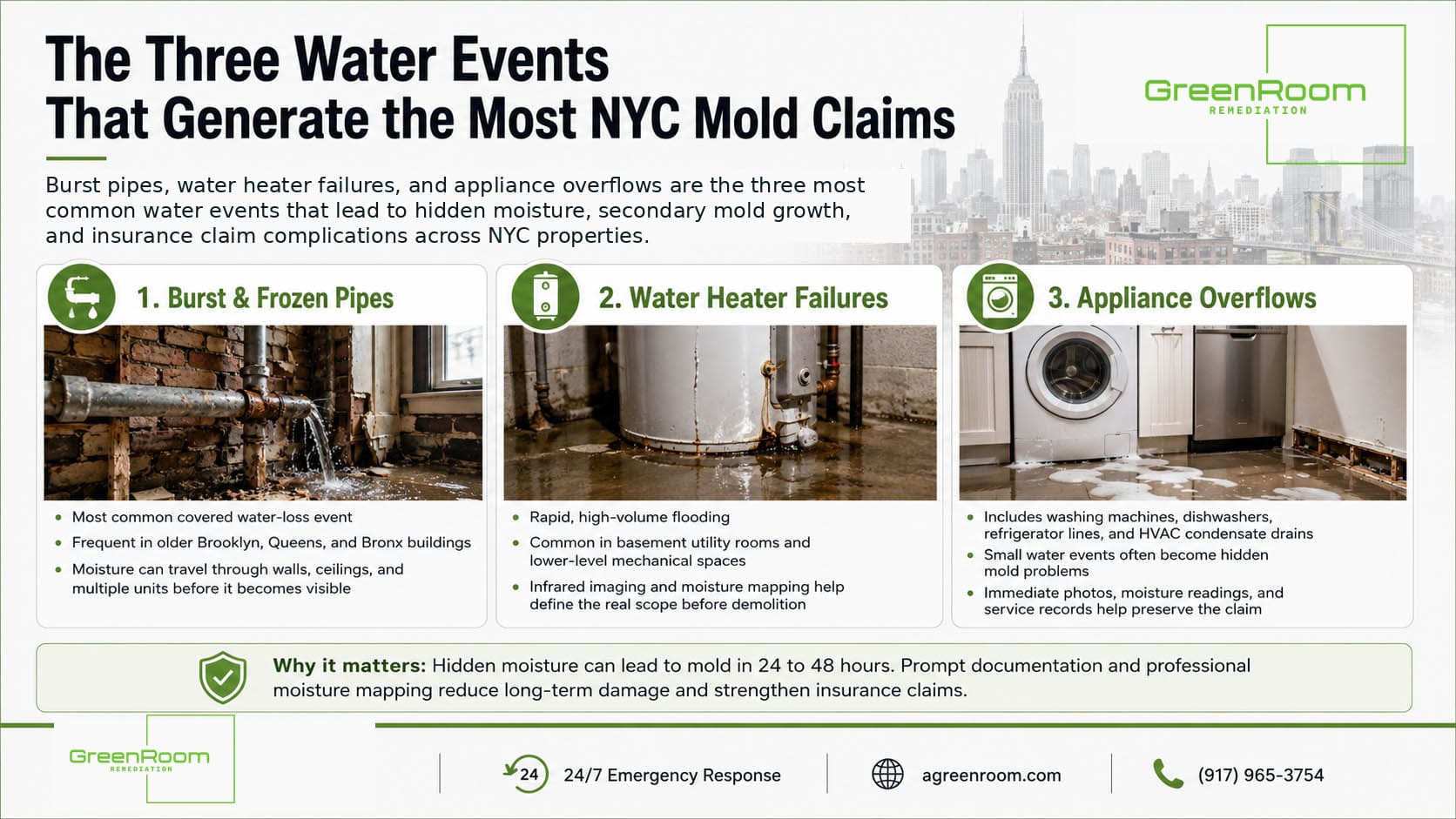
The Three Water Events That Generate the Most NYC Mold Claims
Will Your NYC Insurance Policy Cover the Damage | NYC Mold Remediation & Water Damage Restoration
Burst and frozen pipes are the single most common source of covered mold claims across NYC’s five boroughs, Long Island, and Westchester. Older buildings account for a disproportionate share of these failures, cast iron and galvanized steel plumbing systems in pre-war buildings are routinely 80 to 100 years old, and pipe wall failures are not maintenance-predictable events. Frozen pipe bursts are concentrated in January and February and affect properties with exterior plumbing walls, inadequately insulated basement runs, and vacant units. When a pipe fails in a multi-unit building, the water can travel through multiple floor assemblies before it surfaces visibly, meaning the affected area often extends significantly beyond where the homeowner first notices moisture.
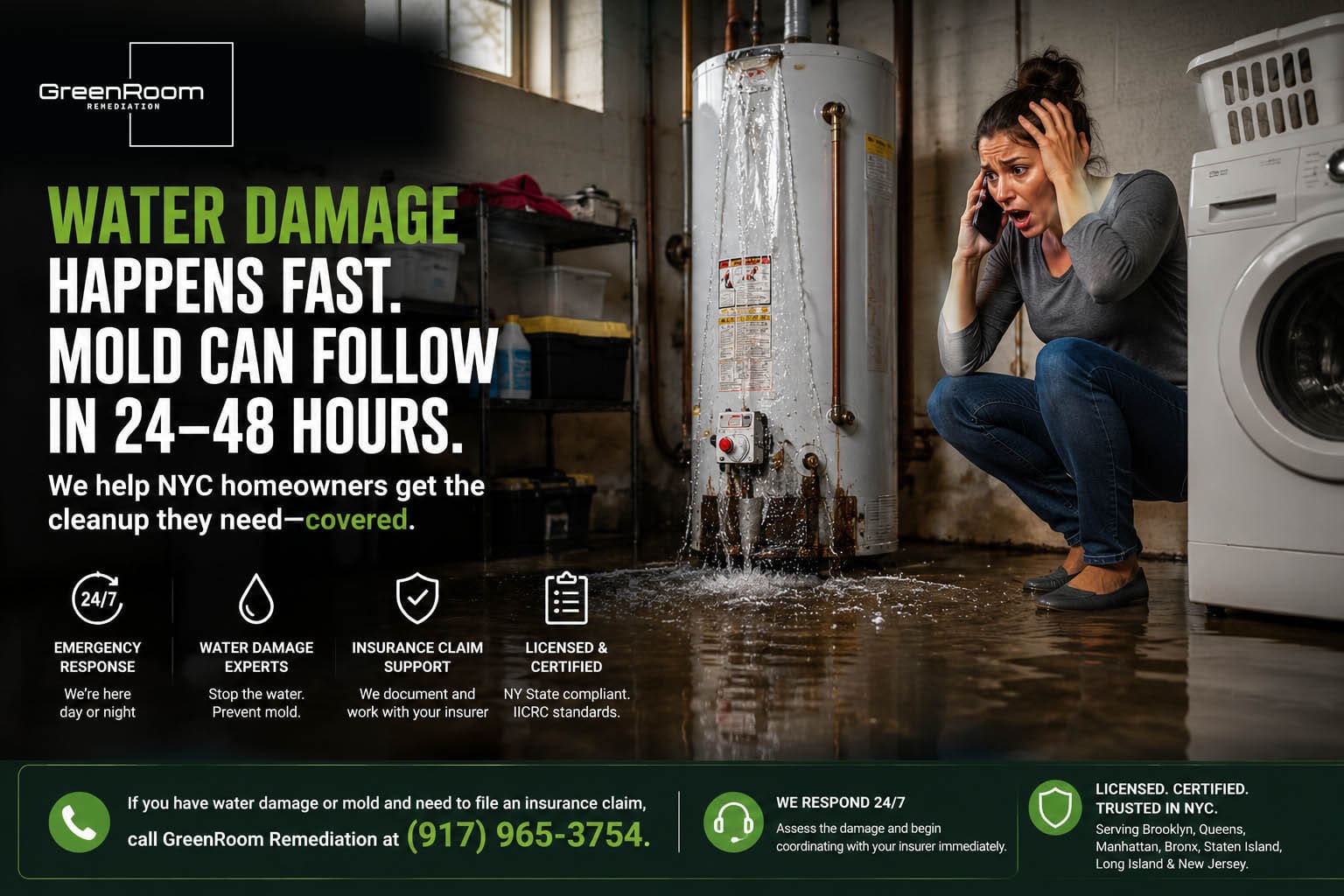
Water heater failures produce high-volume, rapid-onset flooding that saturates floor assemblies and wall bases faster than most property owners realize. A standard 40-gallon residential water heater can discharge its full tank volume within minutes of a tank rupture, and if the failure occurs overnight or while the unit is vacant, that water may sit for 8 to 12 hours before discovery. Water heater-related mold claims in NYC are frequently complicated by the building configuration, water heaters in basement utility rooms mean the water tracks under concrete slabs or through crawl spaces that are not visible during casual inspection. Infrared imaging and moisture mapping are essential for establishing the true scope of these events before demolition begins.
Appliance overflows – washing machines, dishwashers, refrigerator ice maker lines, and HVAC condensate drains are among the most mishandled water damage events from a claims perspective. Because these events often produce smaller initial water volumes than a pipe burst or water heater failure, homeowners sometimes clean up visible surface water and consider the matter resolved. What they miss is moisture that has tracked under flooring, into wall cavities through baseboard gaps, or into the subfloor assembly beneath a washing machine alcove. That hidden moisture produces mold within 48 to 72 hours, and when it surfaces weeks later the homeowner no longer has contemporaneous documentation of the original event. Documenting the appliance failure immediately with photographs, date-stamped moisture readings, and a service call or appliance replacement record is what keeps that claim viable.
What Documentation Your Claim Needs From the First Day
The documentation requirements for a burst pipe, water heater, or appliance overflow mold claim are specific, and insurers in New York operating under NY Regulation 64 (11 NYCRR 216) require complete documentation before the 15-business-day settlement clock begins running. Getting this documentation right on day one is worth more to your claim outcome than almost any other single action.
Photographs and video of the water source and all affected areas should be captured before any cleanup begins. Date and time stamps are critical and they establish the discovery timeline and confirm the relationship between the water event and the damage. If the pipe, water heater, or appliance is visibly failed, that evidence should be documented before any repair or replacement work touches it. The cause of loss needs to be preserved in photographs for the adjuster’s file.
Moisture readings across all affected substrates – flooring, baseboards, lower wall cavities, ceiling assemblies below the event floor establish the moisture migration pattern and prevent the adjuster from arguing that the scope of remediation was inflated. Infrared thermal imaging conducted by a licensed contractor before demolition identifies hidden moisture pockets that the adjuster’s visual inspection would miss. Air quality testing before remediation begins establishes a baseline that post-remediation clearance testing is compared against — without a pre-remediation baseline, clearance testing is far less meaningful to the insurer’s file.
The remediation contractor’s scope of work must itemize every material to be removed with square footage and linear footage measurements, every antimicrobial treatment to be applied with product specifications, and the structural drying plan including equipment placement and duration targets. Daily remediation logs and waste disposal manifests complete the file. This is the package we deliver on every claim-related project, and it is the package that insurance adjusters in New York, New Jersey, and across the NYC metro area are trained to review.
Water damage from a burst pipe or appliance failure needs a licensed assessment immediately. Call GreenRoom Remediation at (917) 965-3754 – we are available 24 hours a day, 7 days a week, and we begin documenting for your insurance claim from the moment we arrive.
How Mold Sub-Limits Apply to These Claims
Even when the water event is clearly a covered peril, the mold remediation payout is subject to the mold sub-limit in your policy and this is where many homeowners with legitimate burst pipe and water heater claims are surprised by the gap between their total remediation cost and what their insurer pays.
Standard HO-3 homeowners policies in New York typically sub-limit mold remediation between $1,000 and $10,000. A burst pipe in a Brooklyn brownstone that saturates two wall assemblies, a wood subfloor, and a basement ceiling can generate legitimate remediation costs of $12,000 to $18,000 — well above a $5,000 sub-limit. The water damage restoration component of the claim (extraction, structural drying, reconstruction) is typically covered under the broader dwelling coverage and is not subject to the mold sub-limit, which is why the line between water damage restoration and mold remediation in the scope of work matters to the settlement calculation.
In New Jersey, many admitted carriers sub-limit mold remediation at $15,000, which accommodates a larger share of typical residential mold claims from plumbing events. Policyholders in NJ who have purchased a mold endorsement may have higher or unlimited mold coverage depending on the carrier. Reviewing your specific policy’s “fungus” or “mold” clause with your agent before a loss event — not after — is the only reliable way to understand your actual ceiling.
| Water Event Type | Typical Mold Remediation Cost (NYC) | Standard NY Sub-Limit Range | Likely Out-of-Pocket Gap |
|---|---|---|---|
| Burst pipe, 1 to 2 rooms affected | $2,500 to $7,000 | $1,000 to $10,000 | $0 to $6,000 |
| Water heater failure, basement affected | $5,000 to $14,000 | $1,000 to $10,000 | $0 to $13,000 |
| Appliance overflow, multi-floor tracking | $4,000 to $12,000 | $1,000 to $10,000 | $0 to $11,000 |
| Burst pipe, multi-unit or whole-floor spread | $12,000 to $30,000+ | $1,000 to $10,000 | $2,000 to $29,000+ |
The water damage restoration components of these same events, extraction, drying, reconstruction are covered separately under dwelling coverage limits, which are typically far higher than the mold sub-limit. A well-organized scope of work from a licensed contractor separates these components clearly, ensuring that the maximum eligible amount is claimed under each applicable coverage category.
What Happens When Mold Is Found Later, After the Water Event Is Closed
 A common and genuinely difficult scenario: a property owner files a water damage claim after a burst pipe, the insurer pays for extraction and drying, the claim is closed and then mold surfaces behind a wall or under flooring two to four weeks later.
This situation is not automatically a denial. Under New York claims handling standards and NY Regulation 64, a subsequent mold discovery directly attributable to the original covered water event can be filed as a supplemental claim or a reopened claim on the original loss. The key requirement is establishing the causal link between the prior water event and the mold which requires a licensed mold assessor’s report connecting the mold’s location, species, and growth pattern to the moisture conditions created by the original pipe failure.
We assist with these supplemental claims by conducting a post-event mold assessment that documents the relationship between the original water intrusion and the subsequent mold growth. The assessment report is formatted specifically for adjuster review and includes the evidence chain the insurer needs to reopen and supplement the original claim. These claims take longer to resolve than primary claims, but they are legitimate and winnable when the documentation is thorough.
If the original remediation contractor did not conduct post-drying moisture verification before the claim was closed, the absence of that verification becomes a factual issue the adjuster will raise. This is one of the most important reasons to use a licensed contractor whose process includes drying verification as a standard deliverable, not an optional add-on.
Frequently Asked Questions
Is a burst pipe always covered by homeowners insurance? In New York and New Jersey, a burst pipe is covered under standard homeowners, HO-6, and landlord policies when the failure was sudden and accidental and not the result of deferred maintenance or gradual deterioration. Frozen pipe bursts are covered under the same standard. Slow pipe leaks that developed over weeks or months are not covered under the sudden-and-accidental standard.
Does my insurance cover the mold that grew from a burst pipe if I didn’t notice the leak right away? Potentially yes, but the timeline matters. If you can establish that the pipe failed recently and you acted promptly upon discovery, the claim remains viable. A longer gap between the water event and the discovery will be scrutinized by the adjuster. A licensed contractor’s moisture assessment and a mold assessor’s report documenting the growth stage can help establish the timeline.
What is the first thing I should do after a burst pipe to protect my insurance claim? Photograph the failed pipe and all visible water damage before touching anything. Turn off the water supply. Contact your insurance company and a licensed remediation contractor simultaneously. NY DFS Circular Letter No. 8 (2021) allows immediate protective repairs for health and safety — a licensed contractor can begin extraction and containment before the adjuster arrives as long as everything is documented.
Will insurance cover mold from a washing machine that overflowed? Yes, if the overflow was sudden and accidental and you reported it promptly. Appliance overflow is a covered peril under most standard policies. The critical factor is documentation of the event and prompt action if you cleaned up visible water and did not check for hidden moisture migration, any mold discovered later will be harder to attribute to the original event.
How do I know if the mold remediation cost will exceed my sub-limit? A licensed contractor’s pre-remediation assessment and scope of work will give you a cost estimate before remediation begins. Compare that estimate to your policy’s mold sub-limit (found in the “fungus” or “mold” clause). If the estimate exceeds the sub-limit, your adjuster and contractor can work together to separate mold remediation costs from water damage restoration costs, which are covered under a different and typically higher limit.
Can I use any contractor for mold remediation after a burst pipe claim? No. Under NY State Labor Law Article 32, mold remediation covering 10 or more square feet must be performed by a NY State-licensed mold remediation contractor. Using an unlicensed contractor gives your insurer grounds to deny the mold portion of the claim regardless of the quality of the work performed.
What if my insurer says the mold is from a pre-existing condition, not the burst pipe? Request the written denial with specific reasons, as required by NY Regulation 64. A mold assessor’s report documenting the mold species, growth stage, and moisture conditions can refute a pre-existing condition argument when the evidence supports the timeline of the water event. If the dispute involves coverage interpretation, an insurance attorney familiar with NY Insurance Law § 2601 can advise on next steps.
How long do water heater failure mold claims typically take to resolve in New York? Under NY Regulation 64, insurers must acknowledge your claim within 15 business days and issue a settlement or denial within 15 business days of receiving complete documentation. Well-organized claims with complete documentation from a licensed contractor typically resolve within 30 to 45 days from the initial filing. Claims with documentation gaps or disputes over scope take longer.
For 24/7 emergency response to burst pipe flooding, water heater failures, or appliance overflows and immediate insurance claim documentation – call GreenRoom Remediation at (917) 965-3754. We serve Brooklyn, Manhattan, Queens, the Bronx, Staten Island, Long Island, Westchester, and Northern New Jersey.
GreenRoom Remediation | NY State Licensed Mold Remediation Contractor (License #24-6S44B-SHMO) | IICRC-Certified | OSHA-Trained | BBB Accredited | Serving NYC, Brooklyn, Queens, Manhattan, the Bronx, Staten Island, Long Island, Westchester, and Surrounding Areas.
view related content