table of contents
Quick answer: Basement mold in NYC keeps coming back because the moisture source driving it is rarely identified and corrected during surface cleaning or basic remediation. The most common causes in NYC basement environments are foundation wall water intrusion, condensation on cold surfaces, failed or undersized sump systems, drainage grading issues, and slow plumbing leaks inside basement walls. Any mold remediation in a basement that involves 10 square feet or more requires a licensed mold remediator under New York State Labor Law Article 32. Surface cleaning without moisture source correction and structural drying verification will produce the same mold growth in the same location within weeks to months. GreenRoom Remediation handles basement mold assessment, remediation, and moisture source investigation across Brooklyn, Queens, the Bronx, Staten Island, Long Island, Westchester, and Northern New Jersey. Call (917) 965-3754 for an assessment.
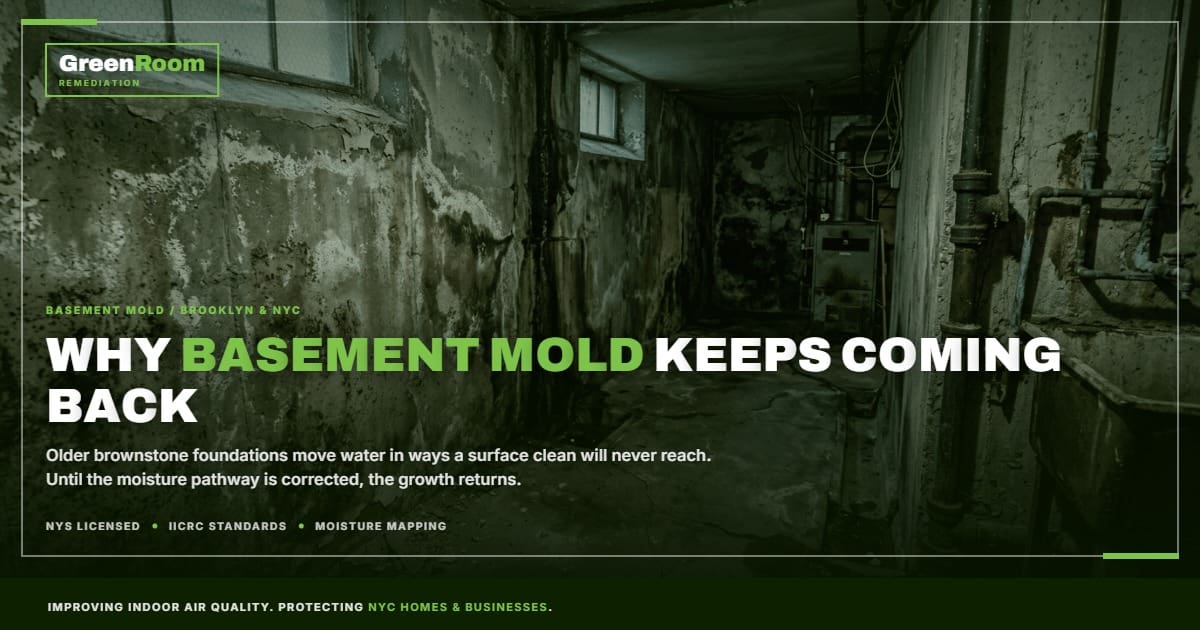
Basement mold is the single most commonly recurring mold problem in NYC residential properties, and the reason it recurs so reliably is almost always the same: the treatment addressed the visible contamination without addressing the moisture conditions that produced it. NYC’s aging housing stock, below-grade living spaces, and aging drainage infrastructure create basement moisture environments that require a more thorough investigation than a typical above-grade mold project. Understanding why basement mold comes back and what a permanent fix actually requires is what separates a one-time remediation from a cycle of recurring treatments.
Why Is Basement Mold So Common in NYC Buildings?
NYC’s residential building stock creates basement conditions that are unusually favorable to mold growth compared to newer suburban construction. Pre-war brownstones and row houses in Brooklyn, Queens, and the Bronx were built with foundations that were not designed to manage the moisture loads that modern urban drainage systems produce. Many of these buildings have stone or brick foundations without any waterproof membrane, relying instead on thick masonry walls and drainage assumptions that no longer apply in a dense urban environment.
Basement apartments, which are common across Brooklyn and Queens, present additional challenges because they are occupied spaces with the full range of moisture-generating activities including cooking, bathing, and laundry in environments with limited natural ventilation. Moisture generated inside a below-grade apartment has nowhere to go in the absence of mechanical ventilation, and it condenses on the coolest surfaces available, which are typically the foundation walls and concrete floors.
The NYC sewer system, one of the oldest combined sewer infrastructure networks in the country, creates periodic basement flooding events during heavy rain when storm water and sewage flows exceed system capacity and back up through floor drains and sump systems. These events, even brief ones, saturate basement materials with Category 3 contaminated water and create mold conditions that are more serious than typical clean water moisture events because the source water contains biological contamination that must be addressed as part of the restoration process.
What Are the Most Common Causes of Recurring Basement Mold in NYC?
Recurring basement mold in NYC properties almost always traces to one or more of the following moisture sources, each of which requires a different correction strategy.
Foundation Wall Water Intrusion
Water infiltrating through foundation walls is the most common source of chronic basement moisture in Brooklyn brownstones and pre-war buildings throughout the boroughs. It presents as efflorescence on foundation walls, staining at the base of walls, or visible water seeping through mortar joints during or after rain. Mold develops on the organic materials adjacent to these wet surfaces, including wood framing, drywall, insulation, stored cardboard, and flooring assemblies. Surface cleaning the mold without addressing the wall infiltration produces a predictable outcome: the moisture continues, the mold returns.
Condensation on Cold Surfaces
Condensation is a primary driver of basement mold in occupied below-grade apartments across NYC. When warm, humid interior air contacts cold foundation walls, concrete floors, or uninsulated pipes, moisture condenses on those surfaces. In summer months, when NYC humidity levels are high and basement temperatures remain low, condensation can be persistent enough to maintain continuously elevated surface moisture levels that support mold growth. The mold appears to grow on the wall or floor surface itself rather than being driven by an obvious leak, which leads many property owners to conclude there is no moisture source to address. Condensation-driven mold requires ventilation improvement, surface insulation, and dehumidification rather than waterproofing.
Sump System Failure or Undersizing
Sump pumps in NYC basements are designed to manage groundwater infiltration and minor flooding events. When a sump pump fails during a rain event, or when the system is undersized for the drainage load the property experiences, basement flooding produces rapid saturation of flooring, wall base materials, and any stored contents. Even brief flooding events that are cleaned up quickly often leave residual moisture in subfloor assemblies and wall cavities that is not visible on the surface and not detectable without moisture meters. That residual moisture produces mold growth 24 to 48 hours later in materials that appeared dry at the time of cleanup.
Slow Plumbing Leaks Inside Basement Walls
Basement utility areas in NYC buildings often contain aging plumbing supply and drain lines that develop slow leaks over time. These leaks may produce enough moisture to sustain mold growth inside wall cavities for months without producing any visible water on the basement floor. Infrared thermal imaging and moisture meter readings are the tools that identify these concealed leaks. Without a moisture investigation, a basement mold remediation project may remove contaminated materials, treat surfaces, and declare the project complete while a slow pipe leak inside the same wall continues to wet the replacement materials. For more on how hidden moisture drives recurring mold problems across NYC building types, see our article on hidden moisture and recurring mold problems in NYC.
Poor Exterior Drainage and Grading
In attached row houses and brownstones, exterior grading that directs rainwater toward the foundation rather than away from it is a chronic moisture source that no interior treatment can permanently resolve. Surface water that pools against the foundation during rain events saturates the surrounding soil and drives moisture through the foundation by hydrostatic pressure. This condition is identifiable by moisture patterns that correlate with rain events and concentrate near exterior walls. The correction requires exterior drainage improvements, grading adjustments, or in some cases, exterior foundation waterproofing, none of which are achievable through interior mold treatment alone.
Why Does Basement Mold Keep Coming Back After Treatment?
The most direct answer is that most basement mold treatments in NYC address the symptom rather than the cause. Bleach, antimicrobial sprays, and even professional surface cleaning that does not include structural drying verification and moisture source correction will produce the same mold in the same location within weeks or months because the underlying moisture conditions were never resolved.
There is also a structural issue specific to NYC basements. Many pre-war basement walls were built with wood framing installed directly against foundation walls without any air gap or moisture barrier. When foundation walls stay persistently damp, that framing absorbs moisture continuously. Even after a proper mold remediation project removes the contaminated drywall and treats the framing surfaces, if the foundation wall continues to introduce moisture, the replacement materials will develop the same conditions within one seasonal moisture cycle. Permanent resolution requires either correcting the foundation moisture source, creating a drainage plane between the foundation and the framing, or both.
Professional mold remediation in a basement context requires the same containment, HEPA filtration, material removal, and clearance testing that any other mold project requires, plus a moisture investigation thorough enough to identify all contributing sources. Without the moisture investigation, the remediation is incomplete regardless of how thoroughly the visible contamination is addressed.
What Does a Proper Basement Mold Remediation Include?
A properly executed basement mold remediation in a NYC property follows a sequence that differs from above-grade remediation primarily in the emphasis on moisture source investigation and structural drying verification.
The process begins with a licensed mold assessor conducting a full moisture investigation using infrared imaging, moisture meters, and visual inspection of the basement envelope including foundation walls, floor assembly, utility penetrations, sump system condition, and any plumbing in the area. The assessor identifies all moisture sources contributing to the mold conditions and includes them in the written remediation protocol. This protocol defines both the scope of contamination removal and the moisture correction steps required as part of the project.
Remediation then proceeds with containment, HEPA-filtered air scrubbing, and systematic removal of contaminated porous materials. In many NYC basement projects, this includes drywall, insulation, wood base plates, and in some cases subfloor materials. After material removal, structural surfaces are treated with EPA-registered antimicrobial treatments. Industrial drying equipment is deployed and moisture readings are tracked daily until all structural assemblies reach acceptable moisture content levels.
Moisture source correction is completed either during or immediately after the remediation, depending on the nature of the source. Plumbing repairs are typically completed during the remediation phase so that structural drying begins with a dry envelope. Foundation waterproofing, grading corrections, or sump system upgrades are coordinated with appropriate contractors and completed before the project is considered ready for clearance testing and reconstruction.
Post-remediation clearance testing by an independent licensed assessor confirms that air quality has returned to acceptable baseline levels before reconstruction begins. For basement projects connected to insurance claims, clearance testing documentation is required before the insurer will authorize the reconstruction phase of the claim. See our article on post-remediation clearance testing and why insurers require it for more on what that process involves.
Does Homeowners Insurance Cover Basement Mold in NYC?
Insurance coverage for basement mold in NYC depends entirely on the cause of the mold, not on the location. Mold that developed from a covered sudden and accidental event such as a burst pipe in the basement, a water heater failure, or an appliance overflow that saturated basement materials is typically covered under a standard homeowners or landlord policy subject to the mold sub-limit in the policy, which commonly ranges from $1,000 to $10,000 in New York.
Mold from chronic foundation moisture, gradual condensation buildup, or long-term drainage issues is typically excluded as gradual damage or maintenance-related deterioration. Flood-driven basement mold requires a separate NFIP flood insurance policy, not the standard homeowners policy. NYC sewer backup events fall into a particularly complicated coverage zone because they may be covered under a specific sewer backup endorsement rather than the standard policy, and many NYC property owners are unaware of whether their policy includes this endorsement until they need to file a claim.
GreenRoom Remediation reviews the cause of loss with every client before beginning basement remediation to help establish whether the project has a viable insurance claim pathway. For a complete breakdown of what triggers coverage and what documentation insurers require, see our guide on whether homeowners insurance covers mold remediation in NYC.
Frequently Asked Questions
Why does mold keep growing in the same spot in my basement?
Recurring mold in the same location almost always indicates a persistent moisture source that was not corrected during the previous treatment. The most common causes in NYC basements are foundation wall infiltration, condensation on cold surfaces, slow plumbing leaks, and drainage problems. A professional moisture investigation using infrared imaging and moisture meters is the most reliable way to identify the source.
Can I clean basement mold myself?
For mold areas under 10 square feet, self-remediation using appropriate protective equipment and safe work practices is permitted under New York State Labor Law Article 32. However, basement mold frequently extends beyond what is visible, and self-remediation without a professional moisture investigation risks missing the underlying cause. Any basement mold connected to a prior flooding or water damage event should be assessed by a licensed professional before treatment begins.
How much does basement mold remediation cost in NYC?
Basement mold remediation in NYC typically ranges from $2,000 to $8,000 for small to mid-sized projects and from $8,000 to $25,000 or more for larger projects involving structural removal, foundation moisture correction, and full basement remediation. The cost depends on the scope of contamination, the materials affected, the moisture source correction required, and building access conditions. For more on what drives remediation costs, see our article on why professional mold remediation costs what it does.
Is basement mold dangerous?
Basement mold at elevated concentrations presents the same respiratory and allergic health risks as mold in any other part of a building. In occupied basement apartments, where residents spend significant time in the same space as the contamination, health risks are elevated compared to mold in an unoccupied utility basement. Children, elderly residents, and individuals with asthma or compromised immune systems face higher risk of significant health effects from sustained mold exposure at any concentration.
Does a dehumidifier fix basement mold?
A dehumidifier manages indoor humidity levels but does not address existing mold contamination, remove contaminated materials, or correct external moisture sources such as foundation infiltration or drainage problems. Dehumidification is an appropriate component of a moisture management strategy after remediation is complete, but it is not a substitute for professional remediation when mold is present. Running a dehumidifier in a basement with active mold growth manages comfort but does not resolve the contamination.
What is the difference between basement mold from flooding versus chronic moisture?
Flooding-related basement mold typically develops rapidly, within 24 to 48 hours of a water event, and affects materials in a pattern consistent with the flood water level. Chronic moisture-related mold develops more slowly and often appears concentrated at foundation wall bases, on framing adjacent to foundation walls, or in areas with persistent condensation. The distinction matters for insurance purposes because flood-related mold from a covered event may be eligible for a claim while chronic moisture-related mold is typically excluded as gradual damage.
For basement mold assessment and remediation in Brooklyn, Queens, the Bronx, Staten Island, Manhattan, Long Island, Westchester, or Northern New Jersey, call GreenRoom Remediation at (917) 965-3754. We are available 24 hours a day, 7 days a week and respond to emergency basement flooding and mold situations same day.
GreenRoom Remediation | NY State Licensed Mold Remediation Contractor (License #24-6S44B-SHMO) | IICRC-Certified | OSHA-Trained | BBB Accredited | Serving NYC, Brooklyn, Queens, Manhattan, the Bronx, Staten Island, Long Island, Westchester, and Surrounding Areas.
view related content