table of contents
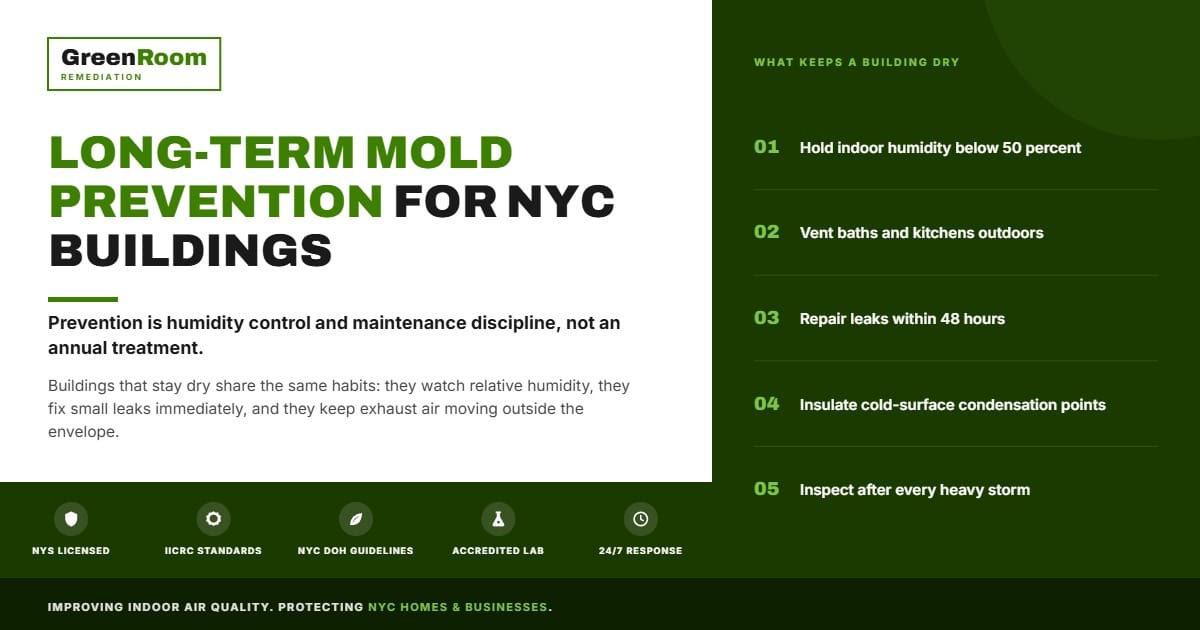
Quick answer: Mold prevention in NYC buildings requires controlling moisture at the source, not cleaning surfaces with antimicrobial products after the fact. The three interventions with genuine long-term effectiveness are: correcting and maintaining plumbing systems so supply and drain leaks cannot establish sustained wet conditions; ensuring mechanical ventilation in bathrooms, kitchens, and laundry areas exhausts to the exterior rather than into wall cavities or attic spaces; and maintaining indoor relative humidity below 60 percent year-round through appropriate ventilation and dehumidification. Surface cleaning, paint additives marketed as mold-resistant, and periodic bleach treatments do not prevent mold from recurring when the underlying moisture conditions remain. GreenRoom Remediation coordinates mold assessment and remediation for NYC properties that want to break the cycle of recurring mold. Call (917) 965-3754.
The mold prevention product market generates significant revenue by selling property owners the idea that periodic surface treatment is a substitute for moisture source control. It is not. Mold is a moisture problem that manifests as a biological problem. Addressing the biological symptom without resolving the moisture condition that caused it produces temporary results at best and a false sense of resolution at worst. This article covers what the research and professional remediation experience actually support as effective long-term mold prevention in NYC’s specific building and climate context.
Why NYC Properties Are Particularly Susceptible to Mold
NYC’s mold risk profile is shaped by three factors that interact to create conditions more favorable to mold growth than most comparable US markets. The first is building age: the majority of NYC’s residential building stock is pre-war construction built with materials and moisture management approaches that predate modern understanding of building science. The second is density and shared systems: in NYC’s multifamily buildings, a plumbing failure in one unit creates moisture exposure in adjacent units. The third is NYC’s climate: humid summers with dewpoints regularly above 65°F create significant latent heat loads for building HVAC systems, and buildings with inadequate cooling capacity maintain indoor humidity levels above 60 percent for extended periods during summer. For more on how hidden moisture drives recurring mold in NYC buildings, see our article on hidden moisture and recurring mold problems in NYC.
What Actually Works: Moisture Source Control
The most effective single investment for mold prevention in a NYC residential property is a systematic plumbing inspection and repair program. Supply line fittings under sinks and behind appliances fail gradually and can drip slowly for months before the moisture becomes visible. Wax rings under toilets fail over years. Shower pan liners develop cracks and allow shower water to reach the subfloor. Drain lines develop slow leaks at joints inside walls. Property owners and managers who implement annual plumbing inspections catch incipient moisture conditions before they generate mold.
Every bathroom exhaust fan in a NYC residential property should be verified to exhaust to the building exterior, not into a wall cavity, ceiling space, or attic. This is one of the most common mold generators in NYC residential buildings and one of the easiest to verify and correct. Kitchen range hood ventilation that exhausts to the exterior rather than recirculating also significantly reduces kitchen moisture loads and condensation risk.
Maintaining indoor relative humidity below 60 percent year-round eliminates the primary growth condition that allows mold to colonize building surfaces even when those surfaces do not have direct moisture contact. In NYC’s humid summers, this requires either air conditioning with sufficient dehumidification capacity or supplemental dehumidification in spaces where AC coverage is inadequate. Basement and below-grade spaces in NYC buildings typically require dedicated dehumidification because they cannot maintain acceptable humidity through air conditioning alone.
What Doesn’t Work: Common Prevention Myths
Mold-resistant paint does not prevent mold growth when moisture conditions are present. Paint additives that claim mold resistance inhibit surface mold growth on the paint film itself under dry conditions but do not prevent mold from growing on paint surfaces that remain persistently wet or humid. A wall that has a moisture source behind it will grow mold on mold-resistant paint given sufficient time and moisture.
Periodic bleach cleaning of tile grout, shower walls, and other surfaces where mold appears does not address the humidity and moisture conditions that allow mold to recolonize those surfaces. Mold returns to a clean bleached surface within weeks to months when the humidity and moisture conditions that supported the original growth continue. The appropriate response to recurring surface mold in a bathroom is improving ventilation, not more frequent bleaching. Air purifiers with HEPA or UV filtration remove some mold spores from the air in a room but do not address the source of those spores and do not prevent mold from growing on building surfaces.
Post-Remediation Prevention: Keeping Mold From Returning
After professional mold remediation, the moisture source correction that should have been part of the remediation project is the primary defense against recurrence. A properly executed remediation that identified and corrected the moisture source, dried the structure to acceptable levels, and applied appropriate encapsulant treatments to remediated surfaces should not recur unless a new moisture event occurs.
Post-remediation monitoring through periodic moisture meter readings of previously affected areas and annual air quality testing in buildings with a history of significant contamination gives property managers early warning of conditions that could generate new growth before it becomes visible. GreenRoom Remediation offers post-remediation monitoring assessments for property managers who want documented confirmation that remediated areas remain dry and clear between annual inspections. For more on what professional remediation involves, see our complete guide at mold remediation, water damage restoration, and indoor air quality.
Frequently Asked Questions
What humidity level should I maintain to prevent mold in my NYC apartment?
The EPA recommends maintaining indoor relative humidity between 30 and 60 percent. In practice, keeping humidity below 55 percent provides a meaningful buffer against mold growth conditions. A basic digital hygrometer costing under $20 placed in the bedroom and living area gives real-time humidity readings that allow you to assess whether ventilation or dehumidification adjustments are needed.
My building management says there’s nothing wrong but I keep getting mold on the same wall. What should I do?
Recurring mold on the same wall surface is a reliable indicator of a persistent moisture condition that has not been identified and corrected. Notify building management in writing, document each recurrence with photographs and dates, and schedule an independent certified mold assessment to identify the moisture source. For more on tenant escalation options, see our guide on mold in NYC rental apartments and tenant rights.
For mold assessment, remediation, and post-remediation monitoring in Brooklyn, Manhattan, Queens, the Bronx, Staten Island, Long Island, Westchester, or Northern New Jersey, call GreenRoom Remediation at (917) 965-3754.
GreenRoom Remediation | NY State Licensed Mold Remediation Contractor (License #24-6S44B-SHMO) | IICRC-Certified | OSHA-Trained | BBB Accredited | Serving NYC, Brooklyn, Queens, Manhattan, the Bronx, Staten Island, Long Island, Westchester, and Surrounding Areas.
view related content