table of contents
Quick Answer for NYC Property Owners
Most mold problems in NYC buildings are not caused by surface contamination alone. They are caused by hidden moisture, incomplete drying after water damage, poor ventilation, or unresolved building envelope failures. In Brooklyn brownstones, Manhattan co-ops, Queens multifamily properties, and commercial buildings throughout New York City, successful mold remediation depends on identifying the moisture source, documenting the drying process properly, and restoring indoor air quality through containment, HEPA filtration, structural drying, and long-term prevention strategies.
GreenRoom Remediation approaches mold remediation, water damage restoration, mold inspection, and eco-friendly remediation as connected environmental systems rather than isolated services. In NYC properties where walls, plumbing systems, HVAC infrastructure, and ventilation pathways are interconnected, solving only the visible symptom rarely prevents the problem from returning.
Mold Remediation, Water Damage Restoration, and Indoor Air Quality Guide | NYC Mold Remediation & Water Damage Restoration
Why Mold Problems Keep Returning in NYC Buildings
Most recurring mold problems in New York City properties trace back to hidden moisture conditions that were never fully identified during the original cleanup.
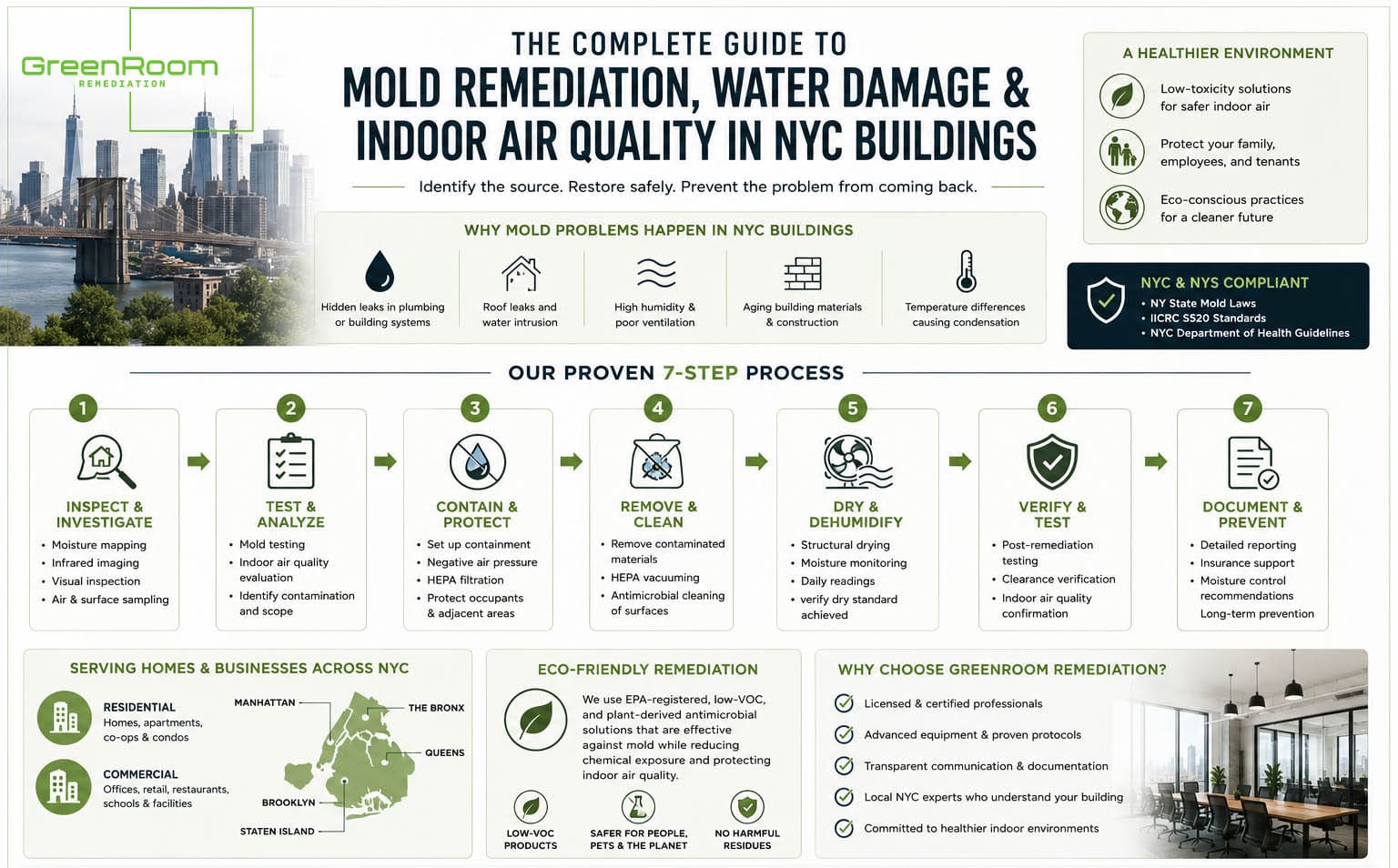
Property owners often assume the visible mold itself is the issue, but mold growth is usually the symptom rather than the source. Moisture trapped inside wall cavities, beneath flooring systems, above ceilings, or within shared building infrastructure creates the conditions that allow microbial growth to continue long after surface cleaning appears successful.
This pattern is especially common in Brooklyn brownstones, pre-war Manhattan apartments, Queens multifamily buildings, and mixed-use commercial properties where older plumbing systems, aging building materials, and limited ventilation allow moisture to move unpredictably throughout the structure.
A slow plumbing leak inside one apartment can impact several neighboring units before visible staining ever appears. Roof intrusion may travel laterally through framing cavities before surfacing far from the actual source. HVAC condensate systems, shared ventilation risers, and poorly insulated exterior walls also contribute to hidden condensation problems that support recurring mold growth.
This is why professional mold remediation in NYC requires moisture investigation, structural drying verification, and long-term moisture control rather than surface treatment alone.
The Relationship Between Water Damage and Mold Growth
Water damage is the primary upstream trigger for most mold remediation projects in NYC.
When building materials remain wet after flooding, plumbing leaks, roof failures, or elevated humidity exposure, microbial growth can begin developing within 24 to 48 hours. By the time visible staining appears, contamination may already exist behind walls, beneath flooring, or inside HVAC systems.
This is one reason emergency water damage restoration in Brooklyn and NYC requires immediate response and detailed documentation during the first 24 to 72 hours. Professional restoration teams document moisture conditions, drying progress, equipment placement, and antimicrobial pretreatment because insurance carriers increasingly rely on objective documentation to evaluate claims.
Water damage restoration also involves more than simply removing standing water.
Effective structural drying requires:
- Moisture mapping
- Infrared imaging
- HEPA-filtered air scrubbing
- Antimicrobial pretreatment
- Daily psychrometric readings
- Structural cavity drying when necessary
In Brooklyn brownstones and Manhattan high-rises, drying strategies must also account for electrical limitations, tenant occupancy, building access restrictions, and shared mechanical systems.
The longer moisture remains trapped inside structural materials, the higher the likelihood of secondary mold remediation becoming necessary.
Why Professional Mold Remediation Is Different From Surface Cleaning
One of the largest misconceptions property owners encounter is the belief that mold remediation simply means spraying chemicals onto visible growth.
Professional mold remediation follows a structured environmental remediation process designed to:
- Prevent cross-contamination
- Remove contaminated materials safely
- Stabilize indoor air quality
- Correct the underlying moisture source
- Document the remediation properly
DIY mold removal methods using bleach, vinegar, hydrogen peroxide, or over-the-counter sprays may temporarily reduce visible staining, but they rarely resolve the conditions allowing mold to grow in the first place.
Professional remediation projects in NYC typically include:
- Containment barriers
- Negative air pressure systems
- HEPA-filtered air scrubbers
- Controlled demolition of contaminated porous materials
- Moisture diagnostics
- Structural drying verification
- Antimicrobial treatment using EPA-registered products
- Post-remediation documentation
Under New York State Mold Laws, projects involving more than ten square feet of contamination require licensed mold remediation contractors. Industry procedures are further guided by IICRC S520 remediation standards.
The Role of Mold Testing and Indoor Air Quality Evaluation
Mold testing and mold inspection serve different functions within the remediation process.
A professional mold inspection evaluates building conditions, moisture pathways, ventilation patterns, HVAC systems, and hidden water intrusion risks. Mold testing may then be used to confirm airborne contamination levels, identify species, establish baseline conditions before remediation, or verify clearance after remediation is complete.
In NYC buildings, indoor air quality testing becomes particularly important because contamination rarely remains isolated to one visible room. Shared HVAC systems, interconnected wall cavities, and dense occupancy patterns allow mold spores and particulate contamination to move between apartments and commercial units more easily than in detached suburban homes.
Testing also supports:
- Insurance documentation
- Real estate transactions
- Liability protection
- Clearance verification
- Scope development for remediation planning
Property owners who skip professional testing often lose important baseline documentation that may later affect insurance claims, disputes, or future property disclosures.
Eco-Friendly Mold Remediation and Indoor Air Quality
Demand for eco-friendly mold remediation in NYC has increased significantly among families, commercial property owners, co-op boards, and occupants concerned about chemical exposure during remediation.
Effective eco-friendly remediation still follows the same containment, HEPA filtration, moisture mapping, and structural drying standards as conventional remediation. The primary difference is the selection of low-VOC, plant-derived, or EPA-registered antimicrobial products designed to reduce residual chemical exposure after the work is complete.
This matters in NYC properties because many apartments and commercial buildings have:
- Limited ventilation
- Shared HVAC systems
- Dense occupancy
- Limited relocation flexibility during remediation
Low-toxicity remediation strategies help stabilize indoor air quality while minimizing long-term chemical residue concerns inside occupied spaces.
However, eco-friendly remediation does not eliminate the need for containment, physical removal of contaminated materials, or moisture-source correction. Any remediation approach claiming otherwise is generally prioritizing marketing over remediation science.
Why Documentation Matters During Water Damage and Mold Projects
Documentation is one of the most overlooked aspects of water damage restoration and mold remediation.
Insurance carriers increasingly expect:
- Moisture readings
- Daily psychrometric logs
- Infrared imaging
- Equipment placement documentation
- Antimicrobial treatment records
- Progress photography
- Structural drying verification
Without these records, property owners may face claim disputes, denied scope extensions, or disagreements regarding secondary mold damage.
GreenRoom Remediation integrates documentation directly into the restoration and remediation process because the documentation itself often determines whether a claim proceeds smoothly or becomes contested later.
This is especially important in Brooklyn multifamily buildings, Manhattan commercial properties, and NYC co-op environments where multiple occupants, building managers, insurance carriers, and contractors may all become involved simultaneously.
What NYC Property Owners Should Verify Before Hiring a Remediation Company
Before hiring a mold remediation or water damage restoration company in NYC, property owners should verify:
- New York State mold remediation licensing
- IICRC certification alignment
- Proper insurance coverage
- Moisture diagnostics capability
- HEPA filtration procedures
- Documentation standards
- Structural drying verification procedures
They should also verify whether the company:
- Uses proper containment systems
- Includes antimicrobial pretreatment
- Provides written scopes of work
- Documents drying progress daily
- Evaluates HVAC systems and indoor air quality risks
Companies that cannot clearly explain these processes often rely on surface-level cleanup rather than complete environmental remediation.
Why NYC Buildings Require Specialized Environmental Remediation
New York City buildings create environmental conditions that differ significantly from newer suburban construction.
Older infrastructure, shared ventilation pathways, multifamily occupancy, aging plumbing systems, commercial-residential mixed-use construction, and limited ventilation create more complex moisture movement patterns and indoor air quality risks.
This is why successful mold remediation in NYC depends on understanding:
- Building science
- Moisture migration
- Structural drying
- HVAC contamination risks
- Airborne particulate control
- Indoor environmental quality stabilization
Addressing only the visible symptom rarely produces long-term success.
The properties that remain stable after remediation are the ones where the underlying environmental conditions were identified, documented, corrected, and monitored properly from the beginning.
GreenRoom Remediation | NY State Licensed Mold Remediation Contractor (License #24-6S44B-SHMO) | IICRC-Certified | OSHA-Trained | BBB Accredited | Serving NYC, Brooklyn, Queens, Manhattan, the Bronx, Staten Island, Long Island, Westchester, and Surrounding Areas.
view related content