table of contents
Quick answer: Mold exposure at elevated indoor concentrations causes well-documented health effects including allergic rhinitis, asthma exacerbation, respiratory irritation, and skin and eye reactions. Symptoms that persist or worsen in a specific location, particularly at home, and improve when away from that location are a meaningful clinical signal of indoor mold exposure. Anyone experiencing persistent respiratory symptoms, unexplained fatigue, headaches, or other symptoms that correlate with time spent in a specific building should see a physician and disclose the potential mold exposure. Getting the mold tested and documented strengthens both the medical evaluation and any subsequent legal or insurance claim. GreenRoom Remediation provides licensed mold assessment across all five NYC boroughs, Long Island, Westchester, and Northern New Jersey. Call (917) 965-3754 to schedule an inspection.
The relationship between indoor mold exposure and human health is one of the most frequently discussed and most frequently misrepresented topics in residential environmental health. Media coverage has generated both excessive alarm about relatively minor exposures and, in some cases, dismissal of legitimate health effects from significant contamination. NYC residents navigating a suspected mold exposure situation deserve an accurate picture of what the research shows, what symptoms warrant medical attention, and how to communicate with their physician in a way that leads to useful clinical guidance.
What Health Effects Does Mold Exposure Actually Cause?
The health effects of indoor mold exposure that are well-supported by epidemiological and clinical research fall into several categories. Allergic reactions are the most common and best-documented effects. Mold spores are potent allergens, and individuals sensitized to common mold genera including Cladosporium, Alternaria, Penicillium, and Aspergillus can develop classic allergic symptoms including nasal congestion, sneezing, runny nose, itchy or watery eyes, and skin rashes when exposed to elevated spore concentrations. For NYC residents with mold allergy, living in a building with significant indoor mold growth can produce chronic low-grade allergic symptoms that impair daily function and sleep quality.
Asthma exacerbation is a significant and well-documented consequence of mold exposure for individuals with existing asthma. Multiple large-scale epidemiological studies have found that residential mold and dampness conditions are independently associated with increased asthma severity, increased emergency department visits, and increased medication use in both children and adults with asthma. The mechanism is both allergic and irritant: mold spores and associated volatile organic compounds directly irritate the airways regardless of sensitization status.
Respiratory irritation in non-asthmatic, non-allergic individuals is also documented at sufficiently elevated spore concentrations, presenting as cough, throat irritation, and mild breathing difficulty. Children, elderly individuals, and people with compromised immune systems face elevated risk of more serious health effects from mold exposure, including opportunistic fungal infections in the most severely immunocompromised populations. For this group, any confirmed indoor mold exposure warrants urgent attention from both the building and medical perspectives.
What Symptoms Should Prompt a Doctor Visit?
The clinical signal most worth taking seriously is symptom correlation with location. Symptoms that are worse at home and improve at work, on vacation, or when spending time in a different building are the clearest indicator that the home environment may be contributing to the health issue. Specific symptoms that warrant a physician visit when they correlate with time in a specific location include persistent or recurrent nasal congestion, new-onset or worsening cough without a clear infectious cause, new-onset wheezing or shortness of breath, persistent headaches, unexplained fatigue, persistent eye or skin irritation, and any respiratory symptoms in a child that worsen at home and improve away from home.
What to Tell Your Doctor About Mold Exposure
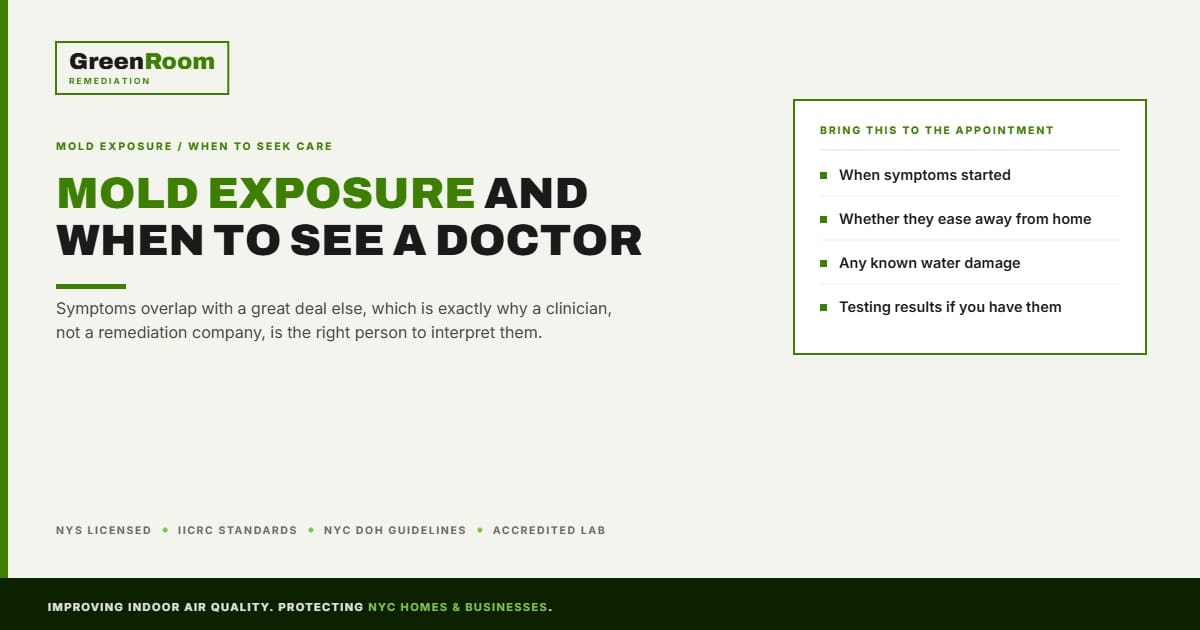
Physicians who evaluate patients with potential mold exposure-related symptoms need specific information to provide useful clinical guidance. The most useful information to bring to a physician appointment includes: the nature and duration of symptoms, the specific pattern of symptom variation by location, any visible mold observed in the home, any known water damage events in the building’s recent history, the results of any mold testing that has been performed, and the specific mold species and spore concentrations from laboratory results if available. If a mold inspection has been performed, bringing the laboratory report to the appointment gives the physician concrete data rather than a general concern to evaluate. For more on how to interpret mold lab reports, see our article on how to read a mold lab report.
Why Documenting Mold Exposure Matters Beyond the Medical Appointment
Medical documentation of mold-related health effects has importance beyond the immediate clinical situation. For tenants dealing with landlords who are unresponsive to mold complaints, physician documentation of health effects attributable to the building environment strengthens the tenant’s legal position in HPD complaints, DHCR proceedings, and housing court actions. For property owners filing insurance claims for mold remediation, medical documentation of health effects in building occupants provides additional support for the urgency and necessity of the remediation scope. For more on how mold claims work with insurance, see our guide on whether homeowners insurance covers mold remediation in NYC.
The parallel step to a physician visit is getting a certified mold inspection to establish the environmental conditions that may be causing the symptoms. A physician visit establishes the health effects. A mold inspection establishes the environmental cause. Together, they create a complete picture that protects the resident’s medical care and legal position. For more on what the inspection process involves, see our article on mold testing in NYC and what the $499 inspection includes.
Frequently Asked Questions
Can a doctor test me for mold exposure?
Physicians can test for mold allergy through standard skin prick testing or serum-specific IgE testing, which identifies sensitization to common mold allergens. These tests indicate whether a person has developed an immune response to specific mold genera. They do not measure current exposure level or prove that a specific building caused the sensitization. Elevated IgE to mold species combined with location-correlated symptoms and environmental evidence of mold exposure together provide the strongest basis for a clinical determination of mold exposure-related health effects.
My landlord says the mold is not harmful. How do I respond?
A landlord’s verbal assessment of mold harm is not a professional or scientific determination. NYC Department of Health and Mental Hygiene guidelines state that all indoor mold growth should be addressed, and NYC Administrative Code Section 24-154 requires landlords to remediate mold in rental units regardless of the species or the landlord’s opinion of its harmfulness. Get a certified mold inspection to produce objective documentation of what is present, see a physician to document any health effects, and notify the landlord in writing. For more on tenant rights and escalation options, see our guide on mold in NYC rental apartments and tenant rights.
To schedule a certified mold inspection in Brooklyn, Manhattan, Queens, the Bronx, Staten Island, Long Island, Westchester, or Northern New Jersey, call GreenRoom Remediation at (917) 965-3754. We serve all five NYC boroughs 24 hours a day, 7 days a week.
GreenRoom Remediation | NY State Licensed Mold Remediation Contractor (License #24-6S44B-SHMO) | IICRC-Certified | OSHA-Trained | BBB Accredited | Serving NYC, Brooklyn, Queens, Manhattan, the Bronx, Staten Island, Long Island, Westchester, and Surrounding Areas.
view related content