table of contents
Quick answer: Mold remediation in NYC schools, daycares, and healthcare facilities follows the same licensed contractor requirements under New York State Labor Law Article 32 and IICRC S520 standards as any other building, but involves stricter air quality monitoring, more rigorous containment protocols, communication requirements for parents, patients, and staff, and in some cases additional agency oversight from the NYC Department of Education, NYC Department of Health and Mental Hygiene, or New York State Department of Health. The sensitive occupant populations in these facilities, including children, immunocompromised patients, and individuals with respiratory conditions, require remediation approaches that minimize chemical exposure and prioritize indoor air quality restoration throughout the project. GreenRoom Remediation provides licensed mold remediation services for schools, daycares, and healthcare facilities across all five NYC boroughs, Long Island, and Westchester. Call (917) 965-3754 for a commercial assessment.
Mold in a school classroom, daycare facility, or healthcare setting creates a set of institutional, regulatory, and communication obligations that do not exist in residential or standard commercial remediation. The occupants are more vulnerable, the scrutiny is higher, the communication requirements are more demanding, and the tolerance for any disruption to air quality during the remediation process is lower. Getting the process right requires a remediation team that understands not just the technical requirements but the institutional context in which the work must be executed.
Why Do Sensitive Occupant Facilities Require a Different Approach?
Children, elderly patients, and immunocompromised individuals are more susceptible to the health effects of mold exposure than healthy adults. Children’s developing respiratory systems are more vulnerable to airborne particulates and mold spore concentrations that a healthy adult might tolerate without significant symptoms. Immunocompromised patients in healthcare settings face potentially serious infection risk from mold exposure that goes beyond the allergic and respiratory effects that represent the primary risk for the general population. This heightened health risk profile requires a more conservative approach to containment, air quality management, and chemical selection during remediation.
In NYC schools and daycares, this means that remediation work in occupied buildings must maintain air quality in adjacent classrooms and common areas at levels that would be acceptable for children throughout the project duration, not just after work is complete. Containment failures that temporarily elevate spore counts in an adjacent hallway or classroom are not acceptable at a level that might be tolerable in an empty commercial building. Real-time air monitoring during remediation in sensitive occupant facilities is a best practice that experienced remediation teams implement on these projects rather than relying solely on pre and post-remediation air sampling.
What Are the Regulatory Requirements for School Mold Remediation in NYC?
NYC public school mold issues fall under the oversight of the NYC Department of Education’s Office of School Facilities and must comply with the DOE’s Health and Safety guidelines for mold remediation in school buildings. These guidelines incorporate New York State Labor Law Article 32 requirements but add additional protocols specific to occupied educational facilities. The DOE requires that school mold remediation be performed by licensed contractors, that work be sequenced to avoid disrupting instructional hours where possible, and that affected spaces be cleared by post-remediation testing before students return.
NYC private schools and daycare facilities are subject to the NYC Department of Health and Mental Hygiene’s guidelines on mold in childcare settings, which similarly require licensed remediation, proper containment during work, and clearance verification before resuming occupancy by children. Daycare facilities that operate under New York State Office of Children and Family Services licensing are additionally subject to OCFS regulations that address environmental health and safety conditions including mold. A licensed daycare that fails to address a documented mold condition promptly after discovery faces regulatory action from OCFS in addition to the civil liability exposure from parent complaints.
For healthcare facilities, the New York State Department of Health provides infection control guidelines for construction and renovation activities that apply to mold remediation projects. These guidelines require infection control risk assessments before work begins, dust control barriers meeting ICRA standards, and in some cases negative pressure rooms or anteroom setups to prevent any potential fungal spore migration into patient care areas. Facilities that treat immunocompromised patients, including oncology units, transplant units, and HIV care settings, apply the most rigorous infection control categories to mold remediation work in or near patient care areas.
How Is Containment Different in Sensitive Occupant Settings?
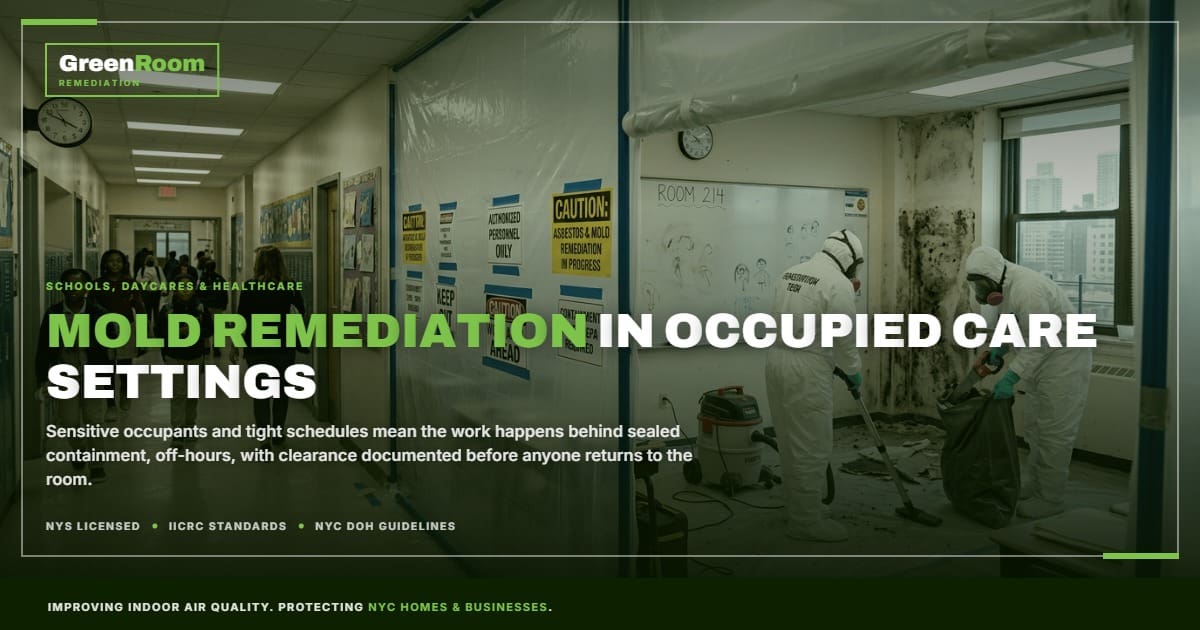
Standard mold remediation containment uses polyethylene barriers to isolate the work area and HEPA-filtered negative air pressure machines to prevent spore migration. In sensitive occupant facilities this baseline is supplemented by additional measures that address the higher consequence of any containment breach.
Double-layer containment with a clean anteroom entry creates an additional barrier between the work area and adjacent occupied spaces. Workers change outer protective equipment in the anteroom before entering occupied areas, preventing transport of contaminated material on clothing or equipment. Continuous air quality monitoring in adjacent occupied spaces with real-time particulate counters provides immediate warning of any containment performance degradation. Negative air pressure verification at the beginning of each work shift confirms that the pressure differential is maintained before work begins.
In healthcare settings where mechanical systems must remain operational to support patient care, coordination with facility engineers on HVAC management during remediation is essential. HVAC systems that serve both the work area and patient care areas may need to be temporarily isolated, reconfigured, or supplemented with portable HEPA units during remediation to prevent spore migration through ductwork. For more on how HVAC systems distribute mold contamination across buildings, see our article on indoor air quality testing and duct contamination in NYC properties.
What Are the Chemical Selection Requirements for Sensitive Occupant Facilities?
Antimicrobial product selection for mold remediation in schools, daycares, and healthcare facilities requires consideration of both efficacy against mold and safety for the facility’s occupant population. EPA-registered antimicrobial products that are effective against mold are available across a range from conventional biocides to low-VOC and plant-derived formulations. For sensitive occupant facilities, products at the low-VOC and plant-derived end of this range are preferred because they reduce residual chemical exposure for children and medically vulnerable individuals after remediation is complete.
This is the same principle that drives eco-friendly mold remediation choices in residential settings, applied with greater urgency because of the occupant vulnerability profile. A classroom that smells strongly of chemical treatment after remediation is completed over a weekend is not ready for children on Monday morning. Low-VOC treatment approaches that achieve the same decontamination outcome without leaving chemical residue at concentrations that could affect air quality for sensitive individuals are the appropriate choice for these settings. For more on how eco-friendly remediation approaches compare to conventional methods in efficacy and application, see our article on NYC eco-friendly mold remediation and what actually works.
How Should Schools and Daycares Communicate About Mold to Parents?
Communication to parents and families about mold conditions in a school or daycare is both a legal obligation and a trust-preservation imperative. In NYC public schools, the DOE’s Community Engagement guidelines require notification to parents when significant environmental conditions affect their children’s school. Private schools and daycares face similar expectations from licensing bodies and from parent communities.
Effective parent communication about mold remediation should include what was found and where, what the remediation process involves, what standards the contractor must meet, when work will be completed, how clearance will be verified, and when the affected space will reopen to students. Communication that is vague or delayed tends to generate more anxiety and more parent questions than straightforward early disclosure that the issue has been identified and is being professionally addressed. Facilities that communicate proactively and transparently about mold remediation consistently receive more cooperative parent responses than those where information emerges through parent complaints or press coverage.
Frequently Asked Questions
Does mold in a NYC school require the school to close?
Not necessarily. Remediation of mold in a contained area of a school building can often be performed during non-school hours, on weekends, or during school breaks without requiring full school closure. When contamination is widespread, affects HVAC systems serving multiple classrooms, or requires extensive structural work, temporary closure of affected areas or the full building may be necessary. The specific determination depends on the scope of contamination and the remediation approach, and should be made in consultation with the licensed assessor, the remediation contractor, and the relevant oversight agency.
Who oversees mold remediation in NYC public schools?
The NYC Department of Education’s Office of School Facilities oversees mold remediation in public school buildings. The DOE maintains environmental health guidelines that incorporate NY State Labor Law Article 32 requirements and add school-specific protocols. The NYC Department of Health and Mental Hygiene provides additional guidance on mold in school settings. Community School Boards and parent associations may also have reporting and communication requirements depending on the specific district and school governance structure.
How do I report mold in a NYC school?
Mold conditions in NYC public schools can be reported to the NYC Department of Education’s School Facilities Help Desk, to the principal and school administration, and to the NYC Department of Health and Mental Hygiene. Parents who believe a mold condition is not being addressed promptly can file complaints with the NYC Public Advocate’s office and the relevant Community School Board. For private schools and daycares, complaints can be directed to the NYC Department of Health and Mental Hygiene and the New York State Office of Children and Family Services for licensed childcare facilities.
What clearance standard applies to schools and daycares after mold remediation?
Post-remediation clearance testing in schools and daycares follows the same licensed independent assessor and air sampling clearance process required under IICRC S520 and NY State Labor Law Article 32, with the additional requirement that clearance results demonstrate indoor spore concentrations comparable to or lower than outdoor baseline levels before children are permitted to return to the remediated space. Some DOE and DOHMH guidelines specify additional clearance requirements beyond the standard IICRC clearance framework for spaces serving children. For details on what clearance testing involves, see our article on post-remediation clearance testing and why insurers require it.
For licensed mold remediation in NYC schools, daycares, and healthcare facilities in Brooklyn, Manhattan, Queens, the Bronx, Staten Island, Long Island, or Westchester, call GreenRoom Remediation at (917) 965-3754. We understand the institutional, regulatory, and communication requirements of sensitive occupant facilities.
GreenRoom Remediation | NY State Licensed Mold Remediation Contractor (License #24-6S44B-SHMO) | IICRC-Certified | OSHA-Trained | BBB Accredited | Serving NYC, Brooklyn, Queens, Manhattan, the Bronx, Staten Island, Long Island, Westchester, and Surrounding Areas.
view related content