table of contents

Quick answer: A mold lab report shows spore counts by species measured in spores per cubic meter of air, compared against an outdoor baseline sample collected at the same time. A result where indoor counts for common species such as Cladosporium or Penicillium are similar to outdoor counts generally indicates acceptable indoor air quality. Elevated indoor counts of any species, or any detection of high-concern species such as Stachybotrys chartarum or Chaetomium at concentrations above the outdoor baseline, indicates active indoor contamination requiring remediation. The licensed assessor’s written report interprets these numbers and recommends next steps. GreenRoom Remediation coordinates certified mold inspections and helps clients understand their results across all five NYC boroughs, Long Island, Westchester, and Northern New Jersey. Call (917) 965-3754 to schedule an inspection.
Most property owners who receive mold lab results have never read one before. The report arrives with columns of species names in Latin, spore counts in scientific notation, and comparison data that is meaningless without a framework for interpretation. The licensed mold assessor’s job is to translate those numbers into actionable findings, but property owners who understand what they are looking at can have more productive conversations with their assessor, make better-informed decisions about next steps, and evaluate competing assessments when multiple parties are involved in a transaction or dispute.
What Does a Mold Lab Report Actually Measure?
Standard mold air sampling using spore trap cassettes, the most common method used in NYC mold inspections, measures the concentration of mold spores and fragments in a defined volume of air. The sampling pump draws a measured air volume, typically 75 to 150 liters, through the cassette over a timed period. The collected spores are analyzed at an accredited laboratory using microscopy, where a trained analyst identifies and counts the spore types captured on the cassette medium.
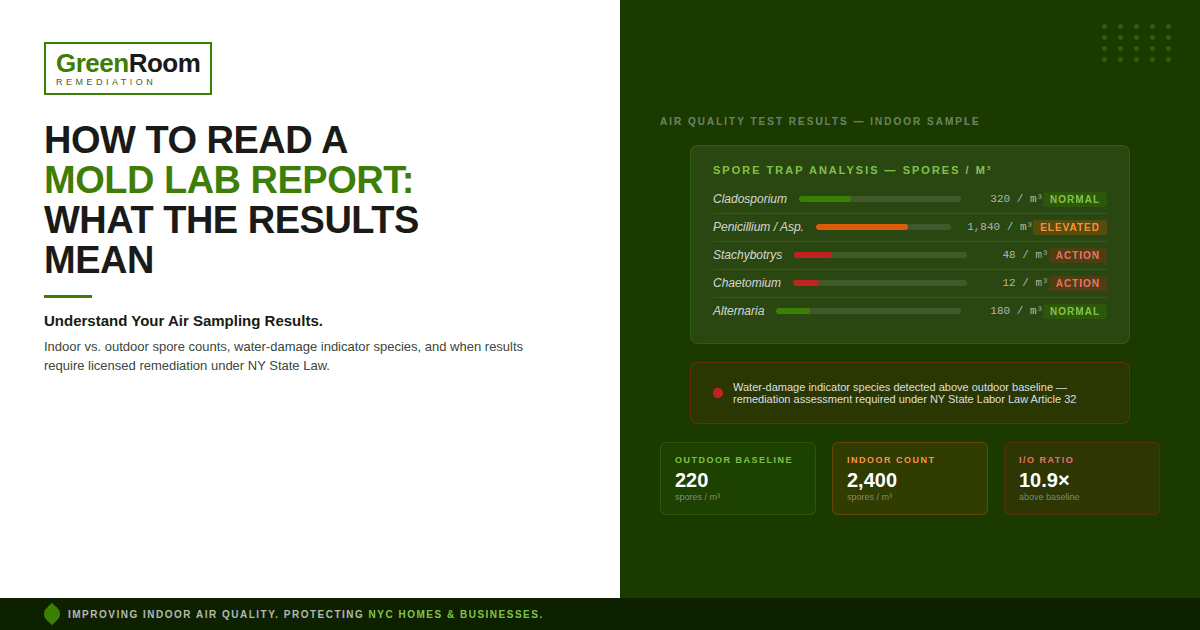
Results are reported in spores per cubic meter of air, abbreviated as spores/m3. This standardized unit allows direct comparison between the indoor samples and the outdoor baseline collected simultaneously. The outdoor baseline is not a fixed number. It varies by season, weather conditions, and geographic location. A result of 500 spores/m3 of Cladosporium indoors means something very different if the outdoor baseline is 2,000 spores/m3 compared to if the outdoor baseline is 100 spores/m3.
Surface sampling, including tape lift and swab samples, measures what species are present on a specific surface rather than what is airborne. Surface samples are reported differently from air samples because they do not have a standard volume denominator. Results are typically reported as the species present and their relative abundance on the sampled surface, categorized as rare, few, moderate, many, or loaded depending on the laboratory’s reporting convention. Surface samples identify what is growing at a specific location but cannot tell you what is circulating through the air of the building.
How to Compare Indoor and Outdoor Results
The most important comparison in any mold air sampling report is the indoor-to-outdoor ratio for each species detected. The fundamental premise of mold air quality assessment is that indoor air in a building without active mold growth should have a species profile broadly similar to the outdoor air entering the building, with counts at or below outdoor levels for common species. When indoor counts substantially exceed outdoor counts for the same species, or when species are present indoors at concentrations significantly above outdoor levels, this indicates that an indoor source is generating those spores.
Common outdoor mold species that are frequently elevated in NYC outdoor air during certain seasons include Cladosporium, Alternaria, and Basidiospores. These species are ubiquitous in outdoor environments and their presence in indoor air at levels similar to outdoor concentrations is generally not concerning. When these species are significantly elevated indoors relative to the outdoor baseline, it indicates an indoor amplification source. The higher the indoor-to-outdoor ratio, the stronger the evidence of active indoor growth.
For species that are rare or absent outdoors, any detection indoors at meaningful concentrations is significant because there is no outdoor source that could explain their presence. Stachybotrys chartarum, Chaetomium, and certain Aspergillus species that are uncommon outdoors but associated with water-damaged building materials fall into this category. A lab result showing even moderate concentrations of Stachybotrys indoors when outdoor counts are effectively zero indicates an active indoor growth source that requires investigation regardless of the absolute spore count.
Understanding the Species Listed in Your Report
Mold lab reports list species by genus or by genus and species where microscopic identification allows that level of specificity. Some genera are reported as Penicillium/Aspergillus because the spores of these two common genera are indistinguishable under standard spore trap microscopy. Understanding what the most commonly reported genera indicate helps property owners contextualize their results.
Cladosporium
One of the most common outdoor and indoor mold genera worldwide. Elevated indoor counts above outdoor baseline indicate moisture or an indoor amplification source, but Cladosporium is generally considered a lower-concern genus from a health risk perspective than some others. It is frequently found in NYC buildings and at moderate indoor-to-outdoor ratios may indicate elevated humidity rather than structural contamination.
Penicillium/Aspergillus
These two genera are reported together and are among the most common genera found in water-damaged buildings. Both can produce mycotoxins under certain conditions and both are associated with allergic and respiratory effects at elevated concentrations. Indoor concentrations substantially above outdoor baseline are a consistent indicator of water-damaged materials in the building. In NYC co-op and condo buildings where older construction materials are common, elevated Penicillium/Aspergillus is frequently the first indicator of a hidden moisture problem.
Stachybotrys chartarum
The species most commonly called black mold. It is not typically detected in air samples at high concentrations because its spores are heavy and sticky and do not become airborne easily under normal conditions. Detection in air samples at any significant concentration above outdoor baseline indicates active growth. Detection on surface samples indicates the presence of active growth at the sampled location and the sustained moisture conditions required to support Stachybotrys, typically continuous saturation of cellulose-containing materials for 10 or more days. For more context on what Stachybotrys actually means for a property owner, see our article on black mold in NYC and when professional remediation is required.
Chaetomium
Chaetomium is a water-damage indicator species that grows on cellulose materials under high moisture conditions similar to Stachybotrys. Its detection at elevated levels above outdoor baseline, particularly on surface samples from water-damaged materials, confirms chronically wet conditions and active growth. Chaetomium is associated with allergic reactions and has been linked to more serious health effects in some research. Like Stachybotrys, its detection indoors above outdoor baseline levels warrants investigation and remediation planning.
Basidiospores
Basidiospores include the spores of mushrooms, bracket fungi, and related organisms. They are common outdoors and typically enter buildings through normal air exchange. Elevated indoor concentrations above outdoor baseline may indicate wood decay fungal growth in structural members, which can co-occur with building-envelope moisture issues that also support mold growth. Elevated basidiospore counts are often associated with wood rot rather than typical indoor mold growth and may indicate structural moisture problems that require attention beyond standard mold remediation.
What Do the Numbers Mean: No Threshold Approach
There is no established regulatory threshold in New York State, New Jersey, or at the federal level that specifies a maximum acceptable indoor mold spore count. Neither the EPA, the NY DFS, nor the NYC Department of Health and Mental Hygiene has published a specific numerical limit above which indoor air is officially classified as unsafe for mold. This is different from how other indoor air quality contaminants such as lead or asbestos are regulated, and it is a source of genuine confusion for property owners who want a simple pass/fail number.
The professional standard used in NYC mold assessments is comparison to the outdoor baseline rather than comparison to a fixed threshold. This approach is endorsed by the American Industrial Hygiene Association, the IICRC, and major mold assessment professional organizations. The outdoor baseline establishes what is normal for the specific location and time of year. Indoor counts that substantially exceed the outdoor baseline for the same species, particularly for water-damage indicator species, constitute the professional basis for a remediation recommendation regardless of the absolute count.
What substantially elevated means in practice depends on the species and the context. For common outdoor species like Cladosporium, an indoor count two to three times the outdoor baseline may be within the range of normal variation. An indoor count ten times the outdoor baseline for the same species strongly suggests an indoor amplification source. For species like Stachybotrys that are rarely detected outdoors, even modest indoor counts above outdoor levels constitute a significant finding. The assessor’s professional judgment, informed by the full context of the inspection including moisture readings, visible conditions, and building history, is what gives the numbers their meaning.
What Happens After You Receive the Report?
If the report shows indoor counts at or below outdoor baseline levels with no significant elevation of any species, the assessor’s report documents that air quality is within acceptable parameters. This result is valuable as documentation for real estate transactions, insurance purposes, or peace of mind following a prior water event. No remediation is indicated, though the assessor may recommend addressing moisture conditions that could generate future problems.
If the report shows elevated indoor counts or detects water-damage indicator species above outdoor baseline, the assessor produces a written remediation protocol defining the scope of work required. This protocol is what a licensed mold remediator such as GreenRoom Remediation uses to plan and execute the remediation under New York State Labor Law Article 32. The remediation cannot proceed until the licensed assessor’s protocol is in hand, and the remediator is legally required to follow the scope defined in that protocol. For more on the full process from initial testing through remediation and clearance, see our article on mold testing in NYC and what the $499 inspection includes.
Frequently Asked Questions
Is there a safe level of mold in indoor air?
No regulatory body has established a specific numerical threshold for safe indoor mold concentrations. The professional standard is comparison to outdoor baseline conditions. Indoor air quality that is comparable to outdoor air for the same species profile is generally considered acceptable. Indoor air quality where specific species are substantially elevated above outdoor baseline, particularly water-damage indicator species, indicates an active indoor source requiring investigation and likely remediation.
My indoor counts are higher than outdoor but my assessor says no remediation is needed. Why?
Context matters in interpreting results. A modest elevation of a common species like Cladosporium without any moisture findings, visible growth, or historical water events may reflect seasonal variation, outdoor air quality variation between the time indoor and outdoor samples were collected, or other factors that do not indicate active indoor growth. Your assessor’s interpretation considers the full inspection findings, not just the numbers in isolation. If you have questions about a specific interpretation, ask the assessor to walk through the reasoning behind their conclusion.
Can mold lab results be used in a legal dispute?
Yes. Lab results from accredited laboratories with documented chain of custody are admissible in legal proceedings including landlord-tenant disputes, real estate litigation, insurance claim disputes, and personal injury cases. The chain of custody documentation is critical because it establishes that the samples were handled correctly from collection through analysis. Samples collected by a licensed assessor using accredited laboratory protocols carry more evidentiary weight than self-collected DIY test kit results.
What is the difference between spore trap sampling and culture sampling?
Spore trap sampling, the most common method in NYC mold inspections, captures all spores both viable and non-viable at the time of sampling and provides results within 3 to 5 business days. Culture sampling captures only viable spores that can be grown on culture medium and takes 7 to 14 days for results because organisms must be cultured. Culture sampling may identify species that spore trap microscopy cannot distinguish, but it misses non-viable spores and requires longer turnaround. For most NYC mold inspections, spore trap sampling provides the information needed for remediation decision-making faster and at lower cost. Culture sampling is used in specific investigative contexts where species identification requires culture confirmation.
Why do I need an outdoor sample with my mold test?
The outdoor sample establishes the baseline of what mold species and concentrations are naturally present in the outdoor air at the time and location of the inspection. Without an outdoor baseline, indoor results cannot be interpreted because there is no reference point for what is normal. An indoor count of 800 spores/m3 of Cladosporium could indicate an indoor problem if the outdoor count is 200, or it could be entirely normal if the outdoor count is 1,000. The outdoor baseline is not optional; it is the essential reference for interpreting every indoor sample.
For certified mold testing with laboratory results and assessor interpretation across Brooklyn, Manhattan, Queens, the Bronx, Staten Island, Long Island, Westchester, or Northern New Jersey, call GreenRoom Remediation at (917) 965-3754. We schedule within 24 to 48 hours and coordinate the full assessment through clearance testing.
GreenRoom Remediation | NY State Licensed Mold Remediation Contractor (License #24-6S44B-SHMO) | IICRC-Certified | OSHA-Trained | BBB Accredited | Serving NYC, Brooklyn, Queens, Manhattan, the Bronx, Staten Island, Long Island, Westchester, and Surrounding Areas.
view related content