table of contents
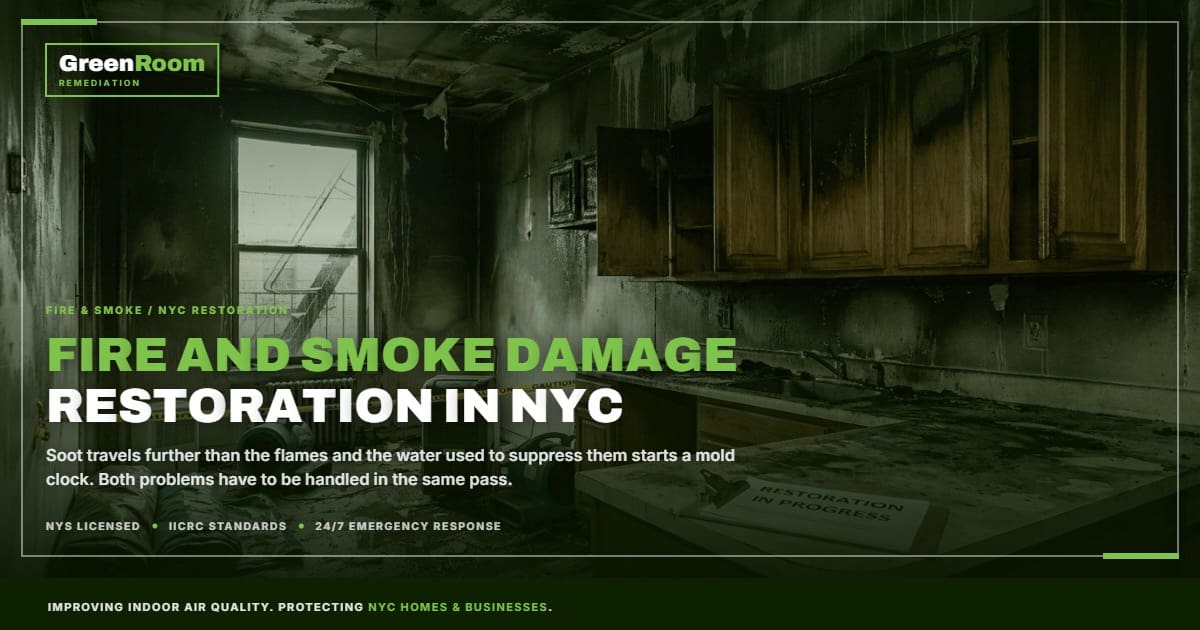
Quick answer: Fire damage in NYC creates two overlapping restoration challenges: smoke and soot contamination that penetrates walls, HVAC systems, and porous materials, and water damage from firefighting efforts that creates ideal mold growth conditions within 24 to 48 hours. Fire and smoke restoration involves smoke odor neutralization, soot removal, structural cleaning, and deodorization, while the water introduced during firefighting requires the same emergency extraction, structural drying, and mold prevention protocols used in any water damage event. Both phases require professional restoration, and the mold risk from firefighting water is real enough that it should be treated as a concurrent concern rather than a secondary one. GreenRoom Remediation handles fire and smoke restoration with integrated water damage and mold prevention services across all five NYC boroughs, Long Island, Westchester, and Northern New Jersey. Call (917) 965-3754 for emergency response.
Property owners dealing with fire damage in NYC are typically focused on the visible destruction: charred materials, broken windows, smoke-blackened walls. What frequently catches them off guard is the water damage from firefighting that may ultimately cause as much long-term structural damage as the fire itself, and the mold growth that follows that water damage within 48 hours if it is not addressed immediately. Understanding both phases of fire and smoke restoration and how they interact is what leads to a complete recovery rather than a series of problems that appear months after the fire is out.
What Does Fire and Smoke Restoration Actually Involve?
Fire and smoke restoration is a multi-phase process that begins immediately after the fire department clears the property for re-entry and continues through structural cleaning, odor neutralization, and reconstruction. Each phase requires specialized equipment and techniques that differ from standard cleaning or mold remediation.
Emergency Stabilization
The first priority after fire department clearance is stabilizing the property against further damage. This includes boarding up broken windows and doors to prevent weather intrusion and unauthorized access, tarping roof damage to prevent rain from entering, and extracting standing water left by firefighting hose lines as quickly as possible. In NYC apartment buildings and row houses where firefighting water flows downward through floor assemblies and wall cavities to affect units below the fire floor, emergency water extraction may need to occur across multiple floors simultaneously.
Smoke and Soot Assessment
Smoke behaves differently from other contaminants because it actively penetrates porous materials and travels through HVAC systems, wall cavities, and structural gaps to affect spaces far removed from the fire origin. A kitchen fire in a Brooklyn brownstone can deposit soot particles on walls and ceilings three rooms away and introduce smoke odor compounds into the HVAC system serving the entire unit. Smoke assessment maps both the visible soot deposition and the less visible smoke penetration into materials, HVAC components, and structural assemblies. This assessment determines the full scope of cleaning and restoration required.
Soot and Smoke Residue Removal
Soot removal from structural surfaces requires dry chemical sponges, HEPA vacuuming, and in some cases chemical cleaning agents specific to the type of smoke residue present. Protein fire residue from kitchen fires, wet smoke residue from slow-burning fires, and dry smoke residue from fast-burning fires each require different cleaning approaches. Using the wrong cleaning method, most commonly wiping wet soot which smears and drives particles deeper into surfaces, can permanently stain materials that would otherwise be cleanable and increases the overall restoration cost.
Odor Neutralization
Smoke odor is one of the most persistent and difficult elements of fire restoration because odor-causing compounds penetrate deeply into porous materials including wood, drywall, insulation, fabric, and even concrete. Surface cleaning removes visible residue but does not eliminate the odor compounds embedded in structural materials. Professional odor neutralization uses thermal fogging, ozone treatment, hydroxyl generators, or encapsulant sealers on structural surfaces depending on the severity of penetration. In NYC apartments with shared wall assemblies, smoke odor that has penetrated party walls can affect adjacent units even when the fire was contained to a single unit.
Why Does Mold Follow Fire Damage So Reliably?
The connection between fire damage and mold growth is direct and predictable. NYC Fire Department hose lines deliver large volumes of water under high pressure to extinguish structural fires. A significant residential fire in a Brooklyn or Queens building can introduce thousands of gallons of water into the structure over the course of suppression operations. That water saturates drywall, soaks into wood framing, floods floor assemblies, and fills wall cavities, creating moisture conditions that are far more extensive and immediate than those produced by a burst pipe or appliance overflow.
Mold colonization begins within 24 to 48 hours of moisture exposure on organic materials at typical indoor temperatures. A fire that is extinguished in the evening and whose structure is not accessed for moisture extraction until the following morning has already provided 12 to 16 hours of mold incubation time in saturated materials. By the time most property owners are cleared to re-enter their property and begin making restoration decisions, mold growth may already be initiating in materials that are not visibly wet because the surface has started to dry while the interior remains saturated.
The fire damage context also creates conditions that accelerate mold growth beyond what a typical water event produces. Fire-damaged materials often have compromised structural integrity that increases surface porosity. Smoke residue on wet surfaces can create a growth medium for certain mold species. And the disruption of normal HVAC operation in a fire-damaged property, whether due to smoke damage to HVAC components or deliberate system shutdown, reduces the ventilation that would otherwise help dry materials naturally. For more on how water damage creates mold risk and what the prevention timeline looks like, see our guide on mold remediation, water damage restoration, and indoor air quality.
How Does Fire Damage Insurance Work in NYC?
Fire damage is one of the most consistently covered perils under standard homeowners, condo, co-op, and commercial property policies in New York and New Jersey. Unlike mold claims, which are subject to sub-limits and coverage restrictions, fire damage claims are typically covered up to the policy’s dwelling or structure limits with fewer exclusions. The firefighting water damage that accompanies a fire is also covered under the same fire claim, not as a separate water damage event, because it is directly caused by the covered peril.
The mold that develops from firefighting water is treated differently. Some policies cover resulting mold as part of the fire claim. Others apply the policy’s mold sub-limit, which commonly ranges from $1,000 to $10,000 under standard NY homeowners policies. Property owners dealing with fire damage should confirm with their adjuster how mold resulting from firefighting water will be classified before remediation begins, because this affects both the scope of work that will be covered and the documentation required to support the mold portion of the claim.
For NYC co-op and condo owners, the question of which policy covers fire damage depends on whether the fire originated in the unit or in a common element, following the same coverage allocation framework described in our guide on insurance claims for mold in NYC co-ops, condos, and rentals. Fire originating from a unit owner’s negligence is typically covered by the unit owner’s policy first, with potential subrogation against that policy by the building’s insurer for damage to common elements.
What Are the First Steps After a Fire Is Extinguished?
The actions taken in the first 24 to 48 hours after a fire is extinguished have a significant impact on both the scope of restoration required and the strength of the insurance claim. The correct sequence is to contact your insurance company immediately to report the loss, document the damage with photographs and video before any cleanup begins, contact a licensed fire and water restoration company for emergency stabilization and water extraction, and secure the property against weather and unauthorized access.
Under NY DFS Circular Letter No. 8 (2021), New York insurers must allow immediate protective repairs when necessary for health or safety. This means emergency water extraction and stabilization can and should begin before the adjuster arrives, as long as conditions are documented before and during the protective work. Waiting for adjuster approval before beginning water extraction after a fire is one of the most common and costly mistakes property owners make, because the mold clock starts immediately regardless of the adjuster’s schedule. For more on how to protect your claim while beginning immediate protective repairs, see our guide on water damage, insurance, and documentation.
How Long Does Fire and Smoke Restoration Take in NYC?
Fire and smoke restoration timelines are highly variable because they depend on the size of the fire, the extent of water damage from firefighting, the building construction type, and whether mold remediation becomes a concurrent scope item. Small kitchen fires in NYC apartments with limited structural damage and prompt water extraction may be restored in 2 to 4 weeks including reconstruction. Significant structural fires affecting multiple rooms or floors in Brooklyn brownstones or Manhattan buildings may require 2 to 6 months for complete restoration when structural repairs, smoke remediation, mold prevention, and reconstruction are all factored in.
The most common cause of unexpected timeline extensions in NYC fire restoration projects is mold discovered during structural opening that developed in the period between the fire and the start of active drying. In older pre-war buildings where structural drying is slower and fire damage may have compromised ventilation pathways, this scenario is common enough that experienced restoration teams treat mold prevention as a concurrent concern from the moment water extraction begins rather than a potential secondary issue to address later.
Frequently Asked Questions
Is smoke damage covered by homeowners insurance in NYC?
Yes. Smoke damage from a fire is covered under standard homeowners, co-op, condo, and landlord policies in New York as a direct result of the covered fire peril. Coverage applies to both the structural cleaning and odor neutralization work and to personal property damaged by smoke. The specific coverage limits and deductibles depend on your policy. Contact your insurer immediately after a fire to report the loss and begin the claims process.
Does renters insurance cover fire damage in a NYC apartment?
Renters insurance covers a tenant’s personal property damaged by fire and may provide additional living expense coverage for temporary relocation while the unit is being restored. It does not cover structural restoration, which is the landlord’s responsibility under their property policy. Tenants whose belongings are destroyed in a fire should file a renters insurance claim for personal property and contact their landlord and the building’s insurer about the structural restoration timeline.
How do I prevent mold after a fire in my NYC property?
Begin water extraction immediately after re-entry clearance is granted, before surfaces that appear wet have time to dry on the surface while remaining saturated internally. Deploy dehumidification and air movement equipment across all affected areas. Document moisture readings from the start and track drying progress daily. Apply antimicrobial pretreatment to wet structural materials as a standard component of the water extraction phase, not as an afterthought. Contact a licensed restoration company within the first few hours after clearance to begin this process rather than waiting for adjuster approval.
Can I live in my NYC apartment while fire and smoke restoration is being done?
For minor smoke damage affecting a small area with no structural compromise, limited occupancy in unaffected areas may be possible with proper ventilation. For significant fire damage involving structural work, HVAC cleaning, or mold remediation, temporary relocation is typically required. Many homeowners and renters insurance policies include additional living expense coverage that pays for temporary housing during restoration. Confirm your coverage limits and eligibility with your insurer as early as possible in the claims process.
What is the difference between smoke cleaning and smoke remediation?
Smoke cleaning refers to the removal of visible soot and smoke residue from surfaces using appropriate cleaning methods. Smoke remediation is a broader term that encompasses cleaning, odor neutralization, HVAC decontamination, and in some cases replacement of materials that cannot be effectively cleaned. Surface cleaning addresses what is visible. Full remediation addresses the smoke compounds that have penetrated into structural materials and systems. Properties that receive only surface cleaning without odor neutralization and HVAC treatment frequently develop persistent smoke odor that returns seasonally as temperature and humidity changes cause odor compounds to off-gas from structural materials.
For emergency fire, smoke, and water damage restoration in Brooklyn, Manhattan, Queens, the Bronx, Staten Island, Long Island, Westchester, or Northern New Jersey, call GreenRoom Remediation at (917) 965-3754. We respond 24 hours a day, 7 days a week.
GreenRoom Remediation | NY State Licensed Mold Remediation Contractor (License #24-6S44B-SHMO) | IICRC-Certified | OSHA-Trained | BBB Accredited | Serving NYC, Brooklyn, Queens, Manhattan, the Bronx, Staten Island, Long Island, Westchester, and Surrounding Areas.
view related content