table of contents
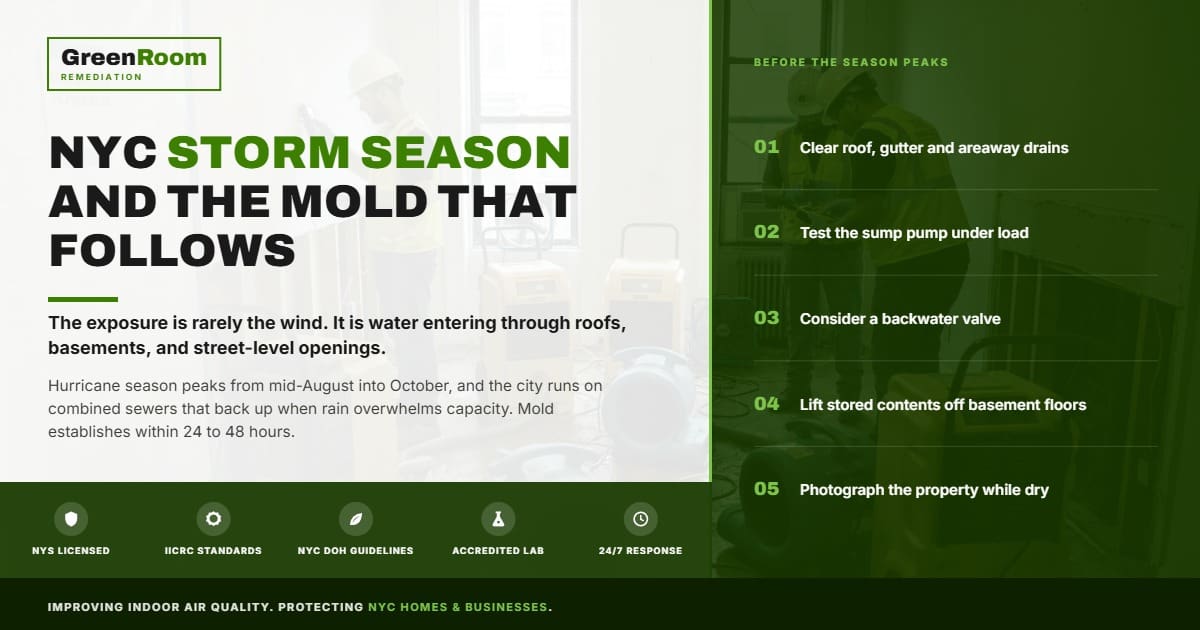
Quick answer: Atlantic hurricane season runs through November and peaks from mid-August into October, which is also when nor’easters begin. For NYC property owners the practical exposure is rarely the wind. It is water entering through roofs, basements, and street-level openings, followed by mold establishing within 24 to 48 hours if the building is not dried properly. The work that matters happens before the storm: clearing drainage, documenting current condition, and knowing what your policy actually covers. GreenRoom Remediation provides emergency response across NYC, Long Island, Westchester, and Northern New Jersey. Call (917) 965-3754.
Why NYC Buildings Fail in Storms
The city’s building stock and its drainage were largely designed for a different rainfall pattern than the one it now gets. Much of NYC runs on a combined sewer system carrying stormwater and sewage in the same pipes. When intense rain overwhelms capacity, the overflow has to go somewhere, and in low-lying properties that somewhere is frequently a basement floor drain running backwards.
That detail matters more than the volume of water. Water arriving through a backed-up combined sewer is contaminated, which changes the response from drying to decontamination and puts most porous materials it touches beyond saving.
The other common failure points are roof drains and scuppers blocked by late-summer debris, areaway drains at basement entrances, window wells, and below-grade commercial units at pavement level. In each case the building is fine until the drainage is overwhelmed, and then it fails quickly.
What to Do Before the Season Peaks
- Clear roof drains, gutters, scuppers, and areaway drains. This is the single highest-value hour anyone can spend on storm preparation.
- Test the sump pump under load rather than assuming it works, and consider a battery backup. Pumps fail most often during the power cuts that accompany the storms they exist for.
- Consider a backwater valve if the property has a history of sewer backup. It is a plumbing job rather than a maintenance task, but for repeat-affected basements it is the intervention that actually works.
- Move anything of value off basement floors and onto shelving. Stored cardboard, textiles, and paper on a basement slab are ideal mold substrates once wet.
- Photograph the property while it is dry, including basement walls, mechanical rooms, and stored contents. A dated before condition is remarkably useful in a claim.
- Read your policy now, specifically for flood exclusions and any mold sublimit.
The Insurance Distinction That Catches People Out
Standard homeowners and commercial property policies generally exclude flood, meaning surface water entering the building from outside. Flood coverage is typically a separate policy, most commonly through the National Flood Insurance Program.
Water arriving from a burst pipe inside the building is usually covered. The same volume of water arriving from a storm surge usually is not, unless flood coverage is in place. Sewer backup is frequently a third category requiring its own endorsement.
Mold sits awkwardly across all of these. Many policies cover mold only when it results from a covered peril and the owner acted promptly to mitigate, and many cap the mold payout well below the general limit. We go into the flood side in detail in our article on what NFIP coverage pays for after a flood. NFIP policies also carry a waiting period before coverage takes effect, which is why buying during hurricane season is usually too late for that season.
The First 48 Hours After Water Enters
Mold can establish within 24 to 48 hours on wet organic material at typical late-summer indoor temperatures. That window is the whole game, and it runs regardless of whether the insurer has responded or the power is back.
Document before you clean. Photograph standing water, the high water mark on walls, and affected contents, following the same discipline we outline for water damage insurance documentation. Once extraction begins the evidence is gone, and adjusters assess what they can see.
Then get the water out and start drying. Emergency extraction, air movement, and dehumidification, with attention to what is behind and beneath surfaces rather than only what is visible. Water tracks under flooring and up inside wall cavities through capillary action, and a floor that feels dry underfoot frequently sits above a saturated subfloor. Our piece on what happens during an emergency water damage call walks through how that sequence runs.
If the water was contaminated, treat it as a decontamination job rather than a drying job. Porous materials it contacted generally come out.
Buildings With Shared Systems
In multi-unit buildings, storm water rarely stays in one unit. It travels through floor assemblies, along pipe chases, and into shared ventilation. A basement flood in a co-op can produce mold complaints on the second floor weeks later, by which point the connection is not obvious to anyone.
For boards and managing agents, the useful discipline is documenting the building-wide condition rather than only the units that reported water. Where responsibility falls between the building and the shareholder is a separate question, and one we address in our article on co-op board mold responsibilities.
Frequently Asked Questions
My basement floods slightly every heavy rain. Is that a mold risk?
Yes, and a more serious one than a single dramatic flood, because repeated wetting keeps materials at elevated moisture without ever fully drying. Chronic low-level intrusion is one of the most common causes of established basement contamination in NYC, and it rarely gets treated as urgent because no single event looks severe.
How quickly do I need a professional after a storm?
For anything beyond a small area of clean water, aim to have extraction and drying underway within the first day. The 24 to 48 hour window is not a marketing figure, it is the practical growth timeline. Waiting for an adjuster before mitigating is also usually the wrong move, since most policies require the owner to take reasonable steps to limit damage.
Does a dehumidifier and fans handle it?
For a small, clean-water spill caught immediately, often yes. For meaningful volumes, consumer equipment lacks the extraction and dehumidification capacity to dry building assemblies before growth begins. The risk is a surface that feels dry while the material behind it stays wet.
For emergency response or a post-storm assessment, GreenRoom Remediation is reachable on (917) 965-3754.
GreenRoom Remediation | NY State Licensed Mold Remediation Contractor (License #24-6S44B-SHMO) | IICRC-Certified | OSHA-Trained | BBB Accredited | Serving NYC, Brooklyn, Queens, Manhattan, the Bronx, Staten Island, Long Island, Westchester, and Surrounding Areas.
view related content